Ball Valves Plastic
You're standing over an open parts catalogue with two plastic ball valves that look almost identical. The price difference is small, the replacement is scheduled soon, and the existing line may serve drinking water, a hot-water loop, or a utility submetering branch. The wrong choice can leave you with a valve that softens at operating temperature, reacts poorly to the fluid, leaks after installation, or lacks the approval documentation an inspector expects.
Selecting ball valves plastic isn't a matter of matching pipe diameter. You need to check the fluid, temperature, pressure, valve material, elastomer seals, connection style, traceability, and jurisdictional approvals. This guide translates those decisions into practical buying and installation steps for Canadian property managers, contractors, and maintenance teams.
Table of Contents
- Why Choosing the Right Plastic Ball Valve Matters
- How a Plastic Ball Valve Actually Works
- Choosing the Right Plastic Material for the Job
- Pressure, Temperature, and Size Ratings Explained
- Standards, Certifications, and Chemical Compatibility
- Pros, Cons, and Common Applications
- Installation and Maintenance Best Practices
- Your Selection Checklist and Next Steps
Why Choosing the Right Plastic Ball Valve Matters
A plastic ball valve can look perfectly suitable on a shelf and still be wrong for the line in front of you. A PVC valve intended for cold water may be unsuitable for a hot recirculation circuit. A valve installed beside chemical dosing equipment may need a different body and seal combination. A product without clear Canadian registration records may create problems during a potable-water retrofit, particularly where approval must be demonstrated before the system is accepted.
The decision has five practical levers:
- Fluid chemistry: Water, disinfectants, acids, solvents, and treated process fluids can interact differently with the body and seals.
- Temperature: Polymer strength changes as temperature rises. A room-temperature rating doesn't automatically apply to hot service.
- System pressure: The allowable pressure depends on the valve design, size, connection type, and operating temperature.
- Certification status: Potable-water and pressure-component approvals affect whether the valve can be installed in a particular application.
- Connection compatibility: Threaded, flanged, solvent-weld, and union-end designs must match the piping system and available maintenance access.
Canada also has a long domestic history with plastic valves. Chemline identifies 1968 as the year it introduced and specialised in plastic valves in Canada, while Praher's Barrie production site was founded in 1986 for North American requirements, as documented in this Canadian plastic-valve market overview. Those milestones matter because ball valves are a central product family within thermoplastic piping systems used for water, industrial, pool, and piping applications.
Practical rule: Treat the valve datasheet, certification record, and installation conditions as one package. The lowest purchase price matters less than choosing a valve that can be installed, inspected, and serviced without rework.
How a Plastic Ball Valve Actually Works
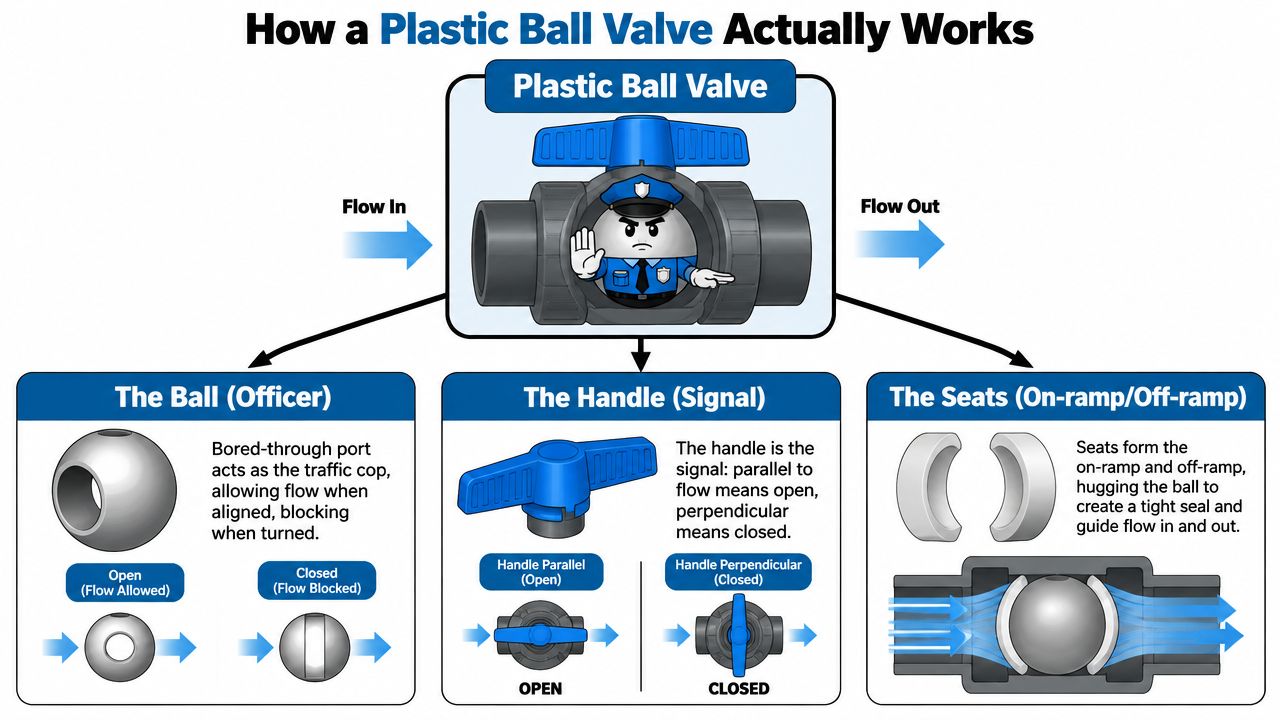
Think of the valve as a traffic officer controlling one lane of a road. The ball is the officer, the handle is the signal, and the seats are the two ramps that press against the ball to stop fluid from slipping around it.
Inside the body, the ball has a hole drilled straight through it. When that hole lines up with the pipe, fluid passes through. Rotate the handle a quarter turn and the solid side of the ball faces the passage, blocking flow. The stem connects the handle to the ball and transfers the turning force.
Three positions with different purposes
- Open: The handle generally sits parallel to the pipe, and the bored port offers a relatively direct flow path.
- Closed: The handle generally sits perpendicular to the pipe, and the ball blocks the passage.
- Partly open: The ball interrupts the passage and creates turbulence, velocity changes, and uneven loading across the seats.
That third position causes a common mistake. A ball valve can physically sit halfway open, but it's designed primarily for isolation, not continuous flow control. If a system needs reliable throttling, specify a valve designed for that duty rather than using the ball as a permanent restriction.
Union-end designs add a maintenance advantage. By loosening the union nuts, a technician may be able to remove the valve body or service the internal cartridge without cutting the pipe, provided the product is designed for that procedure and the line has been isolated and depressurised.
A valve also works as a system, not as a body alone. PVC, CPVC, PP, and PVDF bodies may be paired with EPDM, FKM, or PTFE seals. Each pairing has its own resistance to chemicals, heat, pressure, and compression. The same careful approach used when assessing ultrasonic flow meters applies here, identify the media and operating conditions before choosing the component.
Choosing the Right Plastic Material for the Job
Material selection starts with the fluid and temperature, then moves to pressure and seals. PVC is often the practical choice for cold potable water, irrigation, and mild chemical duties. CPVC is used where the fluid is hotter. PP suits many chemical-handling applications, while PVDF is reserved for demanding service where chemical purity and temperature capability justify a higher material cost.
The comparison below is a selection guide, not a substitute for the manufacturer's product sheet. Exact ratings vary by valve construction, size, seal compound, and connection type.
Plastic ball valve material comparison
Material
Max service temp
Chemical resistance
Best-fit applications
Relative cost
PVC
Lower temperature service
Suitable for many water services and mild chemicals
Cold potable water, irrigation, pool piping
Lower
CPVC
Higher temperature service than PVC
Suitable for hot-water duties and selected chemicals
Hot domestic water, hydronic loops
Moderate
PP
Higher-temperature chemical service
Broad resistance across many acids and bases, depending on concentration
Chemical dosing, sodium hypochlorite and acid feed
Moderate to higher
PVDF
Highest temperature capability among these options
Strong choice for aggressive solvents and high-purity service
Solvent handling, ultrapure water, demanding process lines
Higher
PVC is the budget default only when the service is compatible. For a cold-water branch, it can be a sensible choice. For hot domestic water, CPVC may provide the needed temperature margin. PP can make more sense on a chemical dosing skid, but the chemical concentration and temperature still need to be checked against a published compatibility chart.
PVDF is not automatically better for every installation. Its higher material cost only makes sense when the fluid, cleanliness requirement, or thermal conditions demand it. Buying PVDF for an ordinary cold-water isolation point may add cost without solving a real problem.
The body material is only half the selection. EPDM, FKM, and PTFE elastomers must be checked separately because a chemically resistant body can still leak if the seat or O-ring swells, hardens, or loses compression in the service fluid.
Pressure, Temperature, and Size Ratings Explained
A plastic ball valve doesn't have one universal pressure rating. Its allowable working pressure changes with temperature, and the connection style can change the published limit as well. The useful rating is the point on the manufacturer's pressure-temperature curve that matches the actual fluid temperature.
Canadian technical datasheets illustrate the issue clearly. Socket and threaded PVC or CPVC ball valves are commonly rated at 232 psi at 73°F, while flanged versions are typically rated at 150 psi at 73°F, according to the IPEX Canadian valve data. Those values describe specific products and conditions, not a blanket rating for every plastic valve.
Read the curve, not just the headline number
As fluid temperature rises, the polymer loses stiffness and the allowable pressure falls. The same IPEX data shows CPVC pressure capability declining from 190 psi at 120°F to 130 psi at 180°F. That's why a valve selected from a cold-water line in a catalogue can be unsuitable for a hot-water loop even when the nominal pipe size is correct.
The correct process is:
- Find the valve's material and connection style. Socket, threaded, union, and flanged versions may have different limits.
- Locate the operating temperature. Use the actual process temperature, not the mechanical room's ambient temperature.
- Read the allowable pressure at that temperature. Leave a sensible margin for normal operating changes and pressure transients.
- Confirm the size range. NPS and DN identify nominal pipe sizes, but they don't guarantee identical outside diameters, wall dimensions, or connection details.
- Check torque requirements. High operating pressure, debris, or a stiff seat can increase the force required to operate the handle. A torque chart helps prevent a technician from treating a difficult handle as permission to use excessive force.
Material
73°F (23°C)
100°F (38°C)
140°F (60°C)
PVC
232 psi for commonly specified socket/threaded designs
Consult the manufacturer's curve
Consult the manufacturer's curve
CPVC
232 psi for commonly specified socket/threaded designs
Consult the manufacturer's curve
Consult the manufacturer's curve
The table intentionally avoids filling gaps with assumed values. Manufacturers publish different derating curves, and the installed valve must be checked against its own documentation.
Standards, Certifications, and Chemical Compatibility
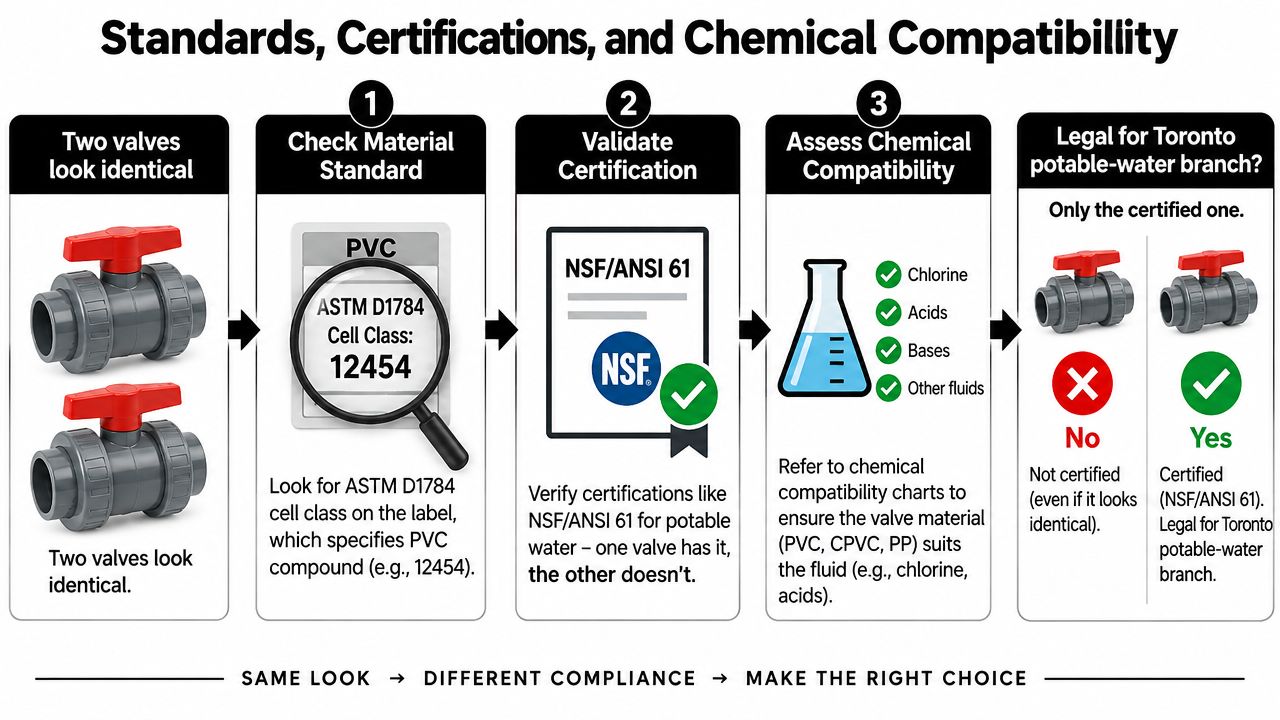
Two plastic ball valves can look identical and still have different installation status. The difference may be hidden in the label, material certificate, test documentation, or registration record rather than in the moulded body.
For potable-water work, technical datasheets commonly identify PVC and CPVC compounds using ASTM D1784 cell classifications, including 12454-A for PVC and 23567-A for CPVC, as shown in this Chemline Type 21 ball-valve datasheet. A cell classification is a material identity and performance description. It helps connect the valve you received to the compound specified by the manufacturer.
Potable-water approval is a separate question. Check whether the wetted components carry the drinking-water certification required by the project, such as NSF/ANSI 61, and verify whether the valve needs a Canadian Registration Number, or CRN, with the applicable authority. In Ontario, TSSA registration can be part of the pressure-component approval chain. A registration or approval that applies in one jurisdiction shouldn't be assumed to clear every other province.
A practical compatibility check
Use a short verification sequence before ordering:
- Identify the fluid: Include treated water, disinfectant, chemical concentration, and any cleaning agents.
- Confirm the temperature: Compatibility can change as temperature rises.
- Check the body: Compare PVC, CPVC, PP, or PVDF against a manufacturer's published resistance chart.
- Check the elastomers: EPDM, FKM, and PTFE may behave differently from the body material.
- Save the paperwork: Keep the datasheet, certification evidence, and registration information with the project record.
This process matters in utility submetering programmes because valves may sit on potable-water branches that need to remain accessible, traceable, and acceptable to the authority having jurisdiction. The valve isn't approved because it has the correct thread or colour.
Pros, Cons, and Common Applications
Plastic ball valves are a strong fit when corrosion resistance, low handling weight, and practical installation cost matter more than extreme temperature or mechanical strength. They're often easier to carry and support than brass or steel, and they don't rust in the same way metallic components do. Those advantages make them useful across irrigation, pool piping, water treatment, chemical dosing, and branch lines serving utility meters.
Metal valves still have an important role. Brass and stainless-steel designs generally tolerate more mechanical abuse and higher service demands, but material selection must still account for corrosion and fluid compatibility. Plastic is the wrong choice for steam service, unprotected impact zones, freezing exposure, or any pressure and temperature combination outside the manufacturer's rating.
Where plastic earns its place
- Irrigation manifolds: Light, corrosion-resistant valves simplify branch isolation and seasonal servicing.
- Pool and spa piping: Plastic suits many treated-water systems when the body and seal materials match the chemistry.
- Water-treatment headers: Plastic can avoid corrosion concerns in suitable water and process applications.
- Chemical dosing skids: PP or PVDF may be appropriate when the chemical and elastomers are confirmed compatible.
- Utility submetering branches: Lightweight isolation valves can make installation and future meter servicing more manageable on long runs.
For a compact service point, a product such as Ring Hot Water's mini valve can be useful as a reference when comparing small-format isolation designs. Its suitability still depends on the project's material, approval, pressure, temperature, and connection requirements.
Selection insight: Plastic wins when the environment attacks metal or when handling weight complicates installation. Metal wins when heat, impact, pressure, or repeated mechanical abuse exceeds the plastic valve's envelope.
An actuated valve changes the selection conversation because the actuator adds power, controls, and maintenance considerations. Review the difference between manual isolation and an electric ball valve before specifying automation for a metering or building-control application.
Installation and Maintenance Best Practices
Most plastic ball-valve failures begin at installation. The installer pulls a misaligned pipe into position, tightens a threaded joint until the body distorts, or leaves the valve unsupported so every handle movement loads the piping. Polymer components need the same care as the rest of the system, but they offer less forgiveness when someone uses force to correct poor alignment.
Build support into the installation
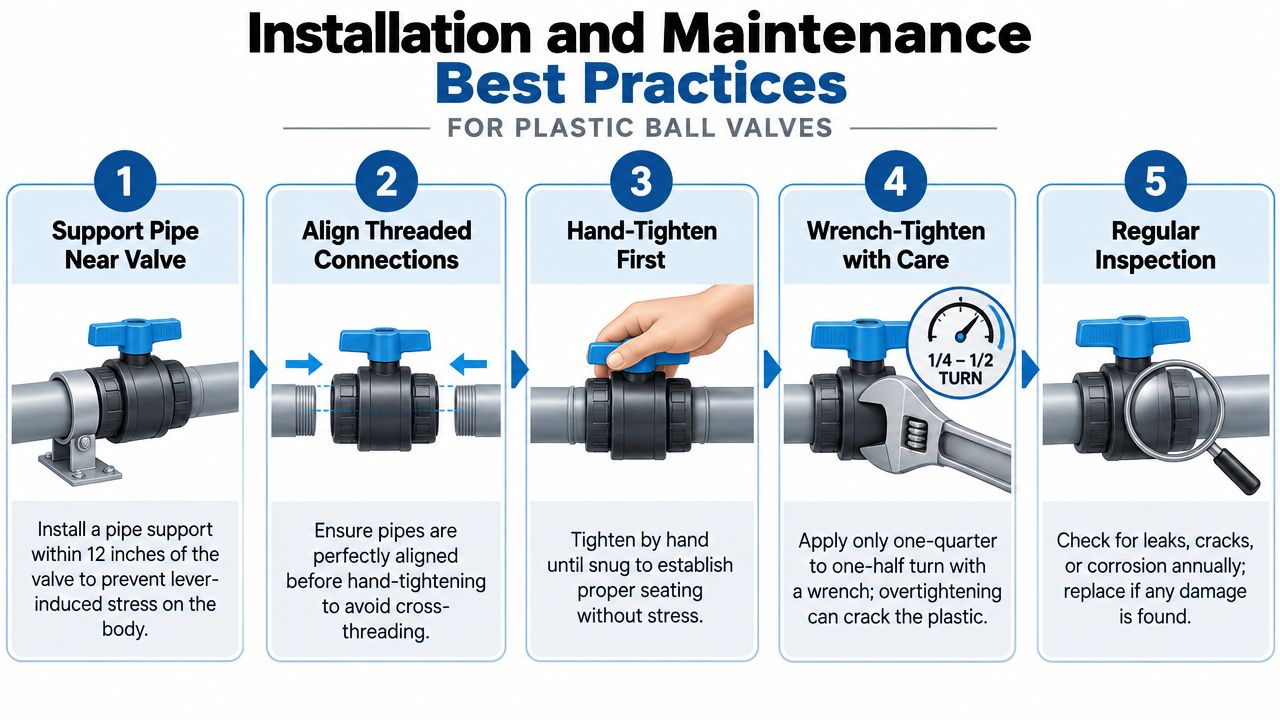
Support the pipe close to the valve so the body isn't carrying the weight of the adjacent run. Keep the valve accessible, especially when union ends are intended to allow cartridge removal. Threaded connections should start by hand with the pipe aligned to the valve. If the threads resist immediately, stop and realign instead of using a wrench to force engagement.
Thread sealant also needs restraint. Excessive tightening can crack female plastic threads, distort the seats, or place the body under permanent stress. Flanged connections need compatible flat-faced gaskets and an even, gradual bolt sequence. Tightening one side fully before the other can bend the flange or create an uneven seal.
Protect the valve after commissioning
Solvent-welded joints need the cement manufacturer's curing instructions followed before the line is pressurised. Pressurise gradually, inspect the valve and connections, and operate the handle through its intended travel. Infrequently used isolation valves benefit from periodic cycling, which helps identify sticking before an emergency shut-off is needed.
A simple inspection routine should include:
- Look for ultraviolet damage: Outdoor valves can become brittle or discoloured after prolonged exposure.
- Check the body and unions: Search for cracks, distortion, and signs of leakage.
- Exercise the handle: Smooth movement is expected. A suddenly stiff handle needs investigation.
- Preserve access: Don't bury union nuts or handles behind permanent finishes.
- Replace damaged parts: Visible ball scoring, cracked bodies, damaged seats, or rough operation usually justify replacement rather than forceful repair.
For water systems that combine isolation with monitoring, leak detection equipment for water lines can add another layer of visibility, but detection equipment doesn't compensate for an incorrectly rated valve.
Your Selection Checklist and Next Steps
Before you place the order, write the service conditions beside the product number. That small discipline prevents a catalogue match from becoming a field problem.
- Confirm the pipe size and connection: Match NPS or DN, outside diameter, and the actual connection style, whether threaded, flanged, solvent-weld, or union.
- Identify the fluid: Record potable water, treated water, chemical solution, or process media. Include concentration where relevant.
- Choose the body material: Use PVC for suitable cold-water duties, CPVC for appropriate hot-water service, PP for compatible chemical applications, and PVDF for more demanding solvent or high-purity service.
- Select the elastomers: Verify EPDM, FKM, or PTFE against the fluid, temperature, and cleaning chemicals.
- Read the pressure-temperature curve: Don't use the room-temperature number as the operating limit. The IPEX figures show why temperature derating must be part of the purchase decision.
- Verify approvals: For Canadian potable-water work, check the applicable drinking-water certification, ASTM D1784 cell classification, and CRN or provincial registration requirements.
- Keep the records: Save datasheets, certificates, lot information, and installation documents for inspectors, owners, and utility submetering programmes.
Escalate the specification when the line carries aggressive chemicals, operates near a material limit, may experience vacuum conditions, or involves potable water where local authority approval is uncertain. A fluid systems specialist can compare the complete valve assembly rather than judging the body material alone.
Axis Meter Solutions coordinates utility submetering programmes for Canadian and US multi-family, condominium, mixed-use, and commercial properties, including metering equipment, installation, commissioning, billing, monitoring, and leak and flood detection. If your project needs a coordinated water submetering design with documented equipment and jurisdiction-specific planning, visit Axis Meter Solutions to discuss the installation requirements with the team.
Ready to Optimize Your Utility Management?
Tell us about the property, utility, number of units, and your billing or monitoring goals. We'll help you identify the right next step.
Book a Call