Flow Meter Digital
You've probably seen it already. A tenant says their bill looks wrong, a common-area line item keeps drifting, or a water issue shows up only after the ceiling stain has spread. That's usually where a digital flow meter becomes more than a product spec, because the question isn't "does it have a display?", it's "can this reading stand up to billing, maintenance, and a dispute?"
In Canadian multifamily and mixed-use buildings, the difference matters. A flow meter digital system can capture interval data, send readings without a site visit, and give you a cleaner record of what happened in each unit, riser, or common area. It only helps, though, if the meter is selected, installed, and validated as part of a full measurement chain, not as a gadget with a screen.
Table of Contents
- What a Digital Flow Meter Actually Does
- The Four Core Sensing Technologies
- Accuracy, Outputs, and How Digital Flow Meters Communicate
- Matching Meter Type to Building Application
- Benefits for Building Owners and Property Managers
- Selection and Commissioning Considerations That Matter
- Common Misconceptions About Digital Flow Meters
What a Digital Flow Meter Actually Does
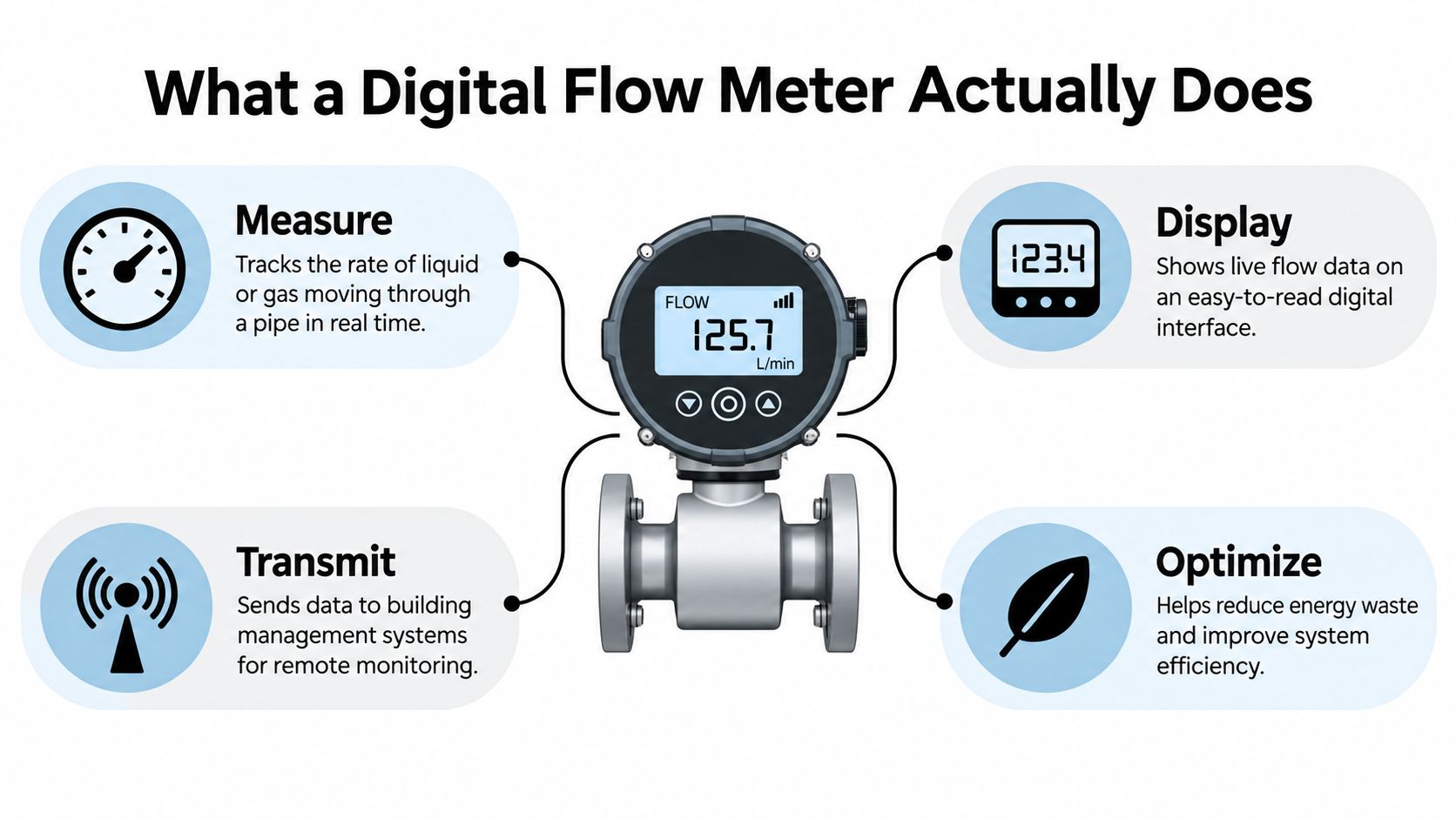
A superintendent opens a mechanical room expecting a routine check and finds a small but steady leak that nobody noticed for weeks. On an old analog setup, the building might only show a slow drift in usage, and by the time anyone catches it, the bill and the damage are already bigger than they should be. A digital flow meter changes that pattern because it doesn't just show a number, it records, stores, and shares what the system is doing over time.
Canada's move from manually read meters to smart meters shows the same shift at utility scale. Statistics Canada described smart meters as electronic devices that automatically collect household and small-business electricity-consumption data, and reported in 2014 that smart metering was fully implemented across Ontario and British Columbia, while Natural Resources Canada later estimated that more than 82% of Canadian electricity meters were smart by the end of 2018 (Statistics Canada). That history matters because a digital flow meter is really part of the same transition, from occasional reads to continuous measurement.
What changes in practice
Think of the old meter as a snapshot and the digital meter as a timeline. Instead of relying on someone to walk up, open a panel, and copy a number once in a while, the meter can keep interval data, communicate readings, and support consumption-based billing. In a multifamily building, that means clearer allocation of electricity or another measured service, better visibility into tenant and common-area usage, and fewer arguments about whether the reading was captured correctly.
A meter that can't preserve its own history is hard to defend later, no matter how modern it looks on install day.
That's why the phrase digital flow meter should make you think about sensing, memory, communications, and data integrity together. The display matters, but the value is the record behind it. In building operations, that record is what turns a reading into something you can use for billing, leak investigation, or compliance.
The Four Core Sensing Technologies
Not every digital meter measures flow the same way. Two meters can both have a screen and remote reading, yet behave very differently once they're installed on a riser, a heating loop, or a gas line. The sensing method is what tells the meter how to “feel” flow, and that choice affects where it works well and where it becomes a headache.
How each technology senses movement
An ultrasonic meter listens to the time difference between sound waves moving with and against the flow. That makes it a natural fit where you want no moving parts and minimal pressure loss. For Canadian owners, ultrasonic options are often discussed first in retrofit work because they can simplify installation in occupied buildings, especially when you want remote reading and less disruption. This ultrasonic flow meter overview is useful if you want a deeper product-level primer.
An electromagnetic meter works differently. It measures how conductive liquid moving through a magnetic field creates a signal, which is why it's usually tied to conductive liquids rather than everything under the sun. A vortex meter watches for the pattern a bluff body creates as fluid passes around it, like listening for the rhythm of swirls in the stream. A thermal mass meter uses heat loss from a sensor, so it's most often associated with gas measurement and other applications where mass flow is the point, not just volume.
The practical question isn't which technology sounds smartest. It's which one matches the liquid or gas, the pipe size, the installation space, and the accuracy you need. A device that's elegant on paper can still be wrong for the building if it can't handle the operating conditions or the service environment.
Where people get tripped up
Owners often ask for “the best meter” when the better question is “the best sensing principle for this service.” A non-intrusive ultrasonic unit may be attractive in a retrofit, but an inline meter might be the right call where process conditions are more demanding. The decision should start with the medium, then the pipe, then the operational goal.
Accuracy, Outputs, and How Digital Flow Meters Communicate
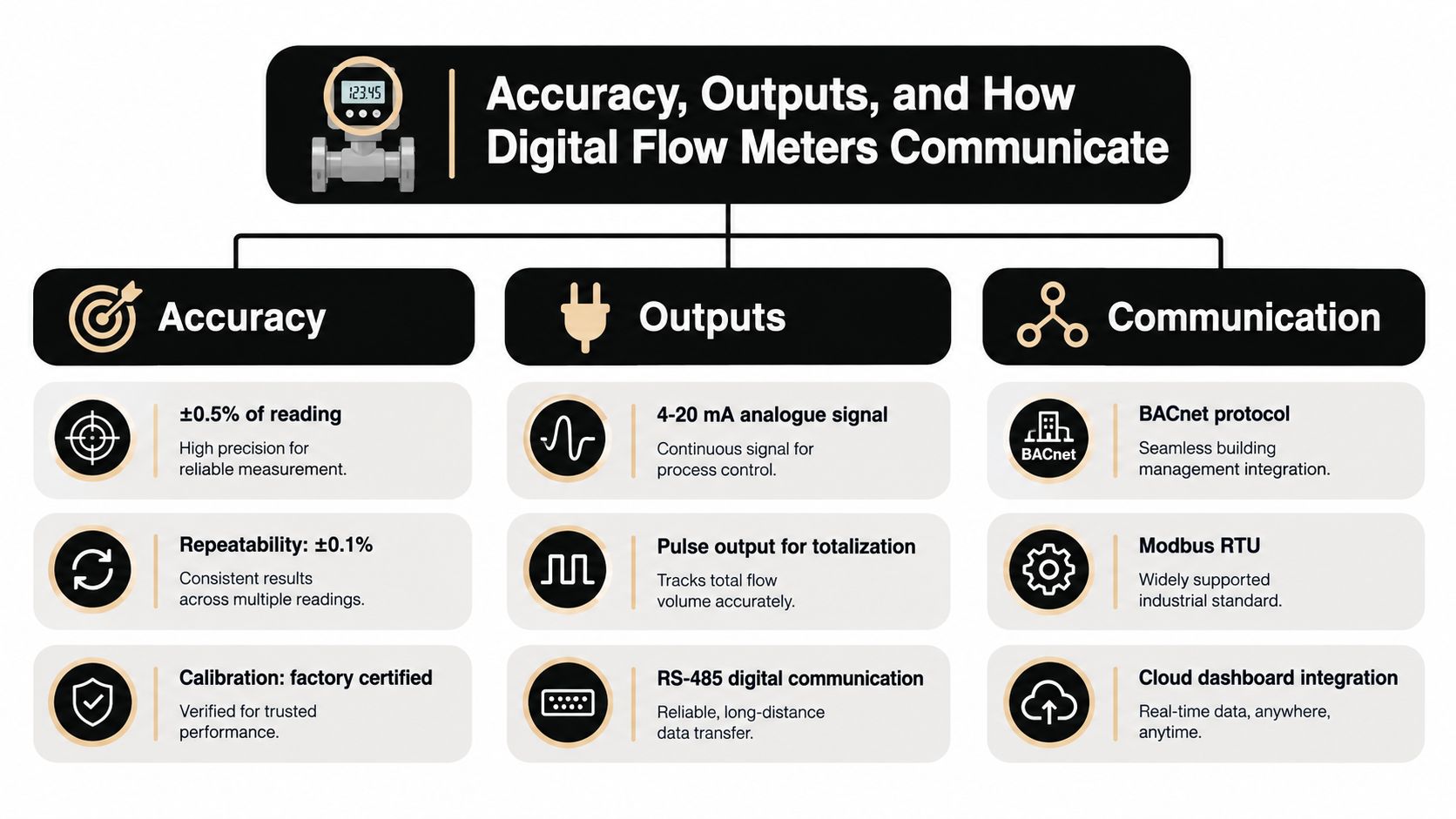
A property owner can buy a meter with strong accuracy on paper and still end up with weak billing data. The full chain matters, because readings need to stay stable, reach the right system, and survive review when a bill is questioned. For Ontario electricity submetering, the code requires billing data to pass through a validating, estimating, and editing process, with a fair and reasonable method that supports correct data for billing (Ontario Unit Sub-Metering Code).
Accuracy is only the starting point
Calibration alone does not guarantee clean results in the field. Installation quality and the data path matter just as much, because a meter that is set correctly but mounted poorly can still produce readings that are hard to defend. Measurement Canada's S-E-02 verification specification for electronic meters requires accuracy results to be reported to a minimum resolution of 0.01%, with test points controlled within ±2.0% of the established test current, nominal voltage, and test load, and the meter's working position kept within ±3° of the specified vertical planes during installation testing (Measurement Canada S-E-02).
That level of control shows why the meter and the installation cannot be treated as separate issues.
Practical rule: if the reading cannot be validated, estimated, and edited in a controlled way, it is not ready for billing.
Outputs and communications work as layers
A pulse output is often enough for a simple allocation job, because it turns flow into countable events. Modbus and similar industrial protocols go a step further by letting the meter sit on a network and send readings to a gateway or building system. IoT-style reporting adds another layer, moving data into dashboards where staff can review patterns and exceptions without a site visit. For buildings that need readings collected without a site visit, see this overview of water meters with remote reading.
The output type affects how the meter fits day-to-day operations. A pulse-only meter suits a straightforward tenant allocation setup. A networked meter is better when staff need remote diagnostics, regular reads, or a tighter link between the meter and the billing engine.
Matching Meter Type to Building Application
The right meter is the one that fits the service, the pipe, and the job you need it to do. A building owner doesn't buy an ultrasonic, electromagnetic, vortex, or thermal meter because the brochure looks polished. They buy one because it handles a specific application without creating bad low-flow readings, intrusive work, or avoidable maintenance.
Digital Flow Meter Technologies by Building Application
Technology
Best For
Limitations
Ultrasonic
Domestic cold water, hot water recirculation, retrofit work, non-intrusive monitoring
Can be a poor fit where pipe condition, air, or installation quality is weak
Electromagnetic
Conductive liquids, larger risers, applications needing stable liquid measurement
Not suitable for every fluid, and usually not the first choice for gas
Vortex
Certain thermal or process services where the flow regime suits it
Less appropriate when the application needs very low-flow sensitivity
Thermal
Gas measurement, leak testing, and related energy applications
Gas-specific behaviour means it needs the right service and setup
A clamp-on ultrasonic meter is often attractive when you want less downtime and less pipe cutting. An inline electromagnetic meter can make sense where the liquid and pipe conditions justify the extra work. Vortex and thermal meters earn their place when the application itself lines up with the sensing principle, not because they sound more advanced.
What matters most is avoiding the mismatch. A technically capable meter can still disappoint if it's asked to do a job outside its sweet spot. In mixed-use buildings, that mistake shows up later as noisy data, frustrated tenants, or unnecessary callbacks.
If a supplier can't explain why a meter type fits the service, the pipe, and the operating range, keep asking questions.
One practical filter helps here. Ask whether the project is about monitoring, allocation, or billing. Monitoring can tolerate a simpler choice in some cases, but billing usually can't. That's where the application table becomes more useful than a long feature list.
Benefits for Building Owners and Property Managers
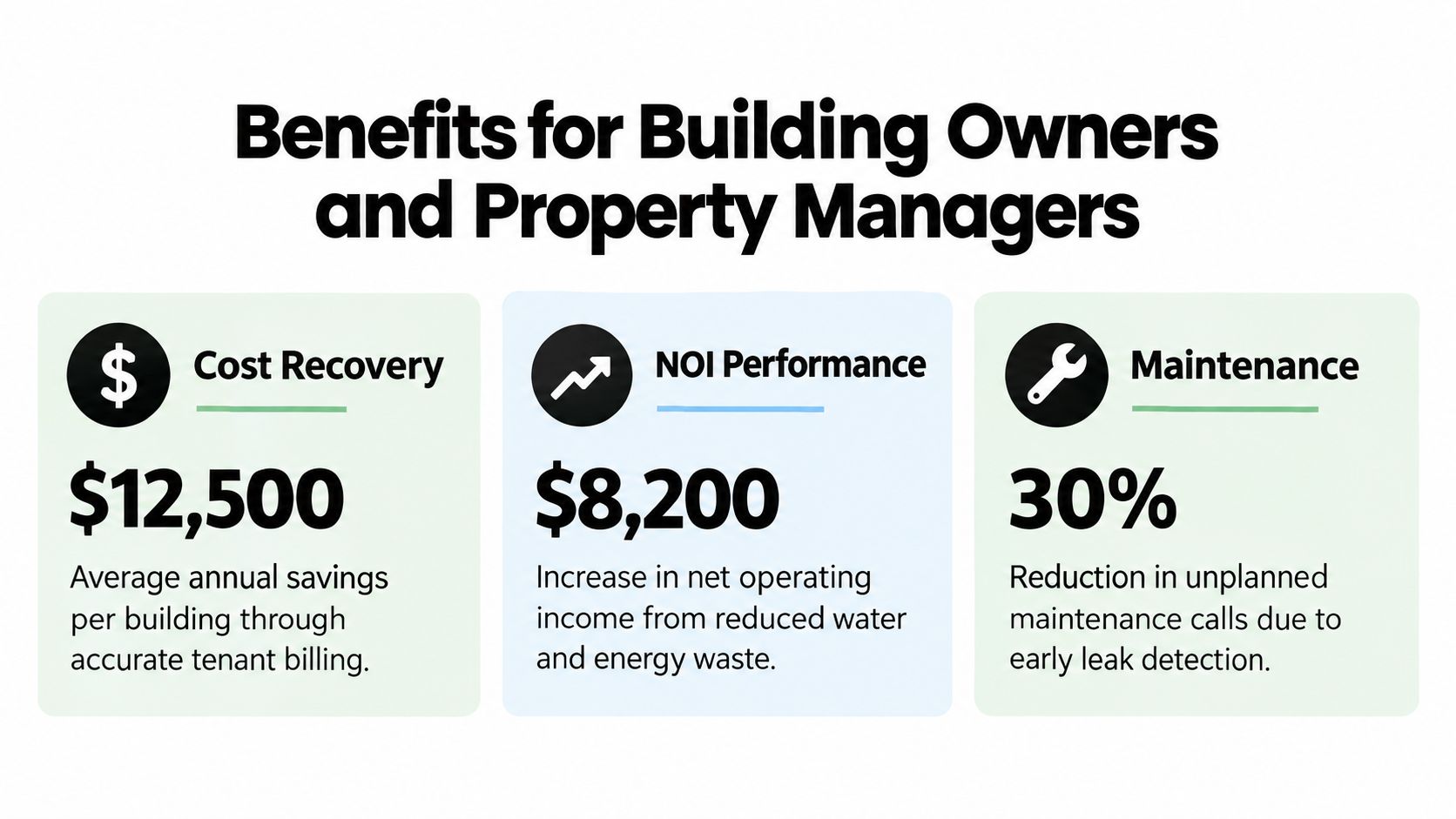
A digital flow meter matters most when the building is trying to answer practical questions quickly. Who used what, where is water being lost, and which issue needs attention first? Clean readings help the owner allocate costs more fairly, help the manager respond to tenant questions with evidence, and help maintenance staff spot unusual behaviour before it turns into damage. The benefit is the decisions the screen supports, not the screen itself.
Three outcomes owners actually care about
Cost recovery comes first. In a submetered building, clearer unit-level allocation reduces arguments over who used what because the reading trail is easier to trust and easier to review. That matters in multifamily and mixed-use buildings, where shared systems can blur the line between tenant use and common-area use.
Transparency matters just as much. When tenants can see that the data comes from a consistent metering chain, the conversation shifts from opinion to evidence. It does not remove disputes, but it gives property staff firmer ground to stand on.
Risk reduction is the third outcome. Calgary reported that water loss from leaks was 23% in 2025, with annual losses between 20% and 24% since 2019, and the city is expanding advanced metering so more frequent data can identify customer-side leaks earlier (Calgary water loss). Metro Vancouver materials also note that combined system and private-property losses can exceed 20% of drinking water, while citing a Vancouver estimate of roughly $20 million in purchased water lost annually. Those figures make the operational case clear, because more detailed data only helps when the building has a process for acting on it.
The strongest deployments tie meter data to routine work, not just dashboards. Teams that are already asking how AI helps proptech teams are often looking for a way to organise alerts, sort exceptions, and cut manual review time. The technology matters, but the workflow turns readings into action.
Selection and Commissioning Considerations That Matter
A digital meter can be the right hardware and still be the wrong choice for the building. Start with the service you are measuring. Billing, monitoring, and leak detection often need different settings, different records, and sometimes different hardware support. A meter chosen only for trend tracking can be fine for insight, while a meter used for regulated allocation needs a much cleaner paper trail.
The questions that should come before purchase
What is the operating range? The meter has to read clearly at the low end, not only at peak demand. If a suite or riser spends most of its time at low flow, a poor match here can produce noisy readings that are hard to trust.
How will it be installed? Orientation, pipe size, access, and straight-run conditions all matter. For building owners working through regulated submetering in Ontario, approval matters here, see this primer on Measurement Canada approved meters for what certification requires. Measurement Canada approval and documented verification records, as noted earlier in the S-E-02 requirements, are part of making a reading defensible.
What happens when communications fail? Missing or duplicated reads need a defined exception path. If the system cannot flag and reconcile them, the billing file can become difficult to defend later.
Documentation is part of the product
Nova Scotia Power's approved smart-meter program is a useful reminder of how operations change when metering becomes automated. The utility planned to invest $133 million to install meters for about 500,000 customers, expected to save $38 million over 20 years, and moved from 60-day manual reads to remote 15-minute transmission (CBC report on Nova Scotia Power). That is not the same as a building submetering project, but the lesson carries over. Data quality pays off only when the process around it is clear.
For projects that need installation, approvals, and billing records to line up, Axis Meter Solutions is one option among others that provides full-service submetering programs, including metering equipment, installation, commissioning, tenant billing, and ongoing service. The better question to ask any supplier is simple, can they show how the meter was commissioned, how the data is validated, and how the records are kept when someone challenges a bill?
Common Misconceptions About Digital Flow Meters
A connected meter can still miss the mark for billing if the setup is weak. Validation, commissioning records, and a clear exception process still have to be in place, especially when a tenant challenges a charge.
More data also does not automatically mean less water loss. The value comes from pairing the alert with an owner, a response threshold, and a repair path. A dashboard can show a problem, but it cannot tell a superintendent whether the issue is a running toilet, overnight baseload, or a communications outage.
Installation can look simple on paper, yet digital hardware still depends on orientation, calibration, validation, and records. As covered in the accuracy and selection sections, Measurement Canada's verification controls and Ontario's billing requirements point to the same lesson, the meter has to be set up correctly before anyone relies on the reading.
The cleanest mental model is this, a digital flow meter is a process as much as a device. If the meter, the communications path, and the billing workflow do not line up, the building ends up with data, but not necessarily with usable data.
Ready to Optimize Your Utility Management?
Tell us about the property, utility, number of units, and your billing or monitoring goals. We'll help you identify the right next step.
Book a Call