How to Submeter Electricity in Multi-Unit Buildings
A property manager usually starts considering electricity submetering after seeing the same problem repeat every month: one bulk hydro bill arrives, suite consumption varies widely, and the operating budget absorbs the difference. Residents ask why their share is so high, owners want predictable expenses, and the electrical room offers little spare space for another project.
The decision isn't only whether meters can be installed. It's whether the recovery and control gained from unit-level data justify the coordination required. In Ontario, that coordination includes an Ontario Energy Board licence, an interval principal meter, Measurement Canada compliance, electrical planning, data validation, billing, and tenant communication. Get the sequence wrong and you'll pay to correct the same gap later.
Table of Contents
- Why Submetering Electricity Is Worth the Effort
- Regulatory Foundations Every Owner Must Clear
- Planning the Project and Budgeting Honestly
- Choosing the Right Meter and Data Resolution
- Installation and Commissioning Without Rework
- Setting Up Tenant Billing That Holds Up
- Running the Program Day to Day
Why Submetering Electricity Is Worth the Effort
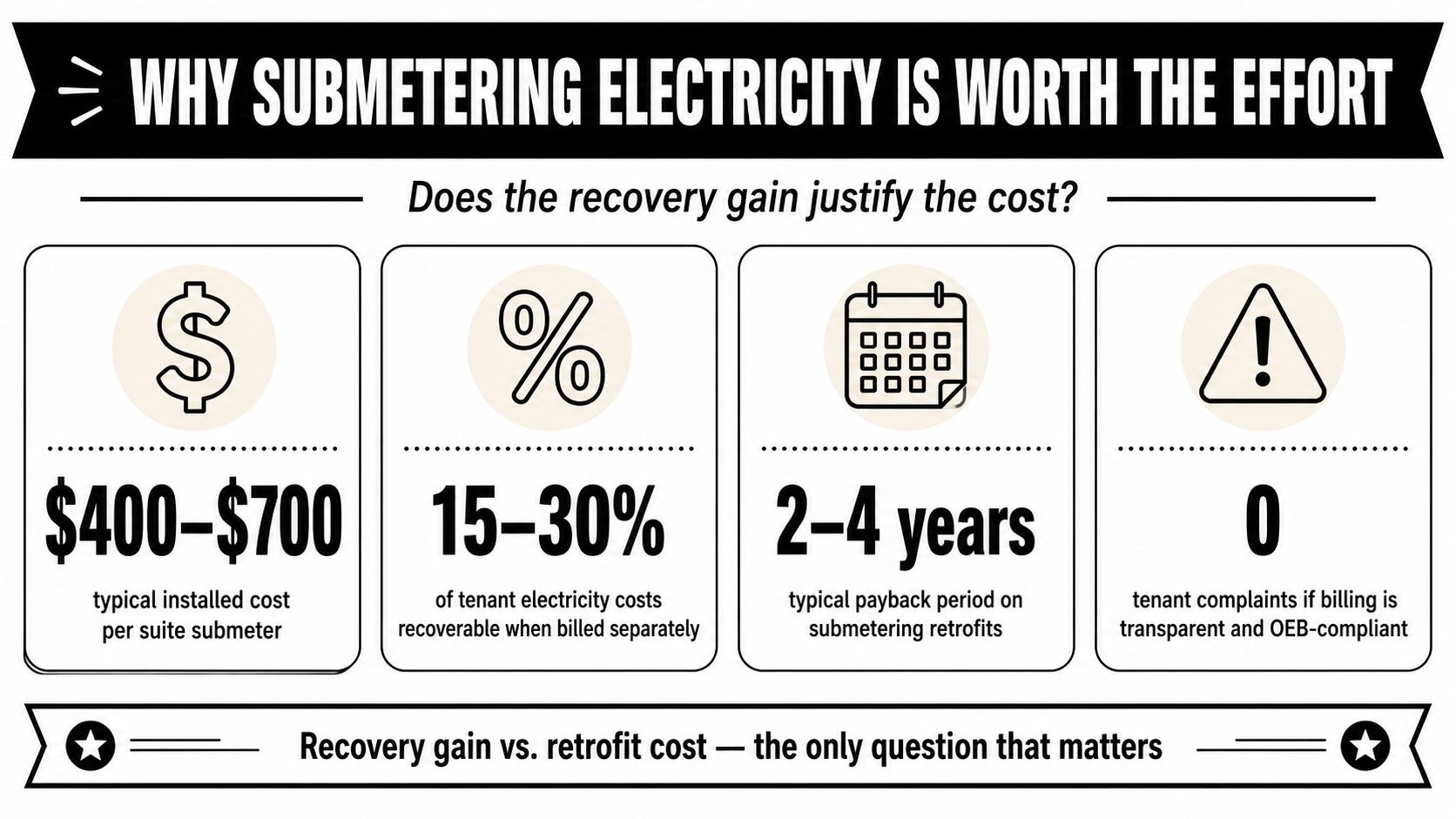
The question is whether submetering is worth the coordination effort for your property. A building with a single bulk meter gives the owner a total, but it doesn't show which suite or load created that consumption. Unit submeters turn that total into a documented allocation that can support tenant billing, operating analysis, and more accountable utility management.
For a suitable multi-unit property, the value comes from two connected changes. First, the owner can move from broad estimates or shared allocations toward charges based on measured suite consumption. Second, residents and property teams gain clearer information about when and where electricity is being used. That visibility can support better conversations about unusual usage and building operations, although it doesn't eliminate the need for sound billing practices.
Submetering isn't automatically a good investment. It can underperform in a small or lightly occupied building, where the installation and administration may be disproportionate to the recoverable electricity expense. It also deserves scrutiny when an owner expects to sell or refinance quickly, because the project needs enough operating time to justify its coordination, commissioning, and billing setup. Properties with very low common-area electrical loads may have less operational insight to gain from additional metering.
Start with the recovery question
Build the business case from the actual bulk bill and the building's electrical layout, not from a generic promise. Identify which loads belong to suites, which belong to common areas, and which costs the lease or tenancy arrangement allows you to recover. Then test whether the proposed billing structure remains fair after provider fees, maintenance, data management, communications, and resident support are included.
Owners should also connect the analysis to property performance. A useful explanation of how utility recovery can affect net operating income in a property is valuable, but the calculation still has to be specific to the building. Don't approve a project until the service entrance, panels, communications route, meter locations, and legal billing arrangement have been reviewed.
The strongest projects treat compliance as part of the financial case. The OEB licence, approved equipment, interval data, and VEE process aren't paperwork added at the end. They're the conditions that determine whether the recovered amount can be billed with confidence.
Regulatory Foundations Every Owner Must Clear
Ontario electricity submetering is a regulated activity. Section 57(c.1) of the Ontario Energy Board Act, 1998 says a person may not engage in unit sub-metering without a licence. The OEB identifies a non-refundable application fee of $1,000 for a new licence or $200 for a renewal, plus an annual registration fee of $800 for every year of the licence. The application process has also moved online, with PDF forms no longer accepted as of July 19, 2022.
That means the owner can't treat the installer as the only party responsible for regulatory readiness. Under the OEB framework, the unit sub-meter provider is responsible for activities including installation, testing, reading, maintenance, billing, and collections in multi-unit buildings. Decide early who will hold the licence, who will operate the billing programme, and who will retain the compliance records.
The principal meter comes first
Ontario Regulation 389/10 defines submetering activity to include providing and maintaining unit sub-meters in a multi-unit complex, including billing and collecting payment. The Ontario regulation is part of the legal foundation for unit-level billing in these properties.
The current OEB Unit Sub-Metering Code adds a prerequisite that controls the project sequence. Before a provider begins service, the principal consumer must request, and the distributor must install, a principal meter that is an interval meter. Don't select suite meters, promise a billing start date, or issue tenant notices before confirming that prerequisite with the distributor.
The Code also requires submetering data used for billing to pass through a validating, estimating, and editing, or VEE, process. Metering installations must meet Measurement Canada standards as a minimum. These requirements make the data workflow just as important as the hardware. A meter that records consumption isn't automatically a compliant revenue-billing system.
Lock the standards before buying equipment
Measurement Canada approval and the OEB framework answer different questions, but they must be considered together. The regulator governs the activity and its operation, while the measurement requirements determine whether the installation can produce data suitable for billing. Owners should confirm the approval status of the proposed billing meter, the installation method, the data path, and the party responsible for testing and records before issuing a purchase order.
For a practical reference on equipment selection, review guidance on Measurement Canada approved meters. Don't accept a vendor's phrase “revenue grade” as a substitute for documented suitability under the applicable Canadian requirements.
Requirement
What It Forces
Project Impact
OEB unit-submetering licence
A licensed party must conduct the regulated activity
Confirm the licence holder and operating responsibilities before launch
Principal interval meter
The distributor must install the required principal meter before service begins
Add distributor coordination to the critical path
VEE process
Billing data must be validated, estimated, and edited under the applicable process
Configure data management before invoices are activated
Measurement Canada minimum standards
The metering installation must meet the applicable measurement requirements
Verify equipment and commissioning records before billing
Defined provider responsibilities
Installation, testing, reading, maintenance, billing, and collections need accountable owners
Put service duties and escalation paths in the agreement
Planning the Project and Budgeting Honestly
Once the regulatory path is clear, the project becomes a site and scope exercise. A credible budget starts with a physical survey, not a meter count. The survey should record panel types, suite feeders, available CT space, circuit labelling, access restrictions, electrical-room conditions, and the route from meter locations to a data collector or building automation gateway.
The one-line review is equally important. It shows how the service enters the property, where suite and common-area loads separate, and whether upstream work requires local distributor coordination. If the one-line drawing is outdated, treat that as a field-verification problem. Don't let a neat drawing create false confidence about what the electrician will find in the panel.
Freeze the scope before pricing
A scope document should distinguish in-suite metering, common-area metering, and any house-load allocation. It should identify the units included, the electrical loads excluded, the communications method, the billing service, the maintenance responsibility, and the access plan. If those boundaries remain vague, competing bids may describe different projects while appearing to offer the same price.
Use the following planning checks before accepting a proposal:
- Meter locations: Confirm where each meter or CT will mount and whether panel access, suite entry, or electrical shutdowns are required.
- Utility and OEB approvals: Map the licence, principal-meter, distributor, and compliance steps before committing to a go-live date.
- Labour and downtime: Schedule electrician hours, access windows, tenant notices, and any interruption required by the chosen installation method.
- Billing system setup: Include meter reading, rate calculation, VEE handling, invoicing, collections, reporting, and resident support in the operating budget.
The capital structure changes the cash-flow picture. An owner-funded project places equipment and installation costs in the capital plan. A provider-funded arrangement may shift hardware ownership, maintenance, and billing administration into a long-term service agreement instead. Compare the total obligations, renewal terms, data ownership, replacement duties, and termination provisions, not just the absence of an upfront invoice.
Budget the work that follows installation
The recurring line items are easy to understate. Include billing-agent charges, data validation, annual reconciliation, communications support, meter testing, replacements, tenant notices, and dispute handling. A low installation quote can become an expensive programme if the contract leaves every downstream task with the property team.
Most delays don't come from the meter price. They come from incomplete panel labelling, inaccessible conductors, missing drawings, late distributor coordination, and residents who weren't given a workable access window. A survey that documents those conditions is cheaper than a return visit after equipment has arrived.
Choosing the Right Meter and Data Resolution
For a retrofit, CT-based meters are usually the sensible starting point. A current transformer can be installed around an existing feeder at the electrical panel, which may avoid extensive rewiring and reduce disruption. That advantage disappears if the panel has no physical clearance for the CT, the conductors can't be identified confidently, or the installation can't support the required testing and labelling.
Hard-wired meters have a cleaner fit in some new construction or planned electrical-room projects. They can be designed into the distribution arrangement from the outset, but they generally require more deliberate wiring coordination and may require an electrical shutdown. The choice should follow the building's conductors and access conditions, not a catalogue preference.
Make the data specification explicit
A practical benchmark for modern submetering is 15-minute interval resolution. Modern submeters may record at 15-minute or hourly intervals, but expert guidance recommends keeping 15-minute data as the default because it supports demand analysis, load profiling, and tenant billing accuracy. The electricity submetering data guidance also highlights a common mistake, specifying what the meter can record without confirming what the system will retain and export.
Ask these questions before selecting a model:
- Does the equipment have the approval status required for billing?
- Can the installation accommodate the voltage, current, and conductor arrangement on site?
- Will the data collector retain and export the required interval records?
- Does the communications protocol work with the existing BAS or standalone platform?
- Who will verify the multiplier, meter address, time settings, and export schedule?
Factor
CT-Based Retrofit
Hard-Wired Meter
Best fit
Existing panels and retrofit distribution
New construction or planned electrical-room layouts
Disruption
Often avoids extensive rewiring, subject to panel access
May require more wiring coordination and planned shutdowns
Main risk
Insufficient CT clearance or unclear feeder identification
Late shutdown coordination and unsuitable panel arrangement
Data responsibility
Still requires an approved meter, collector, and validated billing path
Same compliance and data obligations apply
Procurement check
Confirm CT fit before purchase
Confirm meter base, conductors, and installation design
A reliable communications and support workflow matters as much as the meter. Teams evaluating resident contact handling alongside utility data may also find how Intelligent Contacts serves utilities useful when designing escalation and customer-support processes. For larger properties, review how the advanced metering infrastructure approach fits the chosen collector and reporting environment.
Installation and Commissioning Without Rework
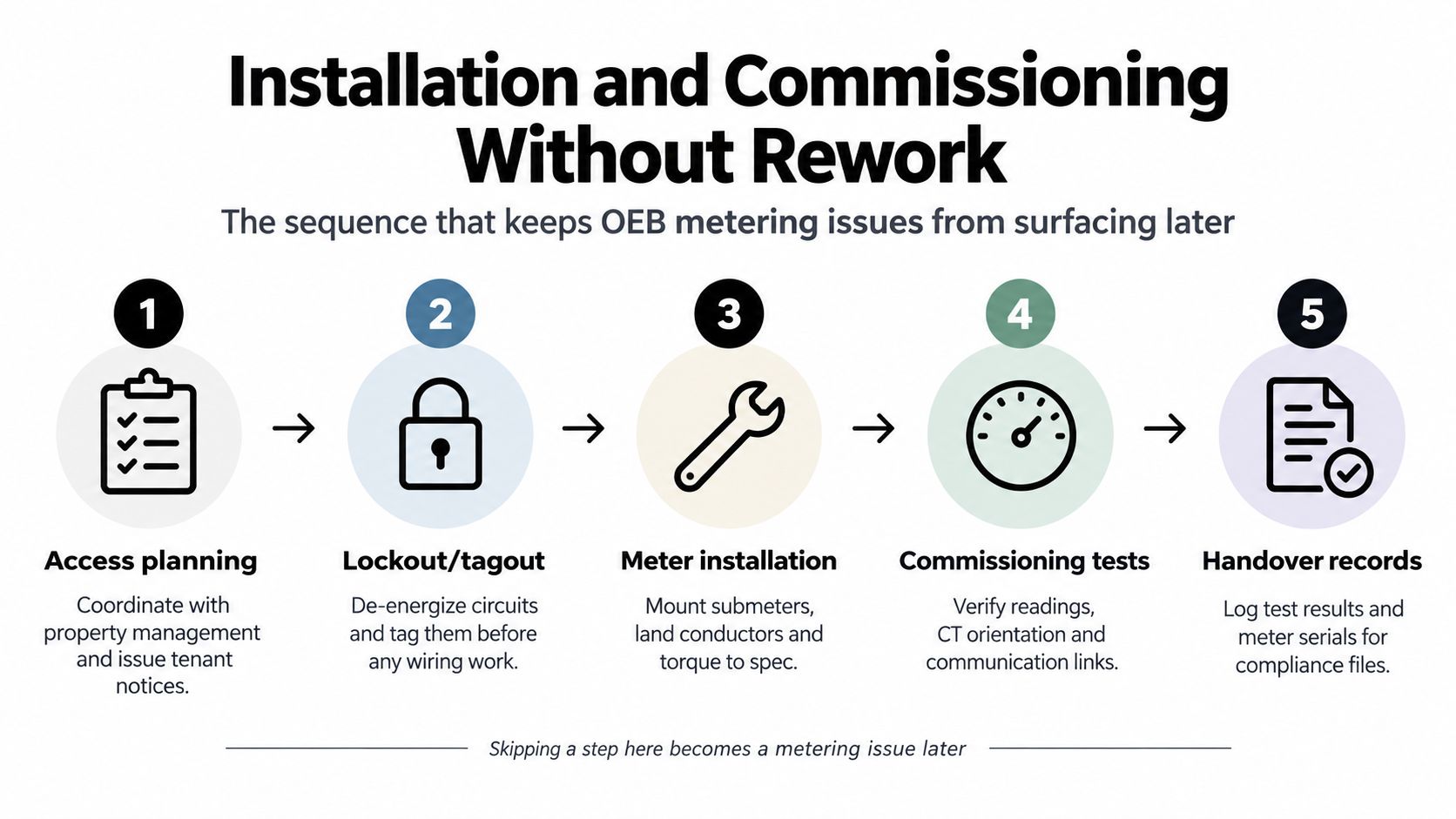
Installation should follow a controlled sequence. Property management first confirms access, issues tenant notices, and identifies rooms that require escorts. The electrical contractor then matches the field conditions to the approved drawings and scope before touching a panel.
Hard-wired work may require lockout and tagout coordination with the local distributor. CT retrofit work can reduce disruption, but it still requires safe isolation practices, suitable access, and verification that the identified feeder belongs to the correct suite or load.
Install against a documented circuit map
Place each CT on the identified phase and record the relationship between the meter, CTs, panel, circuit, and suite. Label the circuit at the panel and the meter location. A property team should be able to trace a reading back to a physical installation without relying on the memory of the electrician who completed the work.
The commissioning sequence should include:
- Access planning: Coordinate property staff, contractors, residents, notices, escorts, and outage windows.
- Safe electrical control: Apply the required isolation, lockout, and tagout process before wiring work.
- Meter installation: Mount meters, place CTs correctly, land conductors, and torque connections to specification.
- Polarity and phase verification: Confirm CT orientation and phase relationships with the appropriate testing equipment.
- Circuit labelling: Match field labels, drawings, meter serials, and tenant records.
- Communications testing: Verify the path through the data collector, gateway, BAS, or other approved system.
- VEE validation: Have the licensed meter data management process confirm interval-data integrity before billing begins.
Commission the data, not only the hardware
Program the meter address, multiplier, time settings, and any demand-reset configuration during commissioning. If the team discovers an incorrect multiplier after invoices have been issued, the provider may need to recalculate records and explain the correction to affected residents. That exposure is avoidable when the settings are tested before billing activation.
The handover file should identify who owns the seal, who owns the interval data, who can change programming, and who signs the commissioning certificate. It should contain meter serials, test results, panel references, communications status, exception records, and the approval to move from testing into billing.
The property manager should receive a clear answer to one final question: what happens when a meter stops communicating? If the answer is an informal email to an unknown contractor, the programme isn't operationally ready.
Setting Up Tenant Billing That Holds Up
A compliant billing programme starts with validated interval data, not with a template invoice. The bill should identify the measurement period, consumption in kWh, the applicable rate calculation, relevant riders and regulatory charges, HST, and a comparison with the previous period where the billing system supports it. Residents should be able to see what was measured and how the amount was calculated.
The invoice also needs a clear origin. If the resident lives in a condo or apartment with an individual meter and the bill comes from a company other than the local utility, Ontario's consumer-protection framework treats that resident as a customer of a unit sub-meter provider. That relationship makes the provider's role, contact details, dispute route, and collection process important parts of the billing design.
Separate suite use from shared loads
Common-area electricity must be handled deliberately. Hallway lighting, elevators, exterior lighting, mechanical equipment, and other shared loads shouldn't appear as an individual suite's consumption. The bulk bill needs to be reconciled against the suite meters, with the allocation method documented in the lease, condominium documents, or applicable agreement.
There are two practical controls:
- Physical separation: Meter common-area feeders independently so the billing system can distinguish shared building use from suite consumption.
- Documented allocation: Where physical separation isn't practical, define the allocation method, inputs, and treatment of unmetered loads before invoices are issued.
Don't let a billing platform hide an unclear allocation policy. Software can calculate a formula consistently, but it can't make an undisclosed formula fair or enforceable.
Give residents a usable explanation
A move-in letter should explain how the meter is read, who issues the invoice, where residents can ask questions, and how they can view their consumption through the available portal or reporting channel. It should also describe the dispute process and explain that the review will refer to validated interval data rather than an unexplained estimate.
Collections need the same discipline. Set due dates to fit the property's broader hydro-bill process, apply late charges consistently with the Residential Tenancies Act and the tenancy documents, and route disputes to a person who can access meter records. A resident shouldn't have to argue with the property manager about a number that only the billing provider can investigate.
Transparent bills won't prevent every complaint. They do give the property team a defensible record, a repeatable answer, and a better chance of resolving a question before it becomes a formal dispute.
Running the Program Day to Day
Submetering becomes reliable when the property team treats it as a building system. The work doesn't end when the electrician leaves. The owner needs a recurring operating rhythm that connects master-meter reconciliation, interval-data review, rate updates, maintenance, resident support, and records management.
Start with a monthly control review. Compare the bulk meter with the sum of the applicable suite and common-area records, investigate unexplained differences, and document exceptions. The IESO's publication of aggregated hourly consumption data by Forward Sortation Area shows that broader load benchmarking is becoming more accessible, but public aggregated data doesn't replace building-level tenant records or the responsibilities of a licensed sub-metering programme. See the IESO data-sharing information for the distinction.
Maintain the controls after commissioning
The property manager, billing provider, and electrical contractor should agree on ownership for these recurring tasks:
- Data review: Check for missing intervals, abnormal readings, communication failures, and VEE exceptions before invoices are released.
- Meter changes: Apply the same mapping, testing, and validation process after a replacement, panel change, or suite reconfiguration.
- Rate maintenance: Update the billing platform when the applicable rate structure or charge treatment changes, then test the invoice output.
- Physical maintenance: Inspect CT installations, labels, connections, and communications equipment during planned electrical work.
- Resident escalation: Keep a documented route for billing questions, move-ins, move-outs, corrections, and collection issues.
- Record control: Retain commissioning evidence, meter serials, test results, data exceptions, and billing corrections in an organised file.
Owners should also connect submeter data to wider energy-management work. Practical commercial-building energy-saving tips can help a team act on load patterns once the metering programme identifies where consumption occurs. The meter doesn't create savings by itself. It gives the operator a more precise basis for deciding which operating change deserves attention.
Operational rule: Every meter change should trigger a mapping check, a data check, and a billing check.
The strongest programmes don't treat submetering as a one-time retrofit or a software subscription. They assign an accountable owner, schedule recurring reviews, and require evidence before billing changes go live. That discipline protects the integrity of tenant charges and keeps the data useful for property operations.
If you're ready to assess a multi-unit property's panels, compliance path, installation scope, and billing workflow, Axis Meter Solutions can coordinate electricity submetering, approved equipment, installation, commissioning, and ongoing tenant billing. Ask for a site-specific review that identifies the principal-meter requirement, access constraints, data-validation process, and long-term service responsibilities before you commit to equipment or dates.
Ready to Optimize Your Utility Management?
Tell us about the property, utility, number of units, and your billing or monitoring goals. We'll help you identify the right next step.
Book a Call