Natural Gas Meter Guide: Types, Approvals and Submetering
A resident in a small apartment gets a winter gas bill that looks like the bill for the whole building. The heating ran, but not that much. The manager points to a meter number, the resident points to a cold living room, and neither side can show how one became the other.
That gap is where most disputes start. A natural gas meter isn't just a box on a wall. It's the evidence that connects actual use to a fair charge, but only if you understand what it counts, how it was approved, and how the billing rules were set before the first invoice went out.
Table of Contents
- What a Natural Gas Meter Measures and Why It Matters
- Types of Natural Gas Meters at a Glance
- How Gas Meters Are Approved and Certified
- Unit-Level Submetering Options for Multi-Unit Buildings
- Installation Checklist and Billing Mistakes to Avoid
- Choose Your Metering Setup and Next Steps
What a Natural Gas Meter Measures and Why It Matters
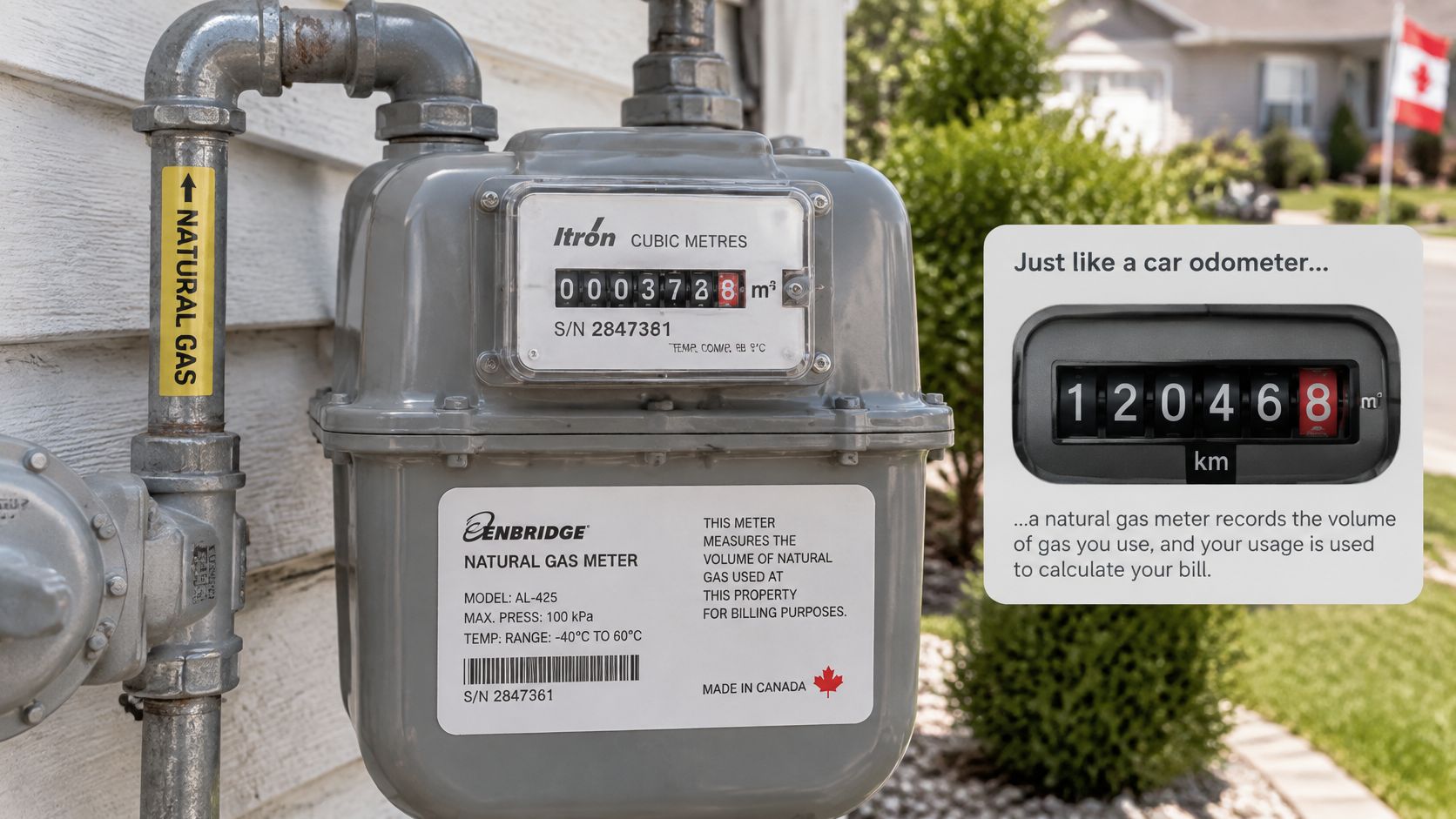
Think of a natural gas meter like a car odometer for gas. An odometer doesn't tell you how fast you're driving right now. It records how far you've travelled in total. A gas meter does the same kind of job, recording the volume of gas that has passed through the service line.
Say you read the dial on the first of the month and again thirty days later. The difference between those two readings is the volume used in between. You'll usually see that volume in cubic feet or cubic metres (m3) on the meter face.
Why the Reading and the Bill Don't Match
Your bill rarely charges you for volume alone. The utility converts volume into energy units, such as therms or gigajoules, using the heating value of the gas supplied. That's why the number on the meter and the number billed look different even when both are correct.
If you want the conversion explained step by step, the Blue Gas Express measurement guide walks through how measured volume relates to billed energy. Keep that distinction in mind whenever you compare a photo of a meter face to an invoice.
A reading proves volume passed through. The bill also needs the right dates, conversion, rate, and account. A dispute can start in any one of those steps.
The meter usually sits on an outside wall or at the building entry, between the utility service line and the building's gas piping. That position matters at scale. The California Public Utilities Commission natural gas overview reports that California's natural-gas utilities serve more than 11 million gas meters, covering homes, multifamily properties, commercial customers, industrial users, and master-metered buildings.
In a house, one meter usually matches one household. In a multi-unit building, one meter may serve the whole property, so it can't by itself show what each unit used. Finding your meter, noting whether it has dials or a digital display, and recording two readings a month apart gives you a basic check. It won't replace the bill calculation, but it tells you whether the story is plausible.
Types of Natural Gas Meters at a Glance
Meter type
Typical use
How it measures
Notes
Diaphragm
Homes, small apartments, small commercial
Flexible diaphragms fill and empty fixed chambers
Most common residential type; check the rated capacity on the nameplate
Rotary
Commercial kitchens, larger multi-unit buildings
Two rotating lobes displace a fixed volume of gas each turn
Wide flow range; suited to heavier simultaneous demand
Turbine
Industrial plants, large commercial loads
Gas spins a rotor, and rotor speed is proportional to flow
Needs a straight pipe run for accurate readings
Smart (electronic)
Residential and commercial accounts with automated billing
Electronic register or sensor with pulse or radio output
Supports remote reading and data logging; may need a signal
Flow and Pressure Decide the Choice
Owners often ask which meter fits a building of a certain size. That's the wrong starting question. Flow rate and operating pressure drive the choice, because the meter must stay accurate when several appliances run at once on a cold morning.
A diaphragm meter suits most homes and small apartments. Inside, flexible diaphragms fill and empty chambers of known volume, and each cycle advances the register. It's a practical, proven design for lower flows.
A rotary meter steps up when demand gets heavier, for example in a commercial kitchen where ranges, ovens, and water heating may run together. Two lobes rotate in sequence, moving a fixed amount of gas with each turn.
A turbine meter belongs in industrial plants and other large loads. Gas spins a rotor, and faster flow spins it faster. Because turbulence can distort that relationship, it needs a straight run of pipe so the gas arrives in a clean, even stream.
A smart meter isn't defined only by how it senses gas. It adds electronic recording and communication, often by pulse or radio, so readings can be collected remotely and logged more often. California shows how large that shift became. The California Public Utilities Commission smart meter benefits page describes authorised programs for approximately 900,000 natural-gas smart meters for San Diego Gas & Electric and approximately 4.2 million for Pacific Gas and Electric.
How to Identify What You Have
- Look at the housing: Diaphragm meters are the familiar bulky residential units. Rotary and turbine meters look more industrial and sit in line with larger piping.
- Look at the face: Older units use a row of dials. Electronic units show a digital display and may have a radio module attached.
- Read the nameplate: Check the maximum rated capacity, serial number, and model before assuming a meter can handle added appliances.
Sizing rule: An undersized meter can cause pressure loss at peak demand. A smart meter can still fail to report if it doesn't have a usable communications signal.
Use the simple rule first. Diaphragm for most homes, rotary for large commercial loads, turbine for industrial plants, and smart features when remote reading and data logging matter.
How Gas Meters Are Approved and Certified
People often treat approval as one stamp. It's a chain, and confusing the links causes trouble. Model approval asks whether the design measures correctly. Verification asks whether the individual meter in front of you measures correctly.
The Approval Layers
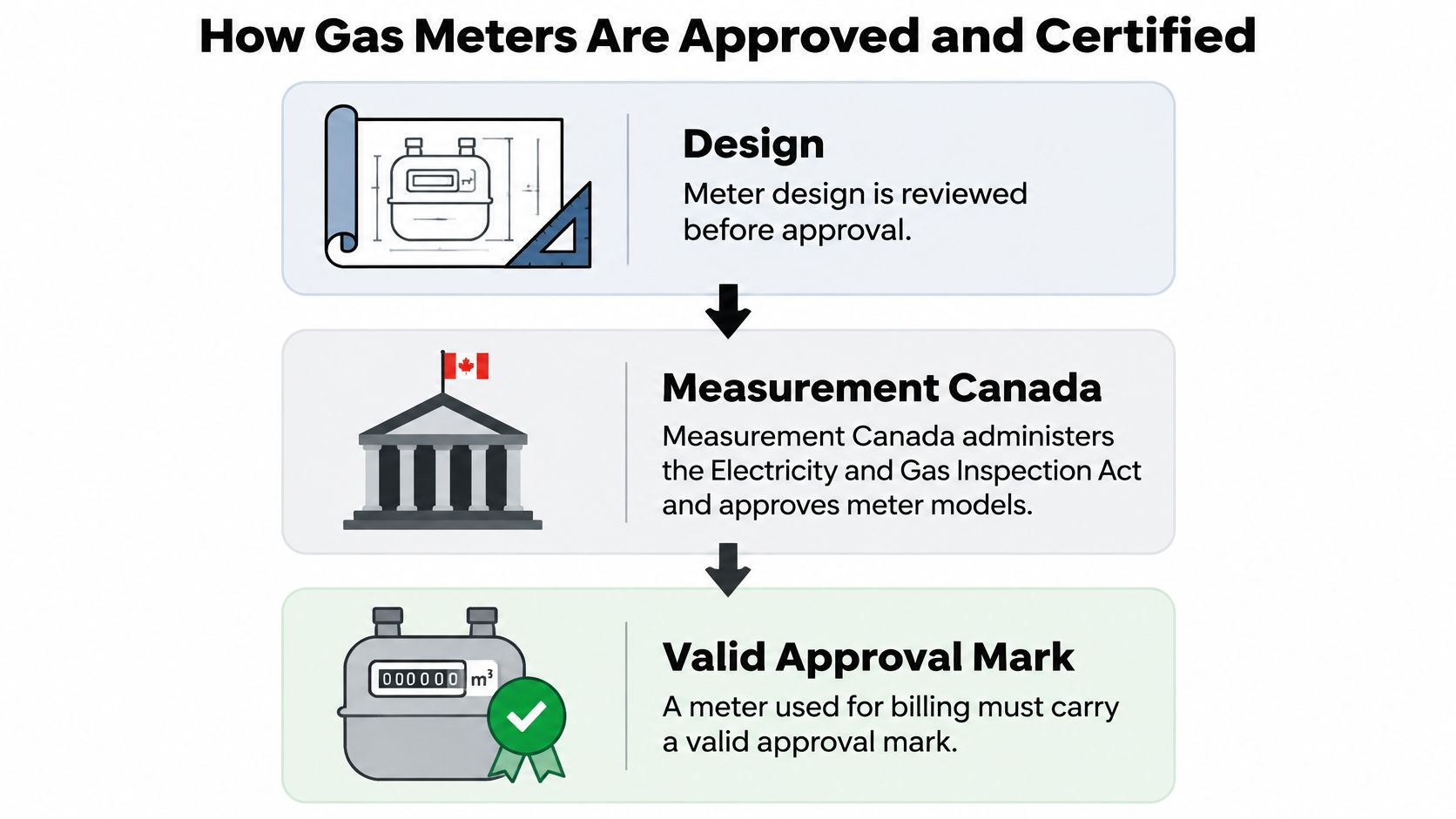
In Canada, Measurement Canada administers the Electricity and Gas Inspection Act and approves meter models. A meter used for billing must carry a valid approval and verification mark. If you're checking what that means for equipment selection, our guide to Measurement Canada approved meters explains the approval marks in plain language.
In the US, diaphragm meter design is commonly referenced to ANSI B109 standards. State public utility commissions set tariffs and metering rules for utilities, while federal pipeline safety rules under 49 CFR Part 192 cover gas service lines and pressure. Those are different jobs. A safety rule for a service line doesn't prove a meter is accurate, and an accuracy approval doesn't set the tariff.
Three Checkpoints to Keep Separate
- Model approval: The design is tested before that type of meter is accepted for billing use.
- Verification: The individual unit is checked, often before or at installation, and marked accordingly.
- Periodic inspection: The meter is checked again in service so accuracy does not drift over time.
On the meter body, look for the verification label or stamp, the serial number, and the relevant date. Photograph all three. If a bill later looks wrong, that photo tells the utility exactly which device supplied the disputed reading.
Start a challenge with facts, not frustration. Ask the utility to test the meter, and include the serial number, the dates in question, and your bill history. Keep your own dated reading photos if you have them. A test can confirm the device, reveal a fault, or show that the error sits elsewhere, for example in an estimated read or a mixed-up account.
Approval confirms the device can measure accurately. It doesn't approve the rate, allocation formula, or common-area split built on top of that measurement.
That last point matters in multi-unit buildings. A perfectly approved master meter can still sit behind an unfair allocation if nobody wrote down how shared gas use is handled.
Unit-Level Submetering Options for Multi-Unit Buildings
Model
Who owns the meter
Who reads and bills
Best fit
Master meter only
Utility
Utility bills the owner
Owner recovers the full bill through rent or fees
Utility individual meters
Utility
Utility bills each unit
Where the utility offers per-suite service
Owner-installed submeters
Owner
Owner reads and bills
Small buildings with in-house billing capacity
Third-party turnkey submetering
Provider under a long-term agreement
Provider reads, bills and maintains
Multi-unit buildings without metering staff
Hybrid with common-area meter
Owner and provider
Provider bills units; owner pays common area
Buildings with shared heating or amenities
The Problem a Master Meter Creates
With one master meter, the utility bills the owner for the whole property. The owner then recovers that cost through rent or a separate fee. Residents who use little gas subsidise residents who use a lot, and nobody can see their own signal to conserve.
Unit-level metering assigns each suite its own share. For a plain explanation of the mechanics, see how submetering works. The physical requirement comes first, though. Each unit needs its own gas branch, or a meter location that isolates that unit's appliances. Buildings with individual gas heating or rooftop equipment often allow that separation. A single central boiler serving every suite usually doesn't.
Before you allocate anything, separate common-area loads. Corridor heating, a shared pool heater, laundry equipment, or a leasing office shouldn't land on tenant bills by accident. Meter those loads separately where practical, or state the allocation rule in writing.
Choose Using Four Decision Points
- Who owns the equipment: Ownership decides who replaces a failed meter and who carries the long-term asset risk.
- Who reads it: Manual reads need access and discipline. Automated collection needs communications that work in the building.
- Who issues the bill: Billing isn't copying a number onto an invoice. Someone must apply rates, handle move-ins, answer questions, and correct errors.
- What the tenant agreement says: Lease language must match the model before billing starts, not after the first complaint.
Match the model to your capacity. Owner-installed submeters can suit a small building where staff already handle billing well. Turnkey submetering suits a larger property without metering staff, because the provider reads, bills, and maintains the system under agreement. A hybrid model fits where suites have individual loads but the property also has shared heating or amenities that belong to the owner.
Tenant Protection Is Part of the Design
Accurate consumption isn't enough if the economics are wrong. A recent California Public Utilities Commission proceeding defines a master-metered property as one where a single utility meter serves a customer of record who distributes, submeters, or allocates service among tenants. California Public Utilities Code §739.5 requires submetered mobile-home-park residents to be charged the same rates that would apply if the utility served them directly, and requires applicable rebates to be passed through to residents.
Rules differ by place and property type, so don't copy California's rule into another jurisdiction. Do copy its lesson. Ask how utility-equivalent rates, eligible discounts, rebates, customer charges, and move-in or move-out dates will be handled. Get the answer in writing before any model goes live, because the owner carries the duty when the owner stands between the utility and the tenant.
Installation Checklist and Billing Mistakes to Avoid
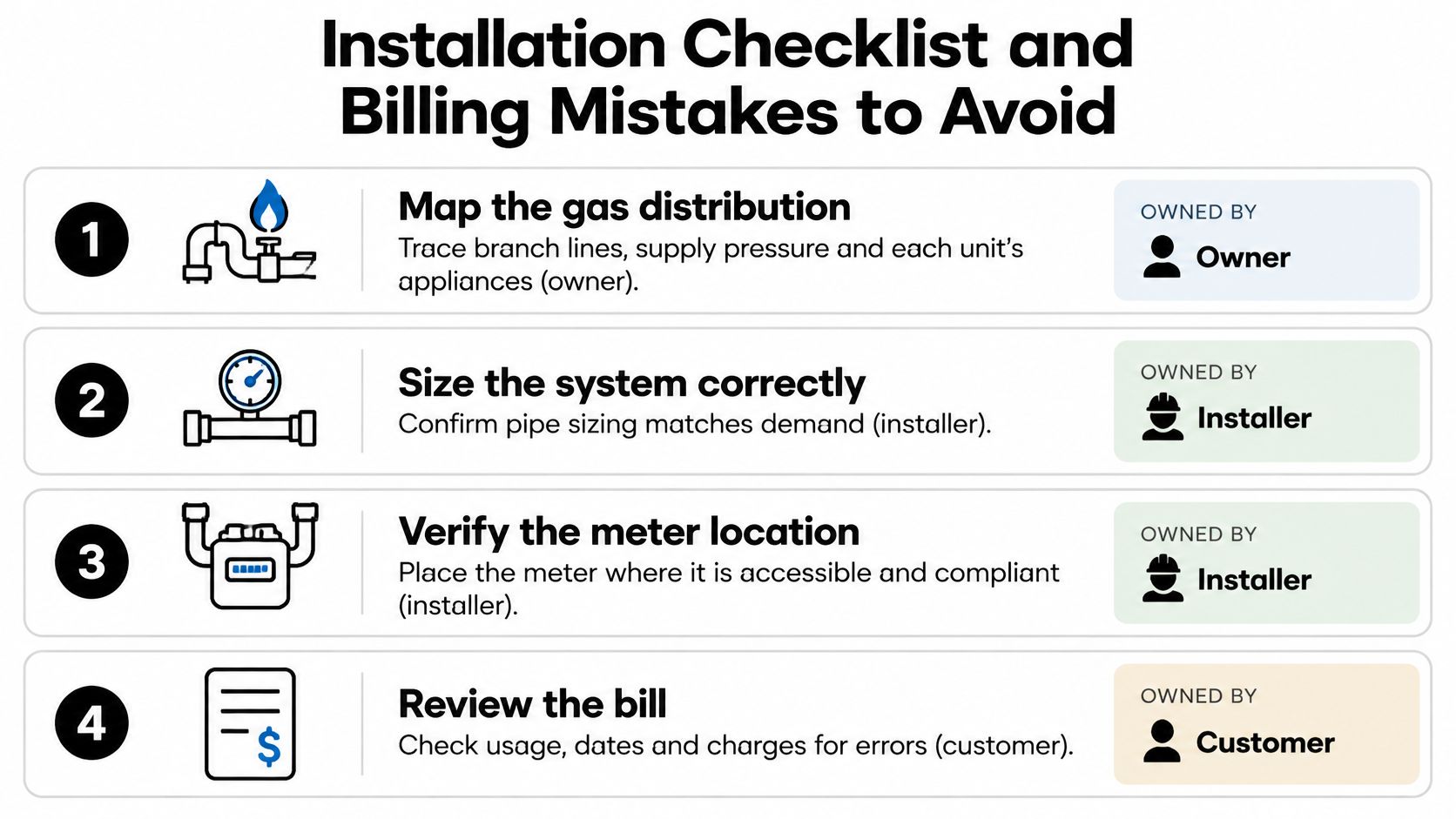
Most billing problems are installed months before the first invoice. A meter goes on the wrong branch, a start reading isn't recorded, or nobody decides who pays for common areas. Work through the steps in order, with one owner for each.
The Ten Step Checklist
- Map the gas distribution (owner): Trace branch lines, supply pressure, and each unit's appliances. A meter can only measure the load downstream of where it sits.
- Size to peak demand (provider or engineer): Include planned appliances, not just today's load. Sizing to average use causes pressure loss in winter when heating, cooking, and hot water overlap.
- Confirm permits and a licensed gas fitter (owner): Gas work isn't general handyman work. If you're preparing for review, guidance on gas line permits and inspections helps you understand what inspectors expect before work starts.
- Plan isolation and access (fitter): Coordinate shutoffs and suite entry early. Gas shutoff often takes one to two days, so residents need notice that matches the schedule.
- Leak test every fitting (fitter): Test after installation, not after the first smell complaint. Document the result for each disturbed joint.
- Verify approvals and record identity (fitter): Log serial numbers, verification dates, and exact meter locations. A swapped serial number can bill Unit 204 for Unit 304.
- Commission the readings (provider): Record start indexes, then reconcile the sum of unit readings against the master meter. Investigate any gap before billing. A small unexplained difference needs a defined home, not a quiet spread across tenants.
- Issue tenant notice and lease language (owner): Explain when billing starts, the estimate rule for missed reads, and the proration formula for move-ins and move-outs. Our overview of how to bill tenants for utilities covers the tenant-facing pieces to settle first.
- Set billing rules (owner): Write down the rate basis, fixed charges, and common-area allocation before the first cycle. A reading alone does not produce a fair bill.
- Schedule maintenance and replacement (provider or owner): Plan for the meters' service life, battery or communications failures where applicable, and periodic accuracy checks.
Where Estimates Go Wrong
Don't let estimates run for months. When the actual read finally arrives, one tenant gets a catch-up bill that looks like a penalty, even if the total gas use was real.
Schedule actual reads on a fixed rhythm and investigate missed reads quickly. If an estimate is unavoidable, label it clearly, state how it was calculated, and say when it will be trued up. Residents accept corrections far better when the method was disclosed before the surprise.
Keep a simple audit file for every unit. It should hold the meter serial number, location, start index, verification details, and the billing rule version in force. When a resident questions a charge, you can walk from the physical meter to the invoice without guessing. That paper trail is the difference between a defensible bill and an argument.
Choose Your Metering Setup and Next Steps
Reduce the decision to three questions. First, which meter type matches the flow and pressure at peak demand? Second, which approval and verification mark applies in your jurisdiction? Third, which submetering model matches who will own the equipment, read it, and bill residents?
Gather Three Documents First
- Utility bills: Collect twelve months of bills so winter peaks and summer lows are both visible.
- Appliance list: List gas appliances by unit, including heating, hot water, cooking, dryers, and rooftop equipment.
- Gas layout drawings: Bring any drawings you have, even if they're old. They give an assessor a starting map to verify in the field.
A site assessment turns those documents into a metering plan built for your building's configuration. We start gas submetering with that assessment, install meters on each unit's gas line where the layout allows, and coordinate regulatory approvals and permits. If your project also involves new gas work during a renovation, background on gas fitting by Total Plumbing can help you separate plumbing scope from metering scope before you hire anyone.
The single next step is to contact Axis Meter Solutions, send those three documents with your request, and ask for a site assessment. Before agreeing to any model, ask for a written metering plan and billing rules covering rate basis, estimate policy, common-area allocation, and move-in and move-out proration. Confirm the meters carry the verification mark required in your jurisdiction, and whether the consultation carries any obligation. We offer a free consultation and a free assessment of a building's gas infrastructure, with no obligation.
The best setup isn't the one with the newest meter. It's the one whose billing rules are written down, whose common loads are separated, and whose readings can be traced from a named meter to a named unit.
Ready to turn one bulk gas bill into clear, defensible per-unit charges? Axis Meter Solutions provides turnkey gas submetering with Measurement Canada approved meters, automated data collection, monthly tenant billing, and ongoing compliance support, with $0 upfront. Visit Axis Meter Solutions to request your free site assessment and send your recent utility bills, appliance list, and gas layout drawings.
Ready to Optimize Your Utility Management?
Tell us about the property, utility, number of units, and your billing or monitoring goals. We'll help you identify the right next step.
Book a Call