Ontario Energy Board Explained: Licences and Your Bill
If your electricity bill comes from a licensed provider, does that mean the Ontario Energy Board approves every charge on it? No. A sub-metered bill can combine regulated utility costs with provider fees that the OEB doesn't set, and knowing the difference changes how you check or challenge the amount.
For property owners, condominium boards and residents, the useful question isn't whether the provider is regulated. It's which part of the bill is regulated, how the provider calculated it, and what evidence supports it.
Table of Contents
- What the Ontario Energy Board Regulates
- Who Needs a Licence to Sub-Meter Electricity
- The Bill Split Between Utility Costs and Provider Fees
- Why Sub-Metered Bills Differ from Advertised Rates
- A Worked Example for One Suite's Bill
- How to Challenge a Sub-Metered Charge
- Verify the Licence Before You Sign or Pay
What the Ontario Energy Board Regulates
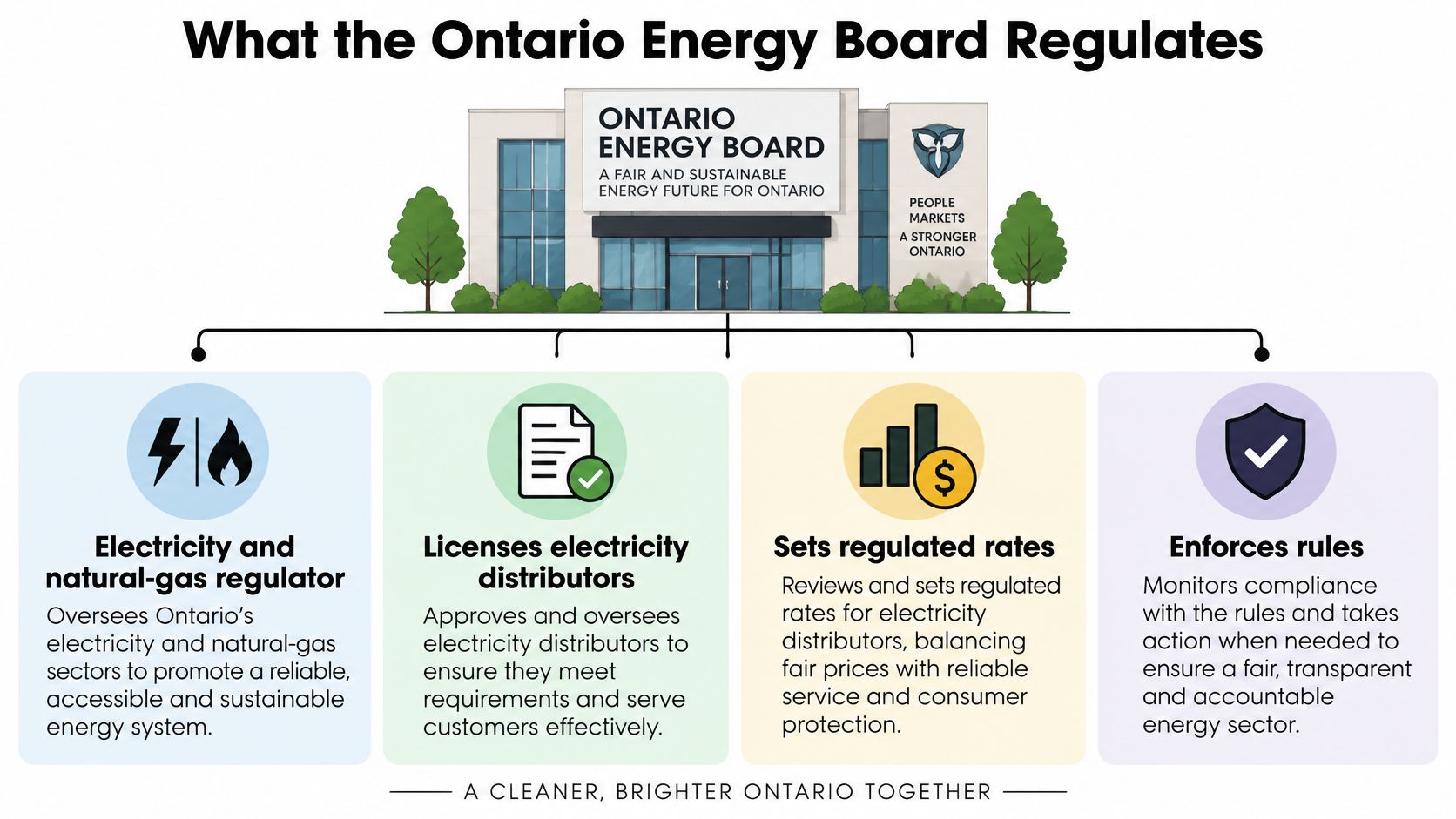
The Ontario Energy Board (OEB) is Ontario's electricity and natural-gas regulator. It licenses electricity distributors, sets regulated rates, and enforces customer-service and consumer-protection rules. It doesn't supply electricity to your suite.
For scale, the OEB's annual report identified approximately 5.51 million electricity distribution customers and 3.93 million natural-gas customers in Ontario for 2024. Those customer bases help explain why clear rules matter, from the utility serving a neighbourhood to the provider billing an individual apartment.
The regulator's responsibilities extend beyond the energy price residents see advertised:
Where electricity sub-metering fits
In a sub-metered building, the utility account and the resident's account aren't necessarily held by the same organisation. The building receives electricity through its utility connection, while a unit sub-meter provider measures or allocates consumption and bills individual suites.
That arrangement operates within a supervised electricity market. It isn't a private invoicing exercise that falls outside consumer-protection rules.
Our Ontario Energy Board licence covers electricity submetering in Ontario. Water, gas and projects outside Ontario are reviewed separately for each jurisdiction, so an Ontario electricity credential shouldn't be treated as approval for every utility service or location.
Start with the charge, not the logo: Identify whether a bill line recovers electricity or delivery costs incurred by the building, or pays the provider for its services.
That distinction is more useful than assuming every charge on a licensed company's invoice has an OEB-approved price.
Who Needs a Licence to Sub-Meter Electricity
Under section 57(c.1) of the Ontario Energy Board Act, 1998, no person may engage in unit sub-metering without an OEB licence, as explained in the OEB's Unit Sub-Metering Code framework. Licensed providers must also comply with the Code and the conditions attached to their licence.
A licence is therefore the starting qualification, not an optional badge. A building owner should establish that the contracting entity can legally perform the proposed activity before comparing commercial terms.
OEB unit sub-metering licence fees
The OEB's published licensing fee structure is summarised below. These are fees paid by the provider, not an approved schedule of charges for residents.
Fee
Amount
When It Applies
New unit sub-metering licence application
$1,000 (non-refundable)
Applying for a first licence
Licence renewal application
$200
Renewing when the annual registration fee is paid
Annual registration fee
$800
Each year the licence is held
Paying these fees doesn't replace compliance with the Code. Nor does it establish that the OEB has approved the provider's service-fee amount.
Check the legal entity and licence scope
Search the OEB register using the provider's legal name. Match that name to the agreement, confirm that the licence covers electricity unit sub-metering, and check that its status is current rather than lapsed.
We are licensed as Axis Meter Solutions Inc., an Ontario electricity unit sub-meter provider under licence ES-2022-0268. Our Ontario licence can be verified on the Ontario Energy Board register.
Keep the verification with the contract approval record. If a proposal uses a trading name or involves another company, resolve which entity holds the licence and which entity will bill residents before signing.
The first question isn't what a licence costs. It's whether the organisation undertaking the licensed activity holds a valid one.
The Bill Split Between Utility Costs and Provider Fees
Utility-cost recovery and provider compensation are different things. The OEB's unit sub-metering guidance states that electricity and delivery costs passed through to occupants cannot be marked up, while the provider's own fees and service charges aren't regulated by the OEB.
The underlying Unit Sub-Metering Code establishes minimum operating, technical, billing and customer-service standards. It also preserves Measurement Canada obligations, with the higher standard applying where OEB requirements exceed federal measurement rules.
Who controls each line on a sub-metered bill
Bill Component
Regulatory Position
Markup Allowed
Suite share of building electricity
OEB-regulated utility cost passed through
No
Delivery charges incurred by the building
Passed through to occupants
No
Provider service fees
Not regulated by the OEB
Set by the provider agreement
Other permitted provider charges
Must be shown separately on the bill
Governed by the applicable agreement and rules, not a utility-cost markup
The electricity line should recover the suite's applicable share of the building's electricity cost. It shouldn't conceal compensation for operating the billing programme.
The delivery line concerns the delivery costs the building incurred. Delivery isn't another name for the provider's administration fee. Our explanation of the delivery charge for electricity helps distinguish that category from energy consumption.
The provider service-fee line pays for the provider's services under the agreement. A resident can question whether the fee was correctly disclosed or applied, but shouldn't assume the OEB sets its price.
An unregulated fee isn't the same as an unchallengeable fee. Check the agreement and billing treatment, rather than asking the OEB to approve a price it doesn't set.
Keep the supporting records aligned
Owners should maintain a compliance file with:
- Licensing evidence: The provider's licence and relevant conditions.
- Meter documentation: Approvals, verification and installation records.
- Commissioning evidence: Results connecting the installed equipment to the billing configuration.
- Account controls: Dispute procedures and checks on billing calculations.
Contracts, billing software and owner reports should all use the same categories. Otherwise, an owner may mistake provider revenue for recovery of a utility expense.
Allocation methods also need clear labels. Homebase's guide to implementing RUBS in rental properties is useful context when considering ratio-based allocation, but an allocation formula shouldn't be presented as a suite meter reading.
Why Sub-Metered Bills Differ from Advertised Rates
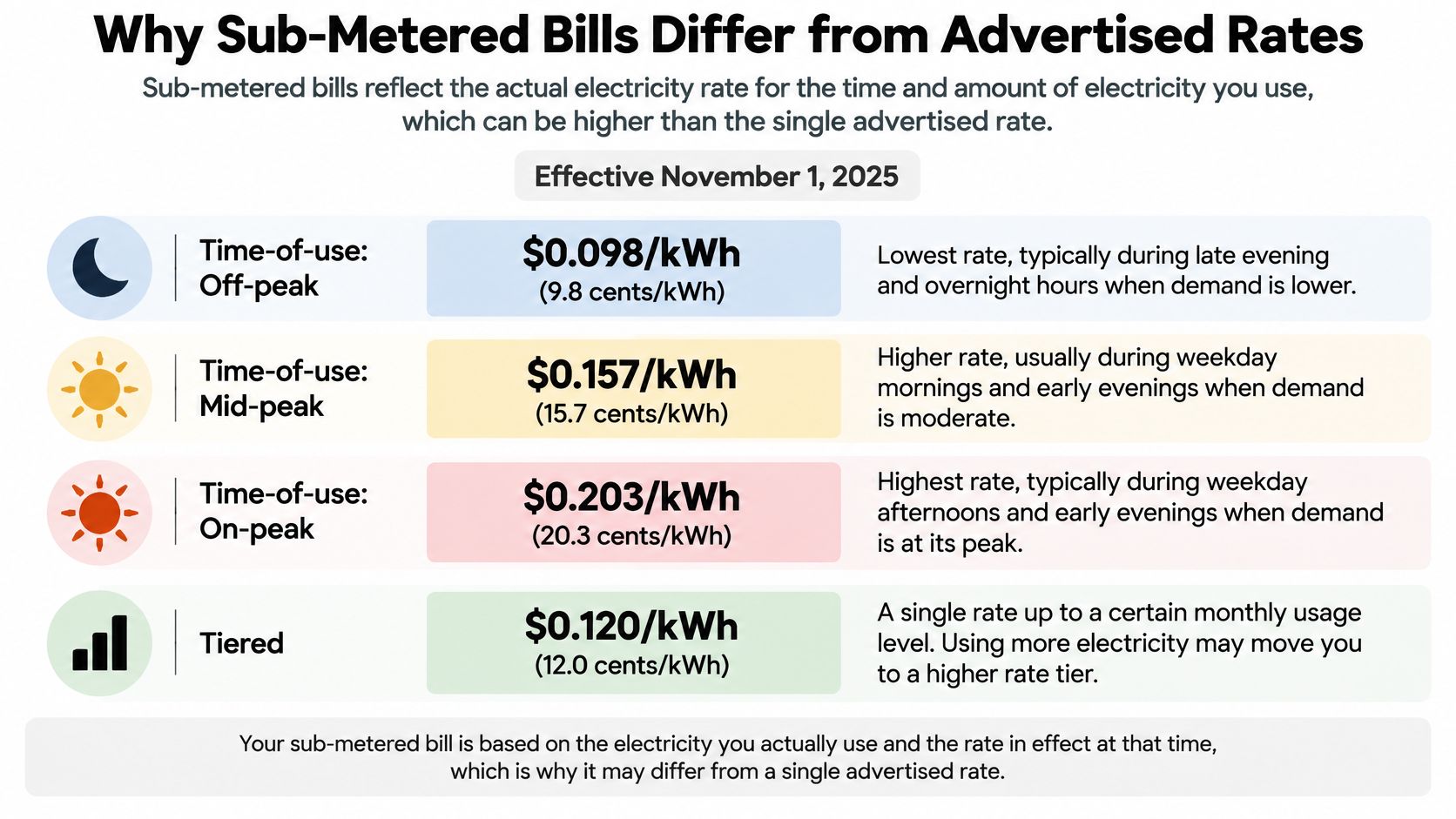
The OEB's historical electricity-rate records list the following residential energy prices effective November 1, 2025. They are energy prices, not an all-in quotation for a sub-metered suite's bill.
Pricing Plan
Period or Tier
Price (cents per kWh)
Time-of-use
Off-peak
9.8
Time-of-use
Mid-peak
15.7
Time-of-use
On-peak
20.3
Tiered
Lower tier
12.0
Tiered
Higher tier
14.2
The visual comparison highlights how the energy price changes by period or tier:
A suite's final amount also reflects its consumption, the billing period and the applicable non-energy charges. An estimated reading can affect the consumption billed, while a later actual reading may require an adjustment.
Match the building's actual billing arrangement
Don't assume an apartment building uses the same rate plan as a detached home. Establish the building's applicable plan, how suite readings feed into billing, and how common-area electricity is treated.
Ask whether a common-area charge represents a separately identified allocation or whether the shared load is excluded from suite consumption. A charge's description should make its basis understandable rather than leave residents guessing.
The video offers another way to approach the billing explanation:
Dividing the total invoice by consumption gives an all-in average cost, not necessarily the energy rate applied. Delivery charges, provider fees, taxes and any permitted allocation can increase that average without establishing that the energy calculation is wrong.
Compare matching billing dates, the applicable rate plan and equivalent charge types. A difference from an advertised cents-per-kilowatt-hour figure is a reason to investigate the components, not proof of overbilling.
A Worked Example for One Suite's Bill
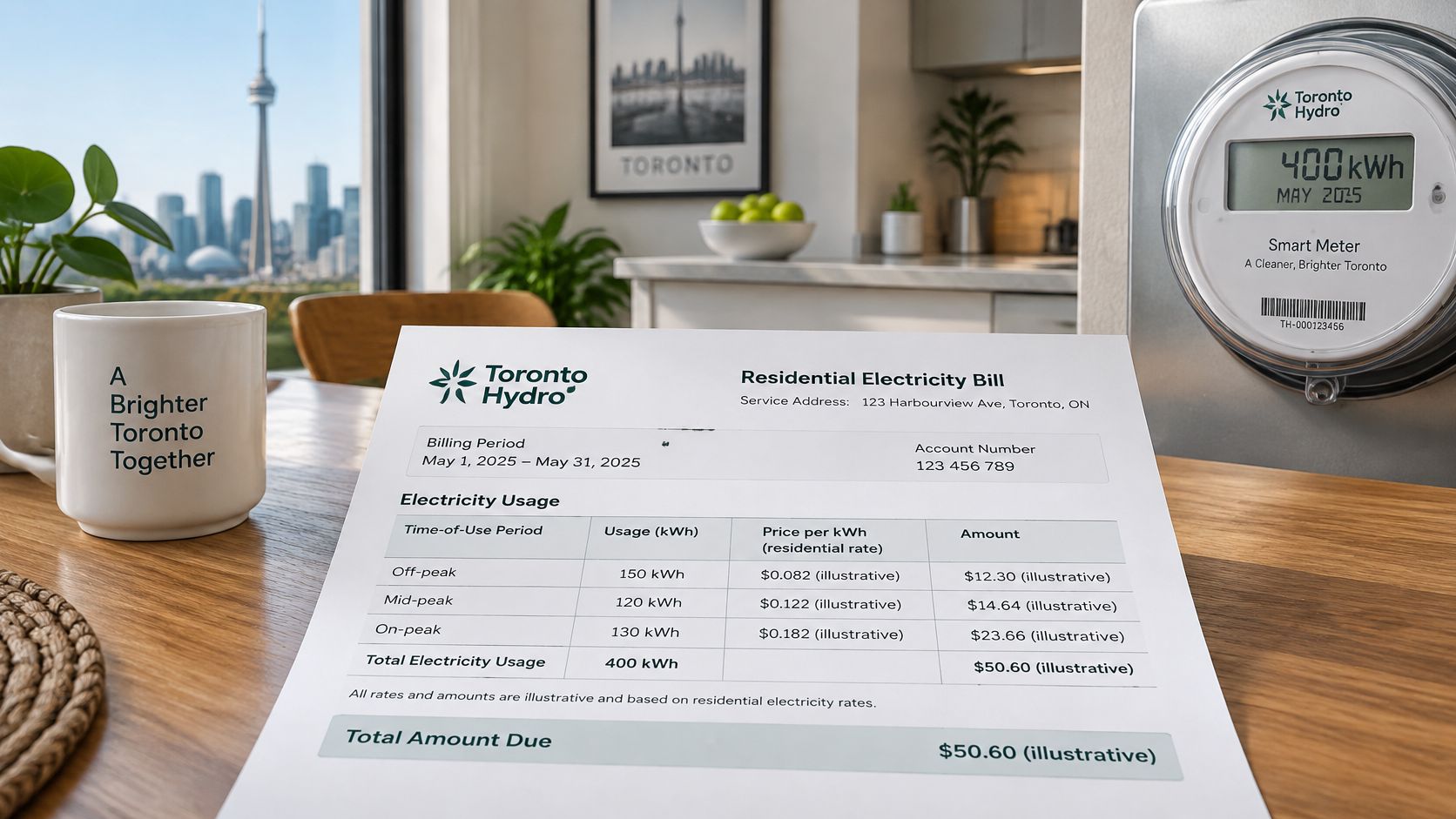
Consider a hypothetical monthly bill for a suite using 400 kWh. Every consumption quantity and calculated dollar amount in this example is illustrative, and the scenario assumes the residential time-of-use prices displayed above apply to the suite's billing period.
The resident's usage is split between 150 kWh off-peak, 120 kWh mid-peak and 130 kWh on-peak. The energy calculation is:
Illustrative usage period
Calculation
Illustrative energy charge
Off-peak
150 kWh × $0.098
$14.70
Mid-peak
120 kWh × $0.157
$18.84
On-peak
130 kWh × $0.203
$26.39
Energy subtotal
Sum of the energy charges
$59.93
That subtotal accounts for the example's energy consumption. It isn't the final bill.
A statement and a meter reading answer different questions about the account:
Add only supported billing layers
To complete the hypothetical bill, the resident would need the actual delivery and other regulated charges attributable to the suite, applicable taxes, any permitted building allocation and the separately identified provider fees. Those amounts aren't invented here because the building account and agreement would determine what needs checking.
The resident should also confirm that the consumption belongs to the correct meter and billing dates. Correct multiplication won't fix a meter-to-suite mapping error or an incorrect starting reading.
Useful calculation: Reconcile each component first. Don't use the invoice total as though it were an energy-only charge.
If the resident divides the eventual invoice total by the example's 400 kWh, the result blends utility-cost recovery with other charges. That figure alone can't show whether a provider marked up electricity or applied the wrong rate.
Build a similar calculation from your own statement. Use its consumption records, billing dates and applicable pricing arrangement, then add each remaining charge as a distinct line with an explanation.
How to Challenge a Sub-Metered Charge
A clear dispute identifies a particular charge and explains what appears wrong. The OEB's annual reporting on unit sub-meter providers describes consumer-protection changes requiring clearer communication and cautions that complaint figures don't independently establish customer satisfaction or regulatory compliance.
Don't use a complaint-rate comparison as proof that your invoice is incorrect. Build the case from your account records.
The challenge process starts with identifying the charge and collecting its supporting calculation:
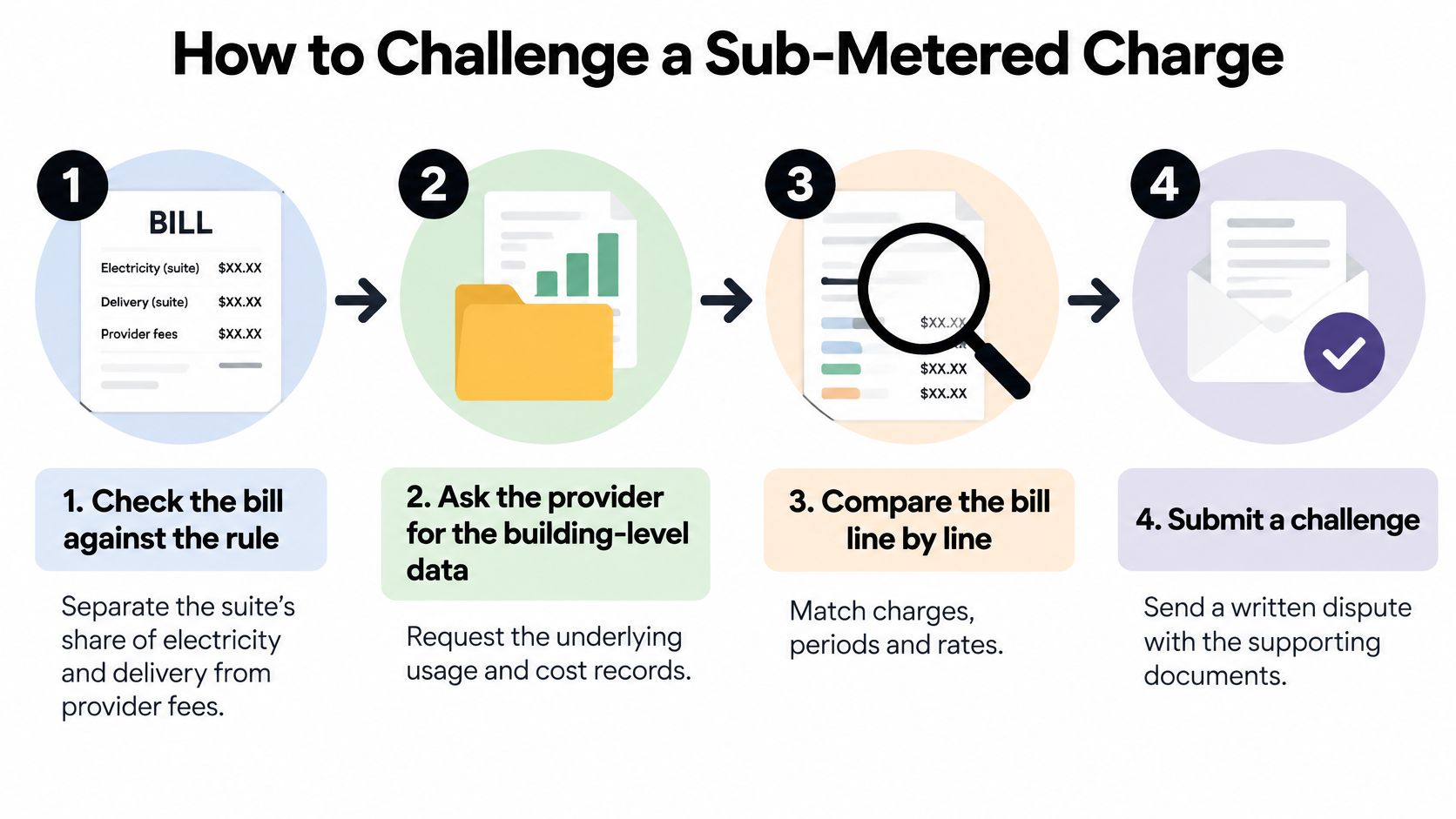
Follow the evidence in order
- Classify the disputed line. Identify whether it concerns consumption, electricity pricing, delivery-cost allocation or a provider fee. That determines whether you're raising a regulatory-compliance issue, a calculation error or a contractual disagreement.
- Request the calculation and relevant records. Ask for the billing period, meter readings, estimated-read status and the basis for the suite's allocation. Relevant building-level information should explain the calculation without requiring access to other residents' personal account details.
- Put the dispute in writing. Name the bill and line item, explain the discrepancy, attach supporting records and state the correction you're requesting. Keep dated copies of emails and notes from calls.
- Identify the appropriate remedy. Incorrect consumption needs a reading or account correction. An incorrectly applied fee needs comparison with the agreement, while dissatisfaction with a correctly applied non-regulated price may require negotiation.
- Address any disconnection notice promptly. Don't assume a dispute automatically suspends collection or disconnection. Ask which protections, notice requirements and restrictions apply, and discuss an arrears arrangement in writing. Under our terms, unpaid electricity or electricity-related charges may lead to disconnection, termination or limited delivery after lawful demand and notice, until paid in full.
- Escalate unresolved compliance concerns to the OEB. Identify the company as a licensed unit sub-meter provider, rather than treating it as a rate-regulated local distributor. Explain the conduct you believe conflicts with applicable requirements, not just that the total feels high.
Check deposits separately
Our Ontario electricity security-deposit policy is consistent with OEB requirements. Before paying a requested deposit, obtain its amount, reason and applicable OEB requirement in writing, then compare it with the Unit Sub-Metering Code.
Our guide to tenants' rights regarding electricity offers additional context for resident questions. Bring the bill, the meter data and the written dispute record when escalating.
Verify the Licence Before You Sign or Pay
A proposal should be understandable before residents receive their first invoice. Owners and condominium boards need enough documentation to evaluate both the metering arrangement and the account procedures, not merely a promise that billing will be handled.
Use this approval checklist:
- Verify the contracting entity. Confirm its current licence on the OEB register and match its legal name to the agreement.
- Confirm the jurisdiction and utility. Our Ontario licence concerns electricity submetering only; water, gas and work outside Ontario require separate jurisdictional review.
- Obtain the compliance file. Include licensing evidence, meter approvals and verification, installation records, commissioning results, dispute procedures and billing controls. Our guide to Measurement Canada-approved meters provides context for reviewing the equipment documentation.
- Inspect a sample bill. Require identifiable utility-cost lines and separately disclosed provider charges.
- Keep written account procedures. Obtain dispute, disconnection and arrears information before billing begins, and retain the responses with the agreement.
A licensed provider, an understandable bill split and written procedures are the baseline a building owner or condominium board should accept.
We provide Ontario electricity submetering through equipment, installation, commissioning, resident billing and ongoing maintenance under the applicable OEB framework. Visit Axis Meter Solutions to discuss your property's metering and billing requirements, or contact us at 226-702-5500 or info@axismeter.com to review the proposed scope before signing.
Ready to Optimize Your Utility Management?
Tell us about the property, utility, number of units, and your billing or monitoring goals. We'll help you identify the right next step.
Book a Call