Paddle Flow Meter Guide for Water and Wastewater
A shower is running, a toilet is filling, and your meter is counting confidently. Then the suite goes quiet, except for a toilet valve that never quite seals and a tap that drips through the night. If that small flow doesn't register, you've got a gap between what's happening in the pipe and what your records show. That gap is where paddle meter selection gets interesting, and it's where many well-intentioned installations start to mislead the people relying on them.
Table of Contents
- Why Paddle Flow Meter Choice Matters
- How a Paddle Flow Meter Works
- Core Parts and Measurement Factors
- Compare Paddle and Other Flow Sensors
- Water and Wastewater Applications
- Install and Commission the Meter Correctly
- Common Errors and Maintenance Priorities
- Build a Reliable Selection Checklist
Why Paddle Flow Meter Choice Matters
A property manager reviews a month of suite data and sees nothing unusual. Showers, laundry, and kitchen use all appear in the records. Yet the building's main meter tells a different story, and a ceiling stain two floors down suggests water has been moving somewhere it shouldn't. The suite meter wasn't broken. It just wasn't turning reliably at the weak, intermittent flow from a leaking fixture.
That's the central tension with a paddle flow meter. It's a practical, widely used way to measure water and water-based liquids, and it can produce useful data for allocation, monitoring, and operations. But it only converts movement into a reading when the fluid, the velocity, and the installation keep it in a condition where it can sense that movement. Choosing one by pipe size and a headline accuracy figure skips the questions that determine whether the data means anything.
What measured consumption can change
There's a strong reason owners pursue metering in the first place. In its national consultation, Measurement Canada cites a 2009 survey finding that Canadian households on volume-based pricing used 73% less water than households on unmetered flat rates, as set out in Measurement Canada's water meter consultation. That figure isn't a promise for any single device. It's evidence that measured consumption changes behaviour and gives operators something concrete to investigate when demand looks abnormal.
So the choice matters on two levels. Pick and install the right meter for the flow regime, and you get records you can act on. Pick it for peak demand alone, and you may record the obvious flows while missing the quiet ones that drive leaks, disputes, and unexplained common-area costs. Everything that follows, from sizing to commissioning, is about closing that gap.
How a Paddle Flow Meter Works
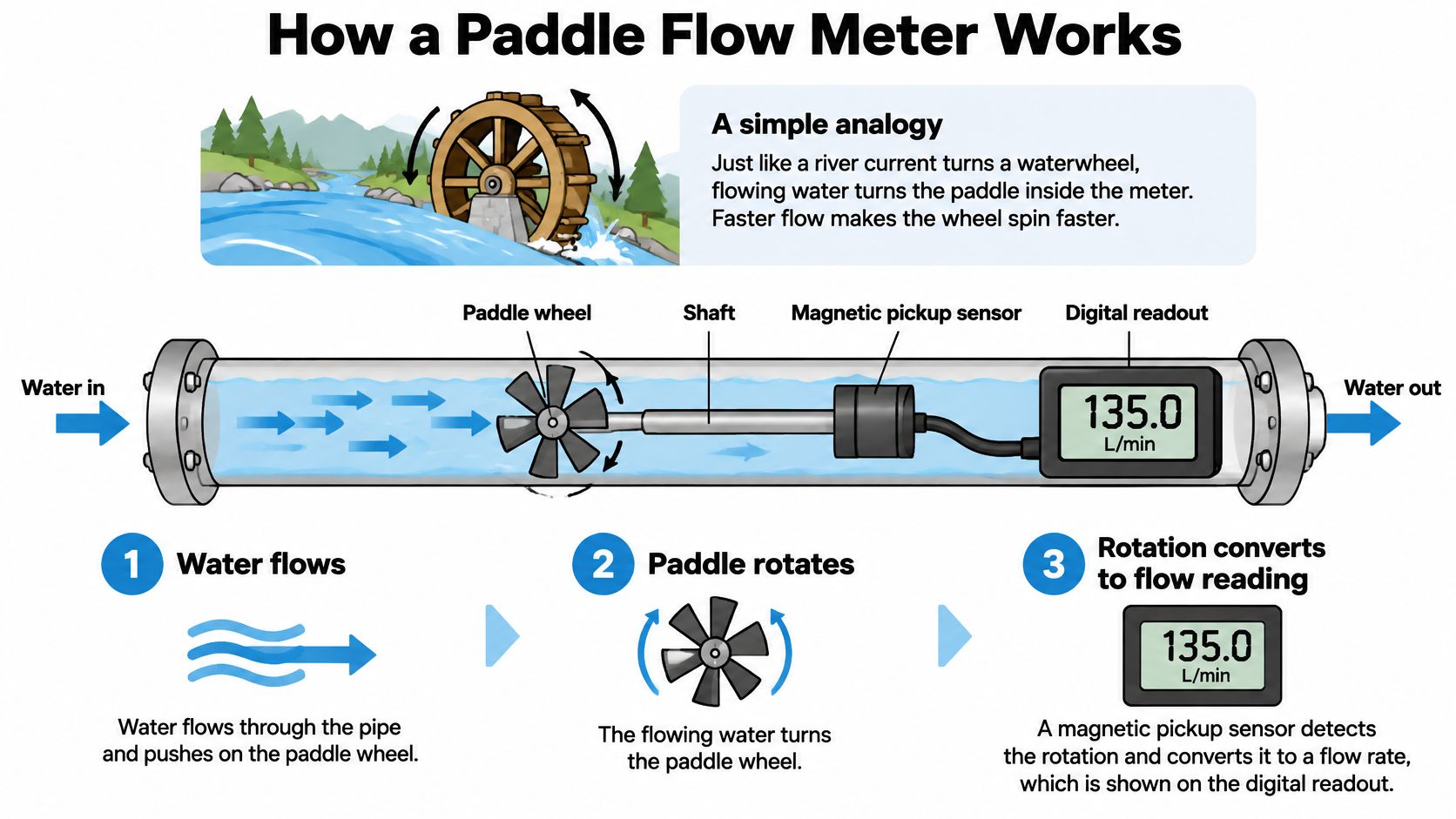
Start with a river and a waterwheel. A slow current turns the wheel slowly. A faster current turns it faster, and if you count the rotations over time, you can estimate how much water has passed. A paddle flow meter works on the same instinct, scaled down to fit inside a pipe.
From moving water to a number
Here's the sequence, step by step:
- Water moves through the pipe: The flow pushes against small blades on a rotor, often called the paddle wheel, that's positioned in the stream.
- The paddle rotates: It spins at a speed related to how fast the water is moving past it. Faster water, faster spin.
- A pickup senses the rotation: A magnetic or electronic pickup detects each pass of the blades without needing to touch the moving water itself.
- The instrument converts counts into flow: Electronics translate those pulses into a flow rate, meaning how fast water is moving right now, and a totalized volume, meaning how much has accumulated over time.
That distinction between rate and total trips people up. Flow rate is like the speedometer in your car. Totalized volume is like the odometer. Billing and allocation usually rest on the odometer reading, while spotting a running fixture at 3 a.m. rests on noticing that the speedometer never dropped to zero.
A paddle flow meter doesn't measure volume directly. It estimates flow from how quickly moving fluid turns a sensor in the stream, then adds those estimates up over time.
Why velocity is the key word
Because the paddle responds to the speed of water at one point in the pipe, it's a velocity instrument. It doesn't trap and count fixed pockets of water the way a positive-displacement meter does. That means the reading depends on the water moving in a reasonably orderly pattern, called a velocity profile, across the pipe. If the flow is swirling after an elbow or squeezing past a half-open valve, the paddle sees a distorted version of the stream, and the converted volume inherits that distortion. Keep that idea in mind, because it explains most of the installation rules you'll meet later.
Core Parts and Measurement Factors
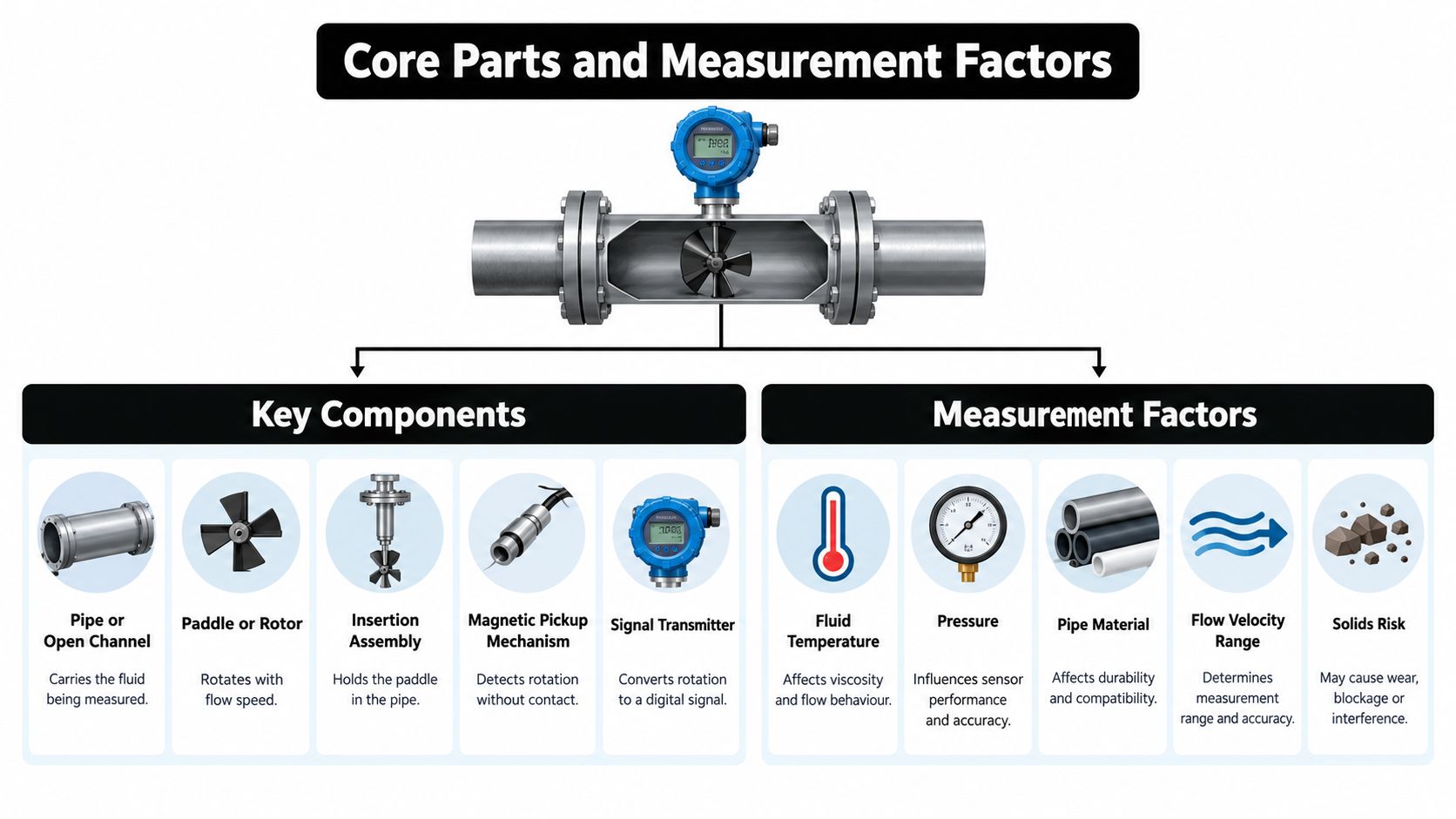
Once you know the meter infers flow from rotation, the parts make sense as a chain. Each link either preserves the quality of that inference or degrades it, and a weak link anywhere shows up in the final number.
The physical chain
- Pipe or channel: The conduit that shapes the flow before the sensor ever sees it.
- Paddle or rotor: The wetted moving part, spun by the fluid.
- Insertion assembly: The fitting or saddle that holds the sensor at the correct depth and alignment in the stream.
- Pickup mechanism: The magnetic or electronic sensor that detects blade passes.
- Transmitter and output: The electronics that turn pulses into a display reading, a pulse output, or another electronic signal your monitoring system can record.
Manufacturer guidance stresses insertion depth, pipe-centreline alignment, and correct flow direction as prerequisites for accuracy, as described in DwyerOmega's paddlewheel flow meter manual. A sensor sitting too shallow samples slower water near the pipe wall. One that's misaligned meets the flow at an angle it wasn't calibrated for. Neither error announces itself. The meter still produces numbers, just numbers with a built-in bias.
The conditions around the parts
The pipe also has to be full. A paddle in a half-full pipe may sit above the waterline or churn in air pockets, and trapped air can make rotation erratic. Before you commit to a location, it helps to calculate pipe flow rate for your expected conditions so you're comparing the meter's operating range against realistic velocities rather than guesses.
Design review should also capture the factors that never appear in a product photo. That includes fluid temperature, operating pressure, pipe material, expected minimum and maximum velocity, risk of suspended solids, the sensor's wetted materials, and the output protocol your data system expects. Documenting those items up front turns commissioning into a verification exercise instead of a troubleshooting session, and it gives you a record to check later when readings drift or a tenant questions a bill.
Compare Paddle and Other Flow Sensors
No sensor technology wins everywhere. Each one trades low-flow sensitivity, tolerance for dirty water, installation demands, and maintenance burden differently, so the honest question isn't which meter is best. It's which set of trade-offs matches your fluid and your purpose.
Flow Sensor Selection Criteria
Sensor type
Measurement principle
Low-flow consideration
Main installation concern
Typical selection priority
Paddle
Rotor speed reflects fluid velocity
Needs enough velocity to spin consistently
Straight runs, full pipe, correct insertion depth
Simple, economical monitoring of reasonably clean water
Magnetic
Voltage induced by conductive fluid moving through a magnetic field
No moving parts to stall at low velocity
Requires conductive fluid and proper grounding
Dirty or corrosive liquids, low pressure impact
Ultrasonic
Sound transit time or frequency shift in the flow
Depends on design and signal quality
Pipe condition, coupling, and profile effects
Non-intrusive or no-moving-parts measurement
Positive-displacement
Traps and counts fixed volumes
Generally strong at small, steady flows
Fouling and pressure drop across moving chambers
Accurate totalizing at low flow
Turbine
Freely spinning rotor in the flow path
Bearing drag affects the bottom of the range
Clean fluid and stable profile needed
Higher velocity, clean liquid service
Reading the trade-offs
A paddle flow meter earns its place where the water is reasonably clean, velocity stays within a comfortable band, and you want pulse or electronic output without a large pressure penalty. Its moving rotor is also its exposure. Suspended solids can foul or wear it, entrained air can disturb rotation, and very small flows may not turn it dependably at all. If your priority is catching a trickle, a technology built for low-flow totalizing may serve you better.
Magnetic and ultrasonic options remove the wetted moving part, which changes the maintenance conversation. You can explore how sound-based measurement handles these questions in this overview of ultrasonic flow meters and their operating principles. Turbine meters share the paddle's spinning-rotor logic but typically suit cleaner fluids and higher velocities, with bearings that need attention over time.
Selection rule: Match the sensing principle to the smallest flow you genuinely need to see, not just the largest flow you expect to survive.
Custody transfer and billing add another layer. Where measurements support charges, approval pathways and documented verification matter as much as the sensing principle, and a technology that's fine for trend monitoring may not be the right foundation for tenant invoices.
Water and Wastewater Applications
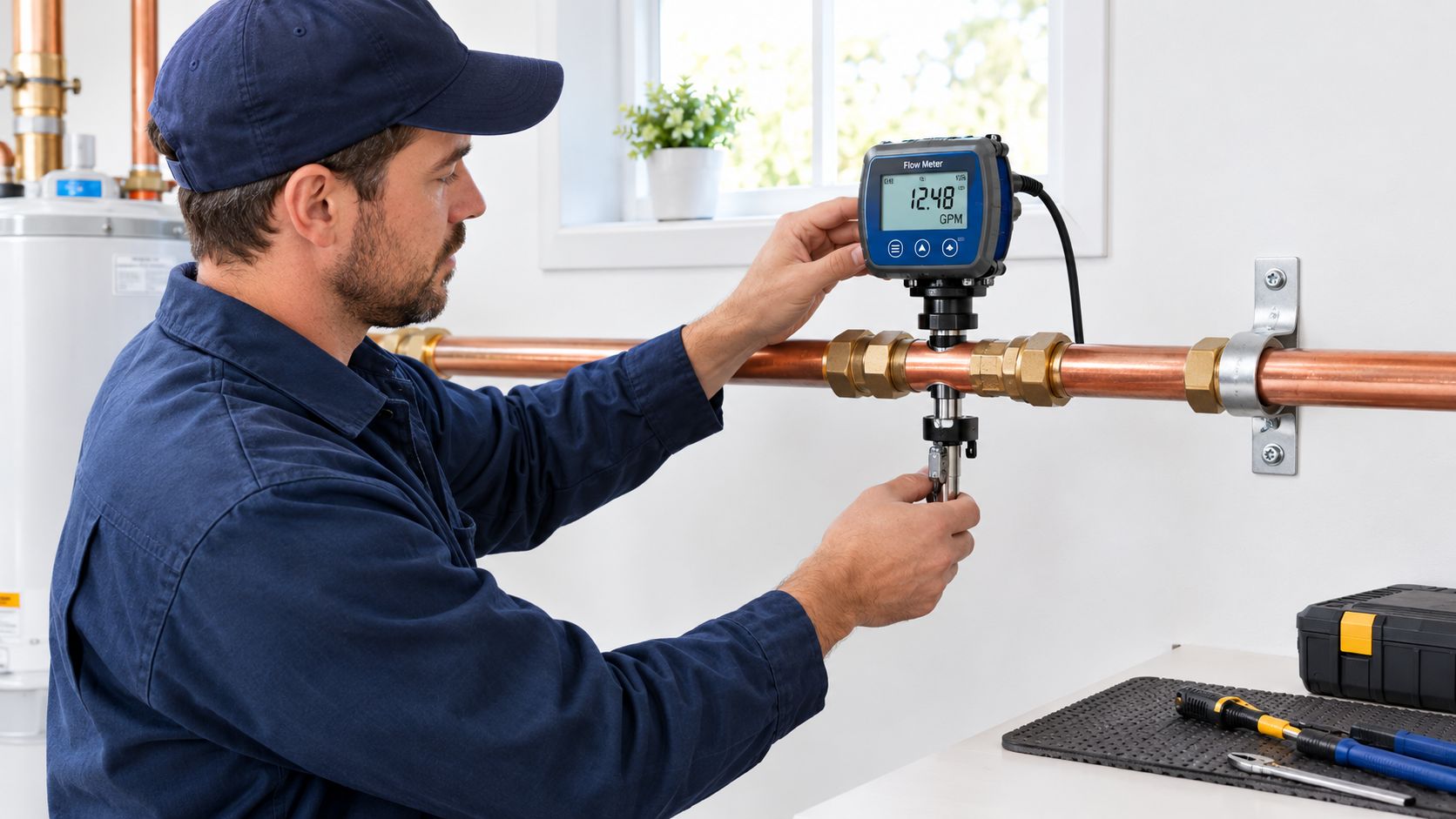
Application lists can make any meter sound universal, so it's more useful to picture specific lines in a building and ask what the water is doing there. The photo below shows the hands-on reality behind those decisions, a technician fitting and checking a meter on residential piping.
On a domestic-water branch line feeding a stack of suites, flow swings between morning peaks and near silence overnight. A paddle meter there can track aggregate demand well, but suite-level use in a vacant unit or a student residence during break periods may sit near the bottom of its reliable range. On a common-area feed for irrigation, a laundry room, or a cooling make-up line, flows are often steadier and larger, which suits a velocity sensor more comfortably.
Hydronic loops raise the temperature question. Published specifications vary a lot between models, and one Canadian-market listing describes a maximum operating pressure of 10 bar at up to 70°C with ±1% full-scale accuracy, while another reports 300 psig at 70°F with ±2% full-scale accuracy, as shown in Comeau's paddle wheel flow meter specifications. Those figures aren't interchangeable, and pressure capability generally falls as temperature rises, so a rating quoted at room temperature shouldn't be carried into a hot loop without checking the derating.
In wastewater process lines, solids and debris are the deciding factor. A rotor that performs well in clean water can foul where fibrous material or grit is present, and that's a setting where a non-intrusive or full-bore approach often makes more sense, a comparison explored further in this guide to how a magnetic flow meter measures conductive liquids. The short video below walks through paddle meter basics visually if you want to see the mechanism in motion.
For every application, four questions do most of the work. What's the fluid, and what's in it? What minimum and maximum velocities are credible? What action should a reading trigger? And if the smallest meaningful flow won't turn the paddle, which sensor would?
Install and Commission the Meter Correctly
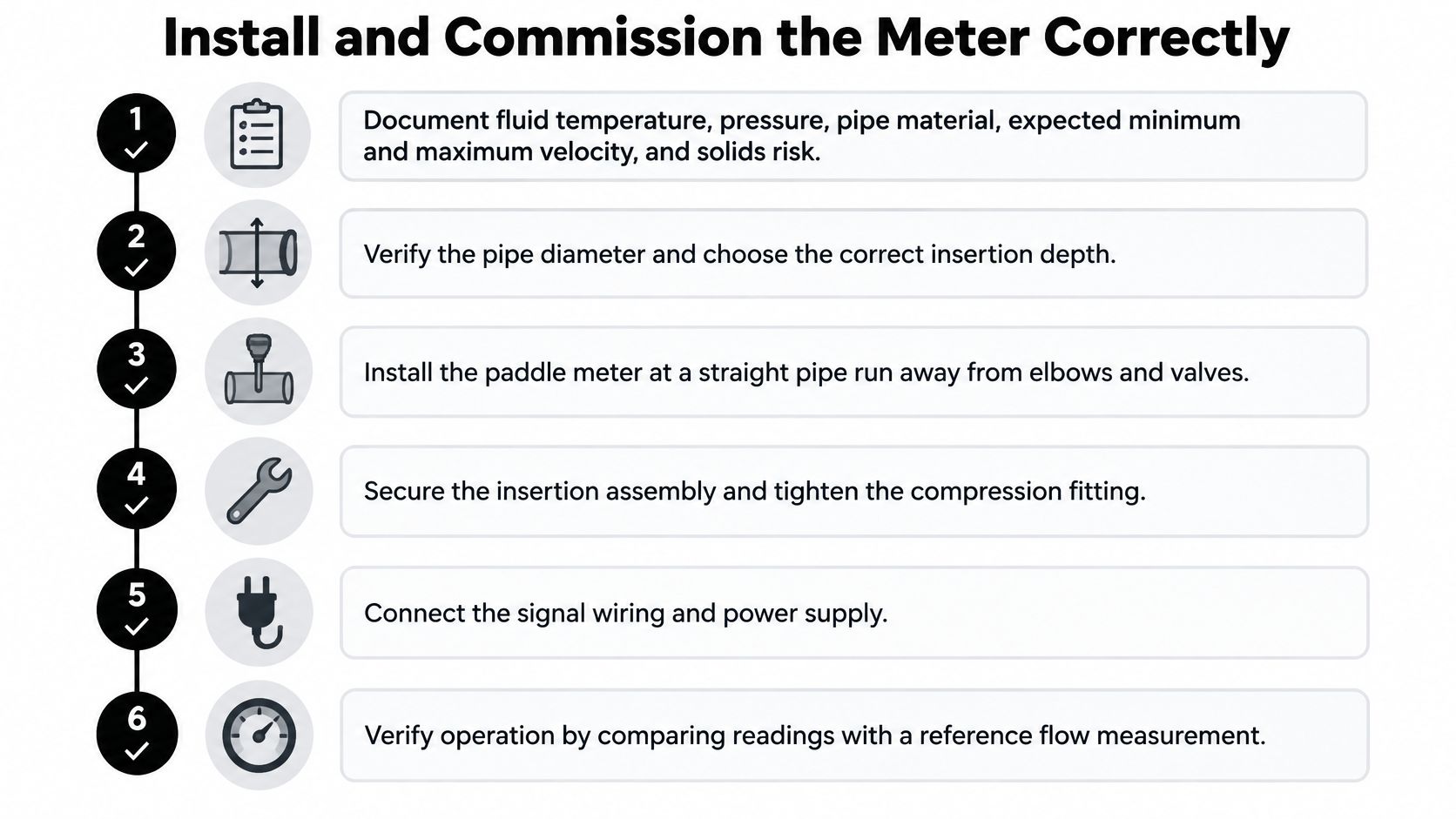
Good installations are mostly decided before anyone picks up a wrench. The sequence below moves from paperwork to pipework to proof, and skipping the early steps usually creates the late-stage surprises.
Before you buy anything
- Document the application: Record fluid temperature, pressure, pipe material, expected minimum and maximum velocity, solids risk, wetted materials, output protocol, and the physical space available.
- Confirm the hydraulics: Verify pipe size, confirm the pipe runs full at the sensor location, and check that normal flows sit comfortably inside the meter's calibrated range rather than at its edges.
- Survey the geometry: Walk the mechanical room and note pumps, elbows, tees, control valves, and isolation valves near candidate locations.
A Canadian-available technical manual specifies an operating velocity range of 0.3 to 33 ft/s (0.1 to 10 m/s), pipe sizes from 1/2 to 24 in (DN15 to DN600), and accuracy of ±0.5% of full scale under stated conditions, and its installation documentation recommends at least 10 pipe diameters of straight upstream run and 5 downstream, with 15 upstream diameters potentially needed near partially open valves, as detailed in Icon Process Controls' paddlewheel installation manual. Horizontal runs are generally preferred because they help low-flow behaviour and reduce trapped-air effects.
Installing and proving it works
Set the insertion depth and centreline alignment to the manufacturer's instruction, orient the sensor to the marked flow direction, and secure the fitting before connecting signal wiring and power. If your project also involves full-bore devices elsewhere in the building, this explanation of in-line water flow meter installation considerations covers how those placement decisions differ.
Commissioning is where assumptions meet water. Test at realistic normal flow, at peak demand, and at the lowest flow you expect to carry useful information, then compare against a reference measurement where practical. Record the zero reading with the line confirmed shut, and write down the minimum reliable flow you observed. That single documented number protects you later, because it defines the boundary below which a reading of zero means "below detection" rather than "nothing is leaking."
Common Errors and Maintenance Priorities
Several comfortable assumptions make a paddle flow meter look more dependable than it is. Naming them plainly is the fastest way to avoid building decisions on them.
Assumptions that don't hold
- Full-scale accuracy applies everywhere: It doesn't. An accuracy stated as a percentage of full scale represents a fixed band of uncertainty, so the percentage error on a small reading is much larger than on a reading near the top of the range. A meter that looks precise on paper can be quite uncertain at fixture-level flows.
- A pressure rating transfers to hot water: Pressure capability drops as temperature climbs, and published ratings differ widely between models. Always confirm the rating at your actual operating temperature.
- Any straight-ish spot will do: A sensor placed just downstream of a pump, elbow, or partially closed valve sees a distorted profile, and the output carries that distortion along without flagging it.
- Zero means no flow: Near the bottom of the range, the paddle may stall or turn inconsistently. Zero can mean the flow is too weak to register.
Keeping the measurement honest
The rotor is a moving part in moving water, so fouling and wear are maintenance realities, especially where scale, sediment, or biological growth can coat surfaces or where pipe deposits narrow the bore over time. Set an inspection and verification cadence based on the service environment rather than the calendar alone. Clean water in a treated loop asks less of you than an untreated line with debris risk.
A meter that records volume is not the same thing as leak protection. Protection requires interval data, alarm thresholds, someone accountable for responding, and often point leak sensors where water would actually appear.
That last distinction matters in high-rise and mixed-use buildings, where overnight baseline flow is a more useful leak signal than a monthly total reviewed weeks later. If leak intelligence is the goal, define sustained-flow and overnight rules during commissioning, test that alarms reach a person, and pair the meter with point detection in high-risk locations. Periodic verification then confirms the meter still measures what you think it measures.
Build a Reliable Selection Checklist
A checklist works best when it separates what the manufacturer guarantees from what your site has to prove. Run through these items before approval, purchase, or any decision to rely on readings for billing.
Confirm before you commit
- Flow regime: What's the realistic minimum, normal, and peak velocity, and does normal use sit well above the meter's lower limit?
- Low-flow information need: What's the smallest flow that would change a decision, such as a leak investigation or a vacant-suite check?
- Fluid quality: Are solids, scale, or air entrainment likely, and are the wetted materials compatible?
- Pressure and temperature: Have you confirmed ratings at operating temperature, not just at ambient conditions?
- Installation geometry: Is there enough straight run, a full pipe, and access for future service?
- Output and data: Does the signal type, power supply, and data retention match how you'll review and act on readings?
- Approval pathway: Does the intended use, especially billing, require jurisdictionally appropriate approval, testing, or documentation?
That last item has real history behind it. Canada's Water Trade Sector Review notes that the former Water Meter Inspection Act required inspection every 6 years with an accuracy tolerance of ±3%, and that any test standard used to certify devices must itself be calibrated and certified by Measurement Canada, as recorded in the federal Water Trade Sector Review. Frameworks have changed since then, but the lesson hasn't. Traceable testing is what makes a reading defensible.
Treat a paddle flow meter as one tool inside a broader water-management system. Selected for the flows you need to see, installed where the water behaves, and verified against a documented standard, it earns its keep. Where very low flow, dirty water, or formal billing accuracy dominates, pair it with, or choose instead, a technology and verification regime built for that job, plus dedicated leak and flood detection where damage risk justifies it.
If you're weighing paddle meters against other technologies for suite, common-area, or thermal metering, Axis Meter Solutions can help you match the sensor to your building's flow regime, handle installation and commissioning, and set up billing and leak detection around the data. Visit Axis Meter Solutions to discuss a turnkey submetering program for your property, with equipment, verification, and ongoing service organised under one agreement.
Ready to Optimize Your Utility Management?
Tell us about the property, utility, number of units, and your billing or monitoring goals. We'll help you identify the right next step.
Book a Call