Smart Metering Solutions Explained for Property Owners

Your building's utility bill has climbed, residents want to know how charges are divided, and the board is reviewing proposals for new meters. The proposals look similar until you reach the service fees, billing responsibilities and contract terms. Then it becomes clear that you're not just buying equipment.
Smart metering solutions are also billing, governance and privacy decisions. The right arrangement should explain where consumption occurs, produce defensible invoices and give staff a workable response to problems. It shouldn't leave residents guessing about charges or owners locked into responsibilities they didn't understand.
Table of Contents
- What Smart Metering Solutions Are and How They Work
- Benefits for Owners and the Limits of Metering
- Approvals and Equipment Rules by Jurisdiction
- Cost Models and Return Compared
- Vendor Selection and Written Scope Before Signing
- Rolling Out Metering in a 40-Unit Building
What Smart Metering Solutions Are and How They Work
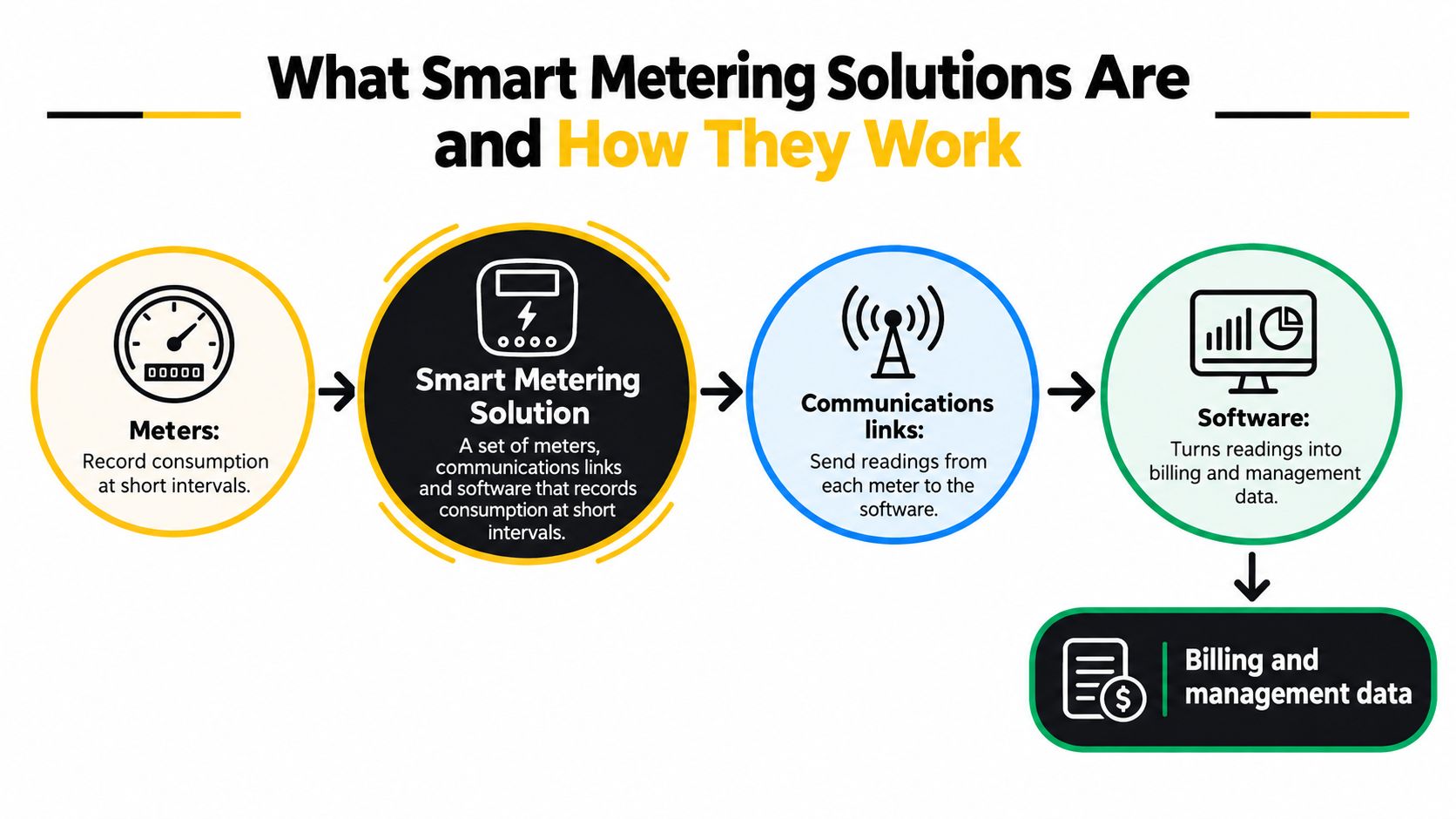
A smart metering solution combines meters, communications links and software that record consumption at short intervals and turn it into billing and management data, without a reader visiting each suite. It can measure electricity, water, gas or thermal energy, provided the equipment suits the service and the proposed use.
A traditional meter works like an odometer checked once in a while: it tells you how much was used between readings. A smart meter works more like a trip log, showing when consumption happened. That timing is what lets staff distinguish a normal pattern from an unusual overnight load or persistent water flow.
From consumption to a usable record
The chain starts at the interval meter, which records consumption in fixed time blocks. A communications link carries those records to a platform, where software checks for missing readings, unexpected values and communication failures. Only after those checks should consumption become a billing quantity.
From there, the platform serves different audiences. Residents need understandable invoices and access to their own usage. Managers need exception reports, common-area summaries and alerts that name a responsible recipient, since an alert with no owner is easy for everyone to assume someone else is handling.
The diagram shows how these parts connect.
Ontario's electricity system has run on smart meters for well over a decade. For owners, that history has a practical implication: the question is no longer whether the technology works, but how a given arrangement assigns billing responsibility and controls access to unit-level data.
Components of a smart metering solution
A useful proposal identifies each component separately. The examples below describe functions worth specifying, and coverage differs from one system to another.
Component
What it does
Example
Interval meter
Records consumption in fixed time blocks, such as hourly intervals
Electricity meter on the building's principal supply
Communications link
Moves readings to a server without a site visit
Wireless or wired link to a central platform
Validation and editing
Checks readings and fills gaps before billing
A missing interval is estimated and the estimate is logged
Billing and reporting
Turns validated usage into invoices and owner reports
Monthly invoice per suite plus a common-area summary
Alerts
Flags abnormal flow or load, subject to reporting frequency
Persistent water flow in an unoccupied suite triggers an investigation
One distinction hides inside the word "meter." A utility smart meter measures consumption for the utility's account. A private submeter measures a downstream portion of that supply, such as an individual suite, for the building's own allocation or tenant-billing arrangement. Both get called smart meters, yet they sit in different account relationships, and confusing them is how owners end up expecting utility-grade billing from equipment that only reports internal usage.
The granularity that makes this data useful also makes it sensitive. Interval records are detailed enough to show when a suite is occupied and how its residents live day to day, so a sound proposal states who may view unit-level data and for what purpose. Treating metering as a billing and privacy arrangement from the start is far easier than fixing access rules after residents start asking questions.
Benefits for Owners and the Limits of Metering
More accurate allocation isn't the same as lower consumption. Owners should assess cost recovery, maintenance response, billing quality and regulatory administration separately, rather than accepting a single promise of savings.
Where owners can gain control
Cost recovery starts with a clear boundary between resident consumption and shared services. Where an owner pays the bulk utility bill, lawful unit-level billing can transfer eligible consumption charges to the users responsible for them. Corridor lighting, irrigation and other common services still need an explicit allocation.
Leak detection supports a different objective. In an illustrative apartment-building scenario, a running toilet might continue until a resident reports it or staff notice an unusual bill. A system configured to identify persistent flow can prompt an earlier inspection, but someone must investigate and arrange the repair.
Tenant billing becomes easier to explain when invoices show measured consumption rather than an unexplained allocation. Compliance administration also becomes more manageable when the agreement names who maintains the equipment records, resolves reading exceptions and answers resident complaints. Outsourcing those tasks doesn't mean the board should stop overseeing them.
For an operational comparison, Resolut's guide can help owners compare utility billing automation vendors, particularly around invoicing workflows and administrative responsibilities.
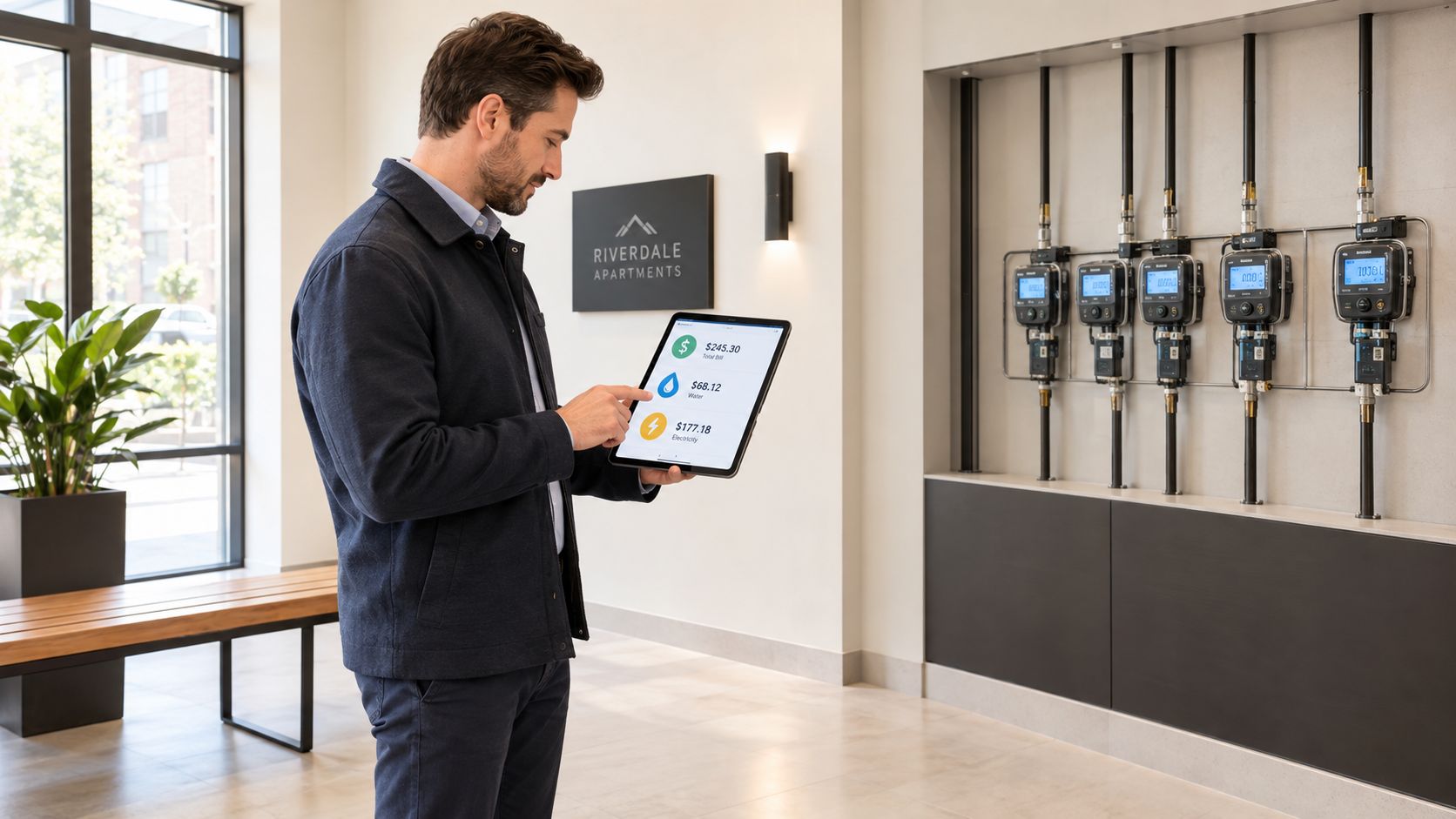
Consumption visibility is useful when managers can act on what they see.
Where measurement stops helping
Residents may have little control over insulation, central heating or owner-supplied appliances. Charging them more precisely won't repair a draughty window or make an inefficient refrigerator use less electricity.
Ontario's Energy Affordability Program notice describes potential electricity-cost reductions of approximately $100 to $750 annually for eligible households through personalised measures. That's a useful distinction: practical improvements can reduce consumption; a meter records the result.
Practical rule: Judge cost recovery, conservation and resident affordability as separate outcomes.
Require safeguards alongside the billing arrangement:
- Separate owner-controlled loads. Don't assign shared equipment to a suite merely because its wiring or piping makes that convenient.
- Correct faulty readings. Give residents a clear route to challenge estimates and request an adjustment.
- Explain the bill. Identify consumption, rates, service fees and adjustments in plain language.
- Review hardship. Consider residents with medical equipment, seniors, students and households that can't readily change their usage.
A sound programme pairs measurement with repairs, accessible support and fair allocation rules.
Approvals and Equipment Rules by Jurisdiction
Requirement
Ontario
Rest of Canada
United States
Provider licence
OEB unit sub-meter provider licence for regulated electricity submetering
Provincial or territorial licensing for the utility type and service being provided
State public utility commission rules on submetering and the resale of utility service
Meter approval
Equipment meeting applicable Measurement Canada requirements
Measurement Canada approval and verification for meters used in trade
State weights-and-measures requirements, plus acceptance by the serving utility
Interval data at principal meter
Required before electricity submetering services begin
Provincial and utility requirements for the incoming supply meter
The serving utility's tariff and metering requirements
Billing data validation
Validating, estimating and editing process required
The applicable provincial billing code or utility rules on estimates and corrections
State rules on billing, estimation and resident disclosure
Electrical work and permits
Licensed electrical contractor and local permit requirements
Provincial trade qualifications and local permits
Contractor licensing and local permit requirements
Approval and equipment requirements by jurisdiction work as a design checklist, and each row answers a different question. Electricity, water, gas and thermal billing may follow different rules even within the same building. A board approving a metering project is also deciding who may bill residents and who holds their consumption data, so this table belongs in the governance discussion alongside the hardware specification.
Ontario's electricity requirements
The Ontario Energy Board's Unit Sub-Metering Code requires a licensed provider to ensure the principal consumer has an interval meter before submetering services begin, requires validating, estimating and editing, and requires compliance with applicable Measurement Canada standards.
The principal meter measures the building's incoming electricity supply. Its interval record preserves the timing of that consumption, which lets the provider compare incoming supply with downstream suite and common-area records. A cumulative total alone can show that a discrepancy exists. It cannot show when it occurred.
Validating, estimating and editing, often shortened to VEE, is the controlled process for checking readings and handling exceptions. Ask for the rules governing missing data, abnormal values and corrections. The provider should retain the original record, the substituted value and an explanation of the change, because every edit eventually shapes what a resident is charged.
Equipment approval needs more precision than a statement that a meter is suitable for billing. Request the model, approval documentation, applicable verification status and installation requirements. This guide to Measurement Canada-approved meters provides context for reviewing those documents.
Confirm the rules before design approval
For a property outside Ontario, ask the relevant regulator, utility and permitting authority to confirm the proposed arrangement. Approval of the hardware does not by itself authorise tenant billing.
Use this sequence before authorising procurement:
- Confirm provider authority. Check the licence or authorisation needed for the jurisdiction, utility type and activity.
- Confirm the principal meter. Establish whether the incoming supply meter supports the intended arrangement.
- Confirm equipment suitability. Document the approvals, accuracy requirements and installation conditions.
- Confirm the billing method. Check allocation, estimation, fee and resident-disclosure requirements.
- Validate the complete design. Have the provider and responsible trades resolve compliance questions before work begins.
An approved meter can still be part of an unsuitable billing arrangement. Review the equipment, installation and customer agreement together.
Keep the resulting approvals in the building's records, including who is licensed to bill residents and under what conditions. A future manager should be able to understand the basis of the system without reconstructing decisions from old emails.
Cost Models and Return Compared
Model
Upfront cost to owner
Who owns and maintains
How cost is recovered
Main risk
Owner-purchased meters
Full equipment and installation cost
Owner, with maintenance assigned internally or by service contract
Owner funds the system and recovers eligible charges where permitted
Owner carries replacement and billing workload
Financed or leased equipment
Reduced initial payment, followed by contractual payments
Lessor or owner, with maintenance allocated by contract
Payments over the financing or lease term
Total expenditure can exceed outright purchase
Provider-owned, no upfront capital
No initial equipment purchase under the proposed model
Provider, subject to the agreement
Tenant billing and agreed service fees
Fee escalators, renewal provisions and exit rules
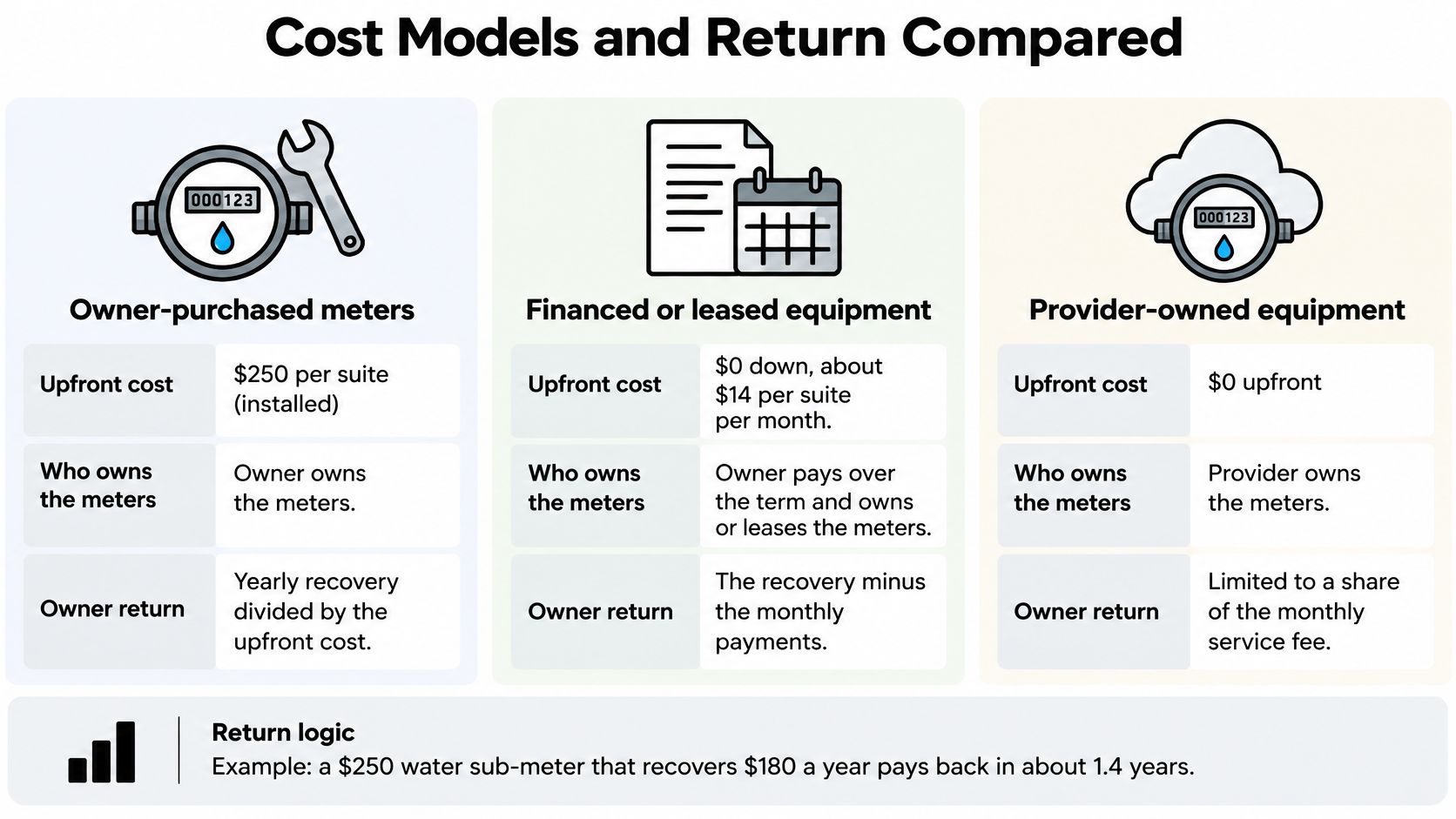
Funding models compared should include more than the purchase price. The owner needs to know who carries equipment failure, communications charges, billing work and resident support over the full agreement.
Calculate net recovery, not gross billing
For an owner-funded system, use:
Simple payback = upfront project cost ÷ annual net recovery
Annual net recovery means eligible utility charges collected, less meter operating costs, maintenance, billing administration and unpaid accounts. Keep genuine common-area consumption savings separate so the board can see whether the return depends on resident payments, building improvements or both.
An illustrative water-metering scenario makes the distinction clearer without assuming a market price. Suppose the building begins recovering suite consumption from residents, but also takes on platform fees, maintenance and collections work. The amount invoiced isn't the owner's return; the amount left after those expenses is the relevant figure.
If annual net recovery is negligible or negative, the system doesn't produce a useful simple payback. It might still support better allocation or leak investigation, but the board should describe those objectives plainly rather than presenting them as investment returns.
For a provider-owned arrangement, compare the expected recovery and operational benefit with all agreed charges over the contract term. No upfront capital doesn't mean no cost, and equipment ownership doesn't automatically tell you who receives each category of utility payment.
Read the commercial terms behind the model
The comparison graphic below illustrates ownership structures. Any prices or payback examples displayed within it should be treated as illustrative, not as a quotation or market benchmark.
Ask bidders to produce a cash-flow schedule that separates the following:
- Installation and commissioning. Include access work, electrical or plumbing changes and restoration.
- Recurring charges. Identify platform, communications, billing and account-management fees.
- Replacement obligations. State who pays when equipment fails or requires renewal.
- Contract changes. Show fee escalation, termination payments, transfer conditions and renewal provisions.
Then test a less favourable scenario. What happens if collections fall short, a communications gateway needs replacement or the property changes hands? A proposal that works only under optimistic assumptions deserves closer review.
For owners assessing the operating statement, this explanation of net operating income and property performance provides a useful accounting context. Keep capital expenditure, operating expenses and resident pass-throughs distinct, and have the property's accountant review their treatment.
Choose the funding model that allocates responsibilities acceptably, not merely the one with the smallest initial payment.
Vendor Selection and Written Scope Before Signing
The lowest monthly fee can be misleading when it excludes replacement meters, billing administration, communications or exit costs. Ask every bidder to price the same scope over the proposed term, with exclusions listed beside the headline fee.
A technically competent supplier should also explain how the service behaves when something goes wrong. Missing readings, disputed charges, failed sensors and changes in building management are ordinary operating situations, not unusual exceptions.
Vendor selection criteria
Criterion
Question to ask
Red flag
Licensing
Which provincial or state authorisation covers this activity?
No verifiable authorisation, or a licence covering a different activity
Equipment approval
What approval and verification documents apply to the proposed meters?
Generic product sheets without relevant approval records
Upfront cost and term
Who owns the equipment, and what obligations continue through the term?
Undisclosed charges or renewal without a clear exit route
Leak detection
Are sensors included, what do they detect, and how are alerts delivered?
An assumed inclusion appears later as a paid add-on
Billing and disputes
Who validates readings and resolves resident complaints?
No audit trail for estimates or corrections
Data privacy
Who accesses interval data, how long is it retained, and how is it deleted?
General security assurances without an operating policy
Insurance and contracts
What insurance, bonding and written agreements support the work?
Verbal commitments or unexplained coverage exclusions
Installation disruption
What access is needed, and who manages appointments and restoration?
Open-ended access requirements without a work plan
A paid leak-detection option isn't automatically unsuitable. The problem is comparing an inclusive proposal with a stripped-down proposal as though they offer the same service.
Treat resident data as an operating responsibility
Ontario's IESO Smart Metering Entity data-sharing framework describes privacy controls for central smart-meter data, including removing household identifiers, excluding uniquely identifiable locations and releasing aggregated information subject to minimum-group thresholds. Those protections shouldn't be assumed to apply automatically to a privately operated suite-level platform.
A suite's electricity or water pattern may suggest when occupants are home, even if the record doesn't include a name. An owner report therefore shouldn't expose detailed resident activity merely because the software makes that view available.
Ask for a demonstration using separate staff roles. Can a maintenance employee acknowledge a leak alert without opening a resident's billing history? Can board members review building performance through aggregated reports rather than browsing individual suites?
The written privacy schedule should address:
- Access permissions. Identify authorised roles and how access is removed when staff leave.
- Retention and move-out. Define retention periods, account separation and deletion or de-identification procedures, while preserving records that must lawfully be retained.
- Resident notice. Explain what is collected, why it is needed and who receives it.
- Secondary use. Restrict unrelated analytics, marketing and onward disclosure.
- Incident response. Name the party responsible for investigation, notification and corrective action.
- Data portability. Establish how the owner obtains usable records when the service ends.
Contract test: If a privacy promise matters to the board, it belongs in the agreement, not only in the sales presentation.
Require a complete written scope
Ask each provider to attach a meter schedule showing suite and common-area locations, the proposed equipment and responsibility for each connection. Include named approvals, equipment ownership, maintenance obligations, fee schedules, escalation provisions and an exit clause.
The same package should contain the data-handling policy, resident-support process, leak-sensor inclusion and site-access plan. Insurance and bonding documents should match the contracting entity, while any subcontracted work should have a clearly identified responsible party.
Good answers are specific and verifiable: a licence that matches the activity, included sensors identified by function, documented replacement obligations and written customer agreements. Don't accept a provider's reputation as a substitute for those records.
Give shortlisted bidders the same utility history, occupancy information and site constraints. Ask them to mark assumptions explicitly, so the board can distinguish a firm commitment from an item that still needs a site survey.
Rolling Out Metering in a 40-Unit Building
Consider an illustrative Ontario building with forty suites whose board wants water and electricity submetering. The superintendent knows where the main services enter, but the drawings don't clearly identify every common-area branch. Before booking installation, the project team must resolve those boundaries and confirm the proposed billing arrangement.
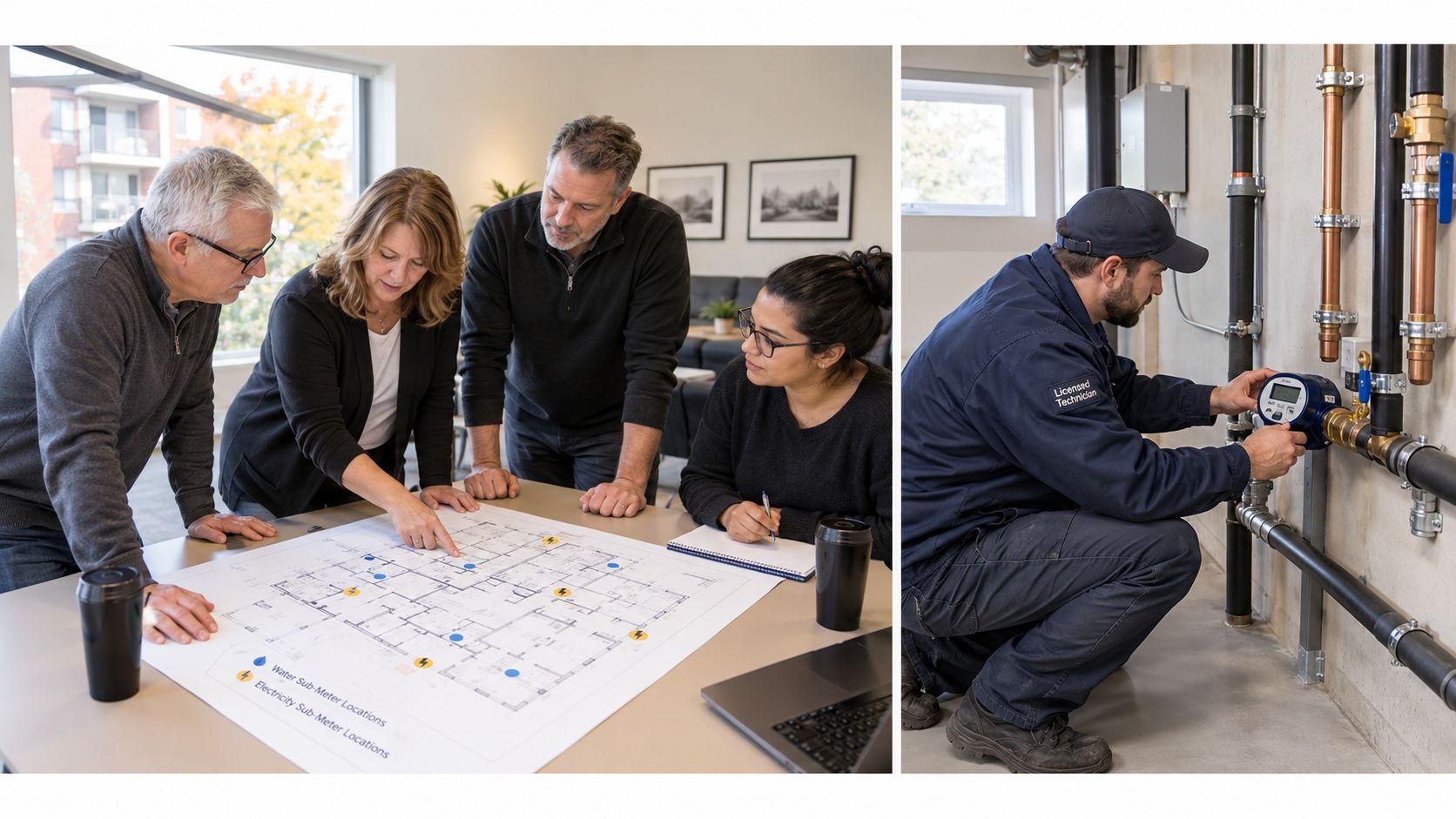
Installation succeeds when the site plan and the resident plan are coordinated.
A practical implementation sequence
The sequence below is a planning example, not a guaranteed programme. Equipment availability, required alterations, inspections and resident access should determine the actual schedule.
- Confirm scope and jurisdiction. Walk the building with the provider and responsible trades. Identify suites, shared services, principal meters and branches that need further investigation.
- Approve the agreement and order equipment. Resolve outstanding commercial and design questions before procurement. Record which changes would require a revised price or schedule.
- Organise site access. Property staff should coordinate resident appointments, shutoffs, keys, accessibility needs and restoration. Access Management Group's construction planning guide provides useful context for organising occupied-property work.
- Install and identify the equipment. Trades should label each meter and record its physical location, serial number and assigned suite or common area. Mount sensors where their intended detection function can be tested.
- Commission the complete data path. Confirm that the platform receives the correct meter channels and that displayed units match the measured service. Investigate unexplained differences before approving live billing.
- Prepare residents and verify account setup. Send notices before charges begin, check move-in information and review sample invoices. Residents need a named contact for questions.
- Hand over ongoing responsibilities. Assign alert response, fault investigation, maintenance and replacement duties. Include these tasks in the property's operating procedures rather than relying on installation staff to remain available.
For procurement discussions, review the proposed utility metering installation and maintenance scope alongside the site-specific work plan.
The video provides another visual reference for the implementation discussion.
Prevent avoidable launch disputes
A missing common-area measurement point can leave staff unable to explain the difference between incoming supply and allocated consumption. Resolve that gap during commissioning, not after residents challenge their bills.
Late resident notices create a separate problem: people receive an unfamiliar charge before they understand the arrangement. Approve the communication package and billing start conditions as formal handover items.
The project is ready when the equipment works, the accounts match the building and the responsible people can explain the service. A live dashboard alone isn't completion.
Axis Meter Solutions offers turnkey utility submetering, including installation, commissioning, tenant billing and ongoing maintenance, as one option for owners evaluating a full-service arrangement. Visit Axis Meter Solutions with your unit count, recent utility bills and property jurisdiction to request a site-specific scope, then put the same commercial, compliance and privacy questions to every bidder.
Ready to Optimize Your Utility Management?
Tell us about the property, utility, number of units, and your billing or monitoring goals. We'll help you identify the right next step.
Book a Call