Water Flow Sensors for Submetering: A Practical Guide

A property manager takes over a 240-unit garden-style community and finds a failing meter stack, unreliable readings, and residents questioning their bills. The replacement quote offers a low-cost ultrasonic retrofit alongside a much more invasive electromagnetic rebuild. The cheaper option looks attractive until the team checks low-flow fixture performance, pipe access, communications, and leak monitoring.
That decision is typical. Water flow sensors aren't interchangeable hardware. The right choice depends on pipe material, available straight run, water quality, billing requirements, maintenance access, and whether the owner needs simple consumption data or a dependable leak-detection layer.
Sensor type
Best starting application
Main advantage
Main limitation
Turbine
Bulk domestic water metering
Familiar, economical inline design
Needs a clean flow profile and moving parts require attention
Clamp-on ultrasonic
Occupied-building retrofits
Installs without cutting the pipe
Performance depends on pipe condition, mounting, and signal quality
Electromagnetic
Large mains and conductive water
Strong repeatability with no internal rotor
Requires pipe interruption and conductive liquid
Paddle-wheel
Simple monitoring points
Low purchase cost and straightforward output
Weak choice for very low or unstable flow
Thermal mass
Specialized low-flow monitoring
Sensitive to small flow changes
Requires the probe to remain wetted and suits fewer water applications
The rest of the specification should answer four questions: How accurate must the reading be? Which technology fits the existing pipe? Can the meter communicate with the billing platform? Does the system need to identify abnormal consumption and shut off water?
Table of Contents
- Why the Right Water Flow Sensors Change a Submetering Project
- The Five Sensor Technologies and How They Actually Measure Flow
- Comparing Water Flow Sensors Across the Criteria That Matter
- Matching Sensor Choice to Multi-Family and Commercial Buildings
- Cost, Calibration, and the Real ROI of Leak Detection
- Installation, Commissioning, and Ongoing Verification
- Recommendations and a Decision Checklist for Property Owners
Why the Right Water Flow Sensors Change a Submetering Project
Owners often treat the meter as a line item. That approach creates avoidable problems because the equipment cost is only one part of the project. A meter that reads well at the bulk entrance may perform poorly on a suite branch where a toilet valve or faucet creates intermittent, low-volume demand.
Start with the billing purpose. If the reading supports tenant charges, the owner needs a documented measurement chain, stable communications, clear commissioning records, and a defined verification process. If the meter supports only operational awareness, the acceptable trade-off may favour a faster retrofit and broader coverage over laboratory-level accuracy.
Four questions to resolve before selecting a meter
- What flow range matters?
A sensor must capture both ordinary fixture use and the small, continuous flows that often indicate a running toilet or a concealed leak. A technology that looks accurate at design flow can still miss the events that matter most to a property manager. - What does the pipe allow?
Copper, steel, PVC, CPVC, and composite piping affect mounting, signal transmission, fittings, and access. Pipe orientation, insulation, valves, elbows, and available straight run can eliminate an otherwise suitable product. - Where does the data go?
Confirm pulse, wired, wireless, AMR, AMI, BACnet, Modbus, or gateway requirements before ordering hardware. A meter that can't deliver usable interval data to the billing or building-management platform isn't a complete submetering solution. - Is leak detection part of the brief?
A meter records flow. A leak system interprets flow against time, occupancy, suite patterns, and shutoff rules. Canadian building-focused guidance increasingly favours combining inline monitoring with point sensors and automatic shutoff in suites, risers, and mechanical rooms, as described in Alert Labs' water monitoring FAQ.
Practical rule: Specify the measurement task first, then choose the sensor. Never choose a sensor solely because its catalogue accuracy looks impressive.
Canada already has a substantial measurement foundation. The Water Survey of Canada reported 2,937 hydrometric stations in its 2023–2024 national network, with 2,274 operated by Environment and Climate Change Canada, and acoustic Doppler velocimeters represented more than 60% of discharge measurements during that period (Water Survey of Canada). That context matters for owners because flow sensing is established infrastructure, not an experimental add-on.
Sensor selection therefore affects cost control, billing defensibility, tenant relations, maintenance planning, and incident response. One technology rarely fits every branch line in a building.
The Five Sensor Technologies and How They Actually Measure Flow
The first mistake in a specification is treating every flow meter as a variation of the same instrument. Each technology observes a different physical effect, and that choice determines where the sensor sits, what the fluid must provide, and how much access the installation team needs.
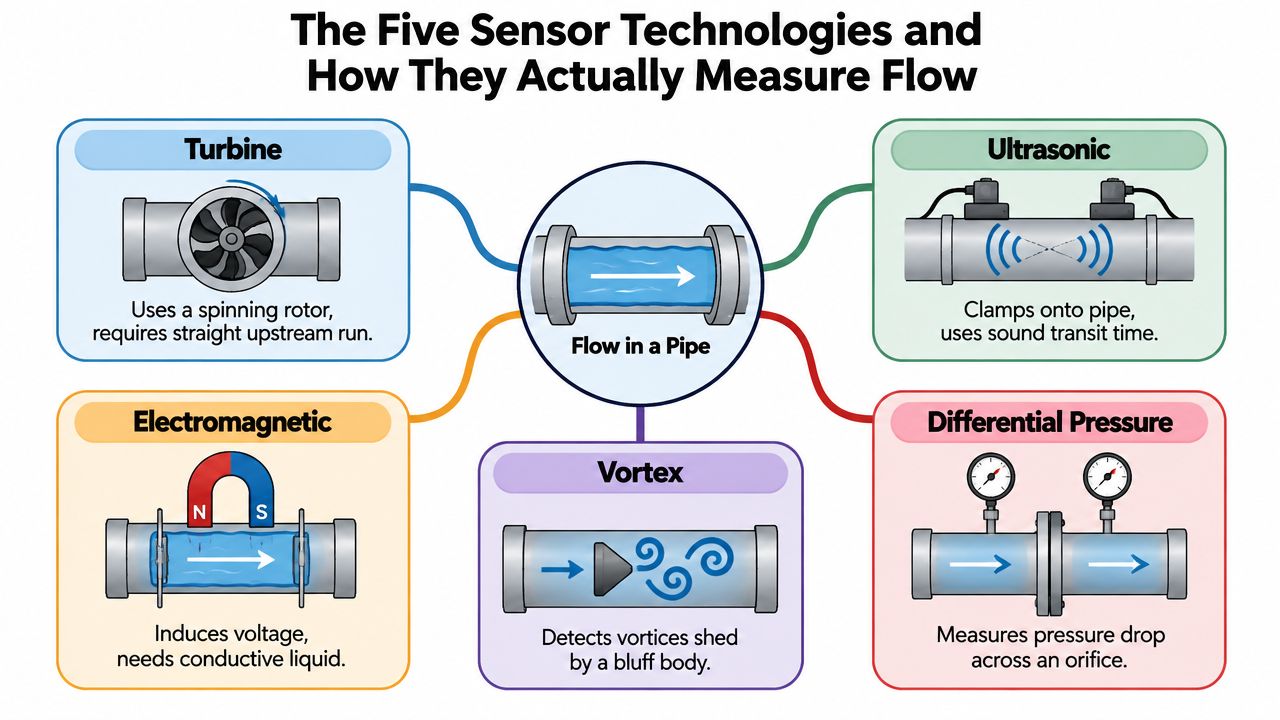
Turbine meters
A turbine meter places a rotor in the stream. Water turns the rotor, and the electronics convert rotational speed or pulses into flow and accumulated volume. The design is familiar and often economical, but the rotor adds a wetted moving component that can wear, foul, or respond poorly to debris.
Turbines also need a reasonably developed flow profile. Elbows, tees, valves, and pumps close to the meter can disturb the reading, so the installer must protect the required upstream and downstream run. Turbine meters normally require a pipe cut-in or an existing meter connection, which makes them easier to use during construction than during an occupied retrofit.
Clamp-on ultrasonic meters
Clamp-on ultrasonic sensors mount outside the pipe. Transit-time models send acoustic signals both with and against the flow, then infer velocity from the difference in travel time. Doppler variants use reflected sound from particles or bubbles in the liquid.
This non-invasive arrangement avoids process contact and pipe cutting, which makes ultrasonic technology attractive in occupied buildings. The installer still needs accurate pipe dimensions, material information, good coupling, and suitable mounting space. Insulation, corrosion, rough surfaces, and poor signal paths can turn a simple-looking retrofit into a commissioning problem.
For a deeper explanation of installation and signal behaviour, review this guide to ultrasonic flow meters.
Electromagnetic meters
Electromagnetic, or mag, meters use Faraday's law. Coils create a magnetic field, and electrodes detect the voltage generated as conductive water moves through the lined measuring tube. There are no internal moving parts, but the fluid must have sufficient conductivity and the pipe must remain full.
The sensor is installed inline, usually between flanges. That means draining, cutting, fitting, electrical coordination, and a planned shutdown. The trade-off is a permanent meter for mains, process lines, and dirty or variable water where an internal rotor would be a liability.
Paddle-wheel meters
A paddle-wheel meter is a simpler rotor design, usually installed through a fitting or saddle. It can provide an economical pulse or digital signal for basic monitoring, but the moving paddle sits directly in the water and is vulnerable to fouling and wear.
Its low-flow behaviour deserves special scrutiny. A weak trickle may not generate enough force to turn the paddle consistently, creating missed consumption or unstable readings. That makes it a poor choice where the primary objective is identifying small continuous leaks.
Thermal mass meters
Thermal mass meters heat a probe and measure how quickly the flowing medium removes heat. They can be highly responsive at low flow, but the probe must remain wetted and the technology is more naturally associated with gas and specialized fluid measurement than ordinary domestic-water submetering.
An empty pipe can produce a misleading result because the sensor's thermal environment changes. For water applications, specify thermal technology only when the low-flow requirement is genuine, the pipe remains full, and the manufacturer can document compatibility with the fluid and operating conditions.
Comparing Water Flow Sensors Across the Criteria That Matter
The table below is a screening tool, not a substitute for a project-specific selection. The verified Canadian guidance provides performance benchmarks rather than universal product ratings. British Columbia hydrometric standards identify analogue submersible sensors reaching 0.1% of full-scale output accuracy and digital sensors reaching 0.02% FSO or better, while also recommending annual verification and calibration to manufacturer specifications (British Columbia hydrometric standards).
Sensor type
Typical accuracy
Cost band per meter
Install method
Low-flow performance
Leak detection capability
Turbine
Product- and installation-dependent, strongest in a stable, clean flow profile
Mid
Inline cut-in
Fair when correctly sized, weak if oversized
Good when paired with interval data and thresholds
Ultrasonic
Product- and mounting-dependent, suitable for many retrofit monitoring tasks
Mid to high
Clamp-on, non-invasive
Good when signal quality and sizing are correct
Strong when configured for continuous-flow and burst alerts
Electromagnetic
Product- and calibration-dependent, suitable for conductive liquids
High
Inline flanged installation
Good across a broad operating range
Strong at mains level when integrated with analytics
Paddle-wheel
Product- and flow-profile-dependent
Low
Inline fitting or saddle
Poor at very small trickles and vulnerable to fouling
Limited unless paired with a separate analytics platform
Thermal mass
Application-specific and highly dependent on wetting conditions
High
Probe or inline installation
Excellent for suitable low-flow applications
Useful in specialized monitoring, not a default domestic-water choice
How to read the matrix
Cost band isn't total project cost. An ultrasonic meter may carry a higher equipment price than a basic paddle wheel, yet avoid a shutdown, pipe cutting, draining, and restoration work. Conversely, a mag meter can justify its cost on a large main where its permanent installation and stable output matter more than retrofit speed.
Straight-run requirements also separate technologies. Turbine meters are particularly sensitive to disturbed flow, while clamp-on ultrasonic meters still need a location with a reliable acoustic path. Don't approve a location from a floor plan alone. Have the installer inspect the actual pipe, insulation, nearby fittings, and access.
Leak detection requires data logic, not just a sensor body. A practical system should distinguish sustained low flow, short bursts, expected occupancy patterns, and simultaneous demand. Owners evaluating maintenance workflows can also look at predictive maintenance for water plants for broader ideas about using condition data to trigger action.
Mag meters deserve special attention where dirty water or a permanent main-meter position makes them appropriate. A magnetic flow meter overview can help the project team understand where the technology fits before comparing quotations.
Matching Sensor Choice to Multi-Family and Commercial Buildings
The building determines the winner more often than the brand does. A retrofit on exposed copper risers has a different risk profile from a new high-rise main concealed behind finished walls. Tenant turnover, water quality, pipe diameter, and shutdown access all change the decision.
Four building situations
Garden-style apartments with copper risers usually favour clamp-on ultrasonic meters where the owner wants suite-level monitoring without opening walls or interrupting every branch. Exposed mechanical areas provide workable mounting locations, and non-invasive installation reduces coordination with residents. The provider still needs to confirm pipe dimensions and signal quality at each riser.
Mid-rise multifamily buildings with CPVC branches require more care. Ultrasonic can be suitable, but the pipe wall and installation geometry must support a reliable acoustic path. If the branches are short, crowded, or poorly accessible, a purpose-designed inline meter may produce a more repeatable result than forcing a clamp-on installation into an unsuitable location.
High-rise commercial buildings with steel mains often benefit from electromagnetic meters at large, permanent mains. Their lack of internal moving parts suits dirty water and continuous service, but the installation needs a shutdown plan, drainage strategy, electrical work, and enough room for flanges and future service.
Retail and mixed-use properties need segmentation. A retail strip centre may use simple paddle-wheel monitoring on an isolated, clean, non-billing branch where low purchase cost matters. A mixed-use tower may use a turbine or mag meter at the bulk point, ultrasonic meters at accessible risers, and separate point sensors around high-risk equipment.
Building type
Pipe material
Recommended sensor
Why it wins
Garden-style apartments
Copper risers
Clamp-on ultrasonic
Limits pipe disruption and supports retrofit monitoring
Mid-rise multifamily
CPVC branches
Ultrasonic or selected inline meter
Choice can follow pipe geometry, access, and required billing accuracy
High-rise commercial
Steel mains
Electromagnetic
Handles permanent, large-main measurement without a moving rotor
Retail strip centre
Copper, PVC, or steel branch lines
Paddle-wheel for non-billing monitoring
Simple installation and economical point coverage
Mixed-use tower
Mixed materials
Hybrid specification
Assigns each technology to the location it can serve reliably
Ontario illustrates why regional data quality matters. Federal reporting listed 211 monitoring stations in the province's 2023 indicator set, the largest provincial count in that summary. 42% showed increasing trends and 19% showed decreasing trends over the 1974–2023 period, while Ontario was among the regions reporting increases in low-flow days (Ontario and national streamflow data). Property owners don't need to copy hydrometric networks, but they should adopt the same discipline: choose equipment that produces dependable records over time, not merely an attractive first reading.
Cost, Calibration, and the Real ROI of Leak Detection
The purchase price is the least reliable way to compare water flow sensors. Total cost includes pipe work, access, shutdown coordination, electrical connection, communications, software, commissioning, calibration, battery or endpoint service, and the labour required to investigate alerts.
A low-cost paddle wheel can be sensible on a non-billing branch with clean water and stable flow. It becomes a false economy when the owner expects it to capture tiny continuous leaks, survive fouling, and support tenant disputes. Clamp-on ultrasonic equipment often earns its place in occupied buildings by avoiding invasive work, while electromagnetic meters can be justified where a permanent main-meter installation is already planned.
Sensor type
Unit cost band
Install cost
Calibration interval
Leak detection ROI
Turbine
Moderate
Moderate to high if cut-in is disruptive
Set by manufacturer and billing policy
Strong when sized correctly and connected to interval analytics
Ultrasonic
Moderate to high
Low to moderate for accessible retrofits
Verify on a documented schedule
Strong where avoided shutdown and early alerts matter
Electromagnetic
High
High when pipe interruption is required
Set by manufacturer and application
Strong on permanent mains and high-consequence areas
Paddle-wheel
Low
Low to moderate
More attention may be needed as fouling and wear develop
Limited for small leaks, useful for basic monitoring
Thermal mass
High
Application-dependent
Application-specific
Valuable only in suitable specialized low-flow work
The business case should start with the loss the system is intended to control. Water damage can create restoration, tenant displacement, staff time, and insurance complications, not just excess consumption. For background on detection approaches and response options, owners can consult this leak detection guide from AMPM Restoration Services.
Don't claim payback before defining the baseline. Canadian coverage identifies a clear gap in quantified lifecycle economics for condo and rental portfolios, with more attention recently given to battery-free sensing, AI-assisted anomaly detection, and lower-cost wireless monitoring than to independently verified Canadian ROI (University of Waterloo discussion of water-damage protection). That means the responsible approach is to model each property using its actual water profile, incident history, labour cost, and monitoring scope.
Calibration is also a recurring budget item. In Quebec field verification of an ADS 4000 flow meter, reported overall bias under normal conditions was 1.6%, precision was 0.74%, and reference-device uncertainty was below 0.25% (ADS 4000 field verification report). The lesson is straightforward. Track bias and precision separately, and document the reference chain.
For owners comparing a full system rather than a component, review the practical factors in leak detection system cost, including integration and ongoing service.
Installation, Commissioning, and Ongoing Verification
A meter becomes billing-grade only after the team proves that the installed device, output signal, communications path, and software record agree. The installation plan must start with a physical survey, not a purchase order.
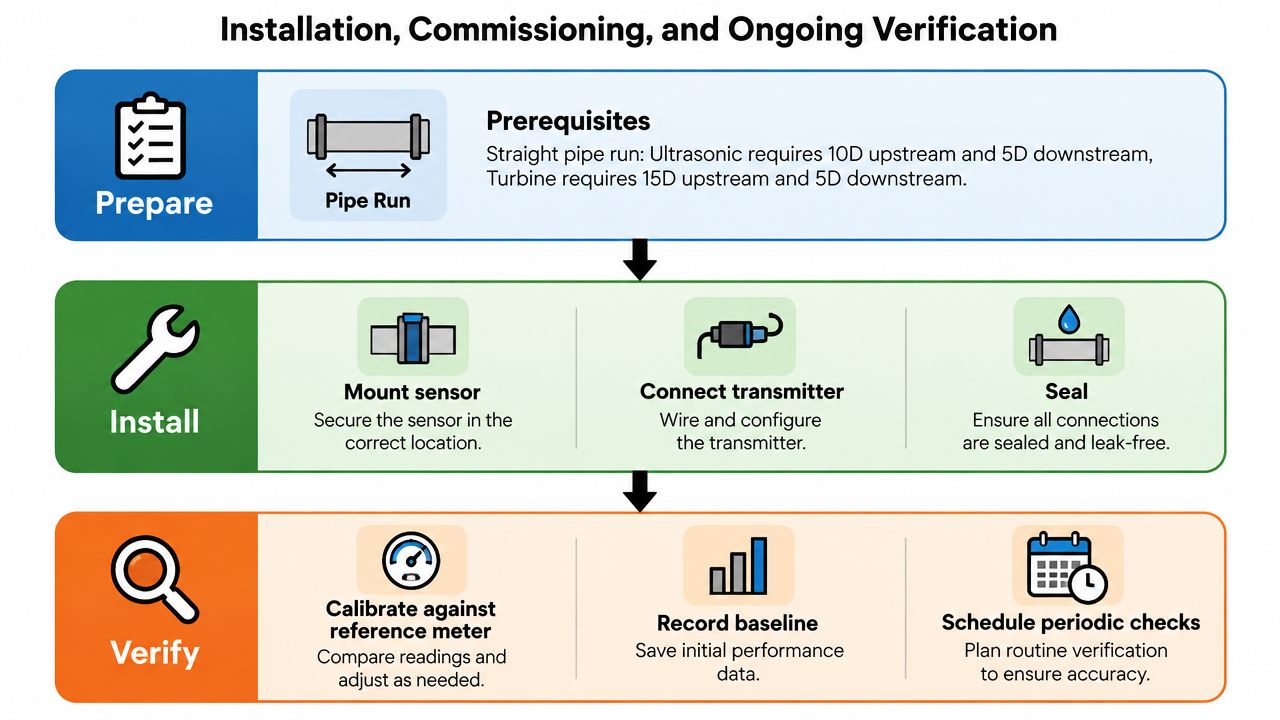
Prepare the site
Confirm pipe material, outside diameter, wall thickness, insulation, orientation, service temperature, water quality, and available straight run. Coordinate shutoffs with the property manager, notify affected occupants, and identify a recovery plan before anyone drains a line.
Install the hardware
Mount the sensor at the approved location, connect the transmitter or endpoint, secure the wiring, and seal the installation against moisture and tampering. Inline devices require fitting, gasket, flange, and pressure checks. Clamp-on devices require careful transducer spacing, coupling, alignment, and surface preparation.
Commission the complete chain
Run water through known operating conditions and compare the meter output against a suitable reference. Test pulses or digital messages, confirm the accumulated volume, check time stamps, pair the data logger with the AMI, AMR, or BMS platform, and record the initial baseline.
A defensible service plan should distinguish operational checks from billing verification:
- AMR systems: Schedule regular spot checks and investigate unexplained drift, missing reads, or unusual consumption.
- Billing-grade AMI: Arrange full calibration and documented verification on the interval required by the manufacturer, contract, and applicable rules.
- Leak analytics: Monitor data continuously for signal loss, reverse flow, sustained consumption, burst events, and changes in the established baseline.
- Every installation: Keep the meter serial number, configuration, calibration record, reference instrument details, commissioning results, and software mapping together.
Annual verification and calibration to manufacturer specifications are recommended in British Columbia's hydrometric standards. For suite billing, the provider should also explain how the process handles a disputed reading, a failed endpoint, a replaced meter, or a period of missing data.
Recommendations and a Decision Checklist for Property Owners
Use a hybrid specification when the building has mixed pipe conditions. The strongest design assigns each meter type to the point where it can produce reliable data with acceptable disruption.
Building profile
Pipe material / size
Recommended sensor
Why it wins
Watch out for
Garden-style apartments
Copper risers, suite branches
Clamp-on ultrasonic
Retrofit-friendly and suitable for accessible riser monitoring
Poor mounting locations, insulation, and weak acoustic coupling
Mid-rise multifamily
CPVC branches and mixed distribution
Ultrasonic or selected inline meters
Balances access, pipe compatibility, and billing needs
Verify pipe-wall characteristics and low-flow behaviour
High-rise commercial
Steel mains, larger permanent lines
Electromagnetic
Strong choice for conductive water and stable main measurement
Shutdown, drainage, flanged installation, and full-pipe conditions
Mixed-use retail
Mixed branch materials
Hybrid, often turbine or ultrasonic by location
Matches the meter to each tenant and common-area condition
Don't use a low-cost rotor where leak sensitivity is essential
Specialized healthcare or laboratory area
Application-specific piping
Thermal mass only where justified
Captures suitable low-flow conditions without defaulting to domestic-water hardware
Empty-pipe behaviour, wetting, fluid compatibility, and service expertise
Hand your provider this checklist:
- Confirm the pipe: Record material, diameter, wall thickness, orientation, insulation, and access at every proposed meter location.
- Define the accuracy need: Separate billing accuracy from operational monitoring and document the required flow range.
- Prove low-flow performance: Ask for the manufacturer's usable lower range and commissioning method, not only a headline accuracy figure.
- Verify communications: Confirm compatibility with the AMR or AMI endpoint, billing platform, BMS, pulse output, and alarm workflow.
- Design leak logic: Specify continuous-flow, burst, reverse-flow, no-flow, and automatic-shutoff rules where required.
- Require records: Obtain calibration certificates, reference details, baseline readings, serial numbers, and commissioning results.
- Set verification dates: Put operational checks, calibration, endpoint testing, and alert review into the service agreement.
Axis Meter Solutions delivers water submetering programs that can combine ultrasonic or wireless meters, communications, tenant billing, commissioning, and included leak and flood detection for multi-family, condominium, mixed-use, and commercial properties. If you want a building-specific sensor plan rather than a generic equipment quote, visit Axis Meter Solutions and request an assessment of your pipe layout, billing requirements, and leak-detection objectives.
Ready to Optimize Your Utility Management?
Tell us about the property, utility, number of units, and your billing or monitoring goals. We'll help you identify the right next step.
Book a Call