Water Leak Detection Sensor Guide for Property Owners
A water leak detection sensor earns its place in a multi-family building when it does more than announce that water exists. It needs to identify which unit, riser, mechanical room, or zone is involved, deliver the alert reliably, and fit into a response process that can get water shut off before a maintenance issue becomes a restoration project.
That distinction matters because water damage is already the dominant property-risk category in Canadian real estate. In a building with shared risers, stacked bathrooms, tenant turnover, and staff who aren't on site around the clock, the question isn't whether a sensor detects a leak. The question is whether your team can locate the source quickly enough to limit damage.
Table of Contents
- Why Water Damage Is Your Biggest Property Risk
- Comparing Five Water Leak Detection Sensor Types
- Three Technical Specifications That Actually Matter
- Strategic Sensor Placement for Multi-Family Buildings
- Integrating Sensors with Monitoring and Alarm Systems
- The Layered Detection Strategy for Complete Coverage
- Measuring Success and Justifying Sensor Investment
Why Water Damage Is Your Biggest Property Risk
A 2024 report from Aon's Canadian Real Estate Practice identified water damage as the leading cause of property claims by both frequency and dollar value. Water-related incidents represented 47% of the 243 claims reviewed, with combined losses of $14.5 million, or approximately $59,700 per claim on average.

Those figures reframe leak detection. This isn't a decorative smart-building feature or a gadget for residents who want another phone notification. It's a risk-control measure aimed at one of the most expensive and disruptive failure categories a property operator manages.
Condominiums multiply the consequences
Earlier Canadian insurance reporting cited in the Aon report found that water-related claims can represent between 60% and 90% of condominium insurance claims, compared with roughly 40% for residential and commercial properties generally. A condominium or apartment building concentrates plumbing fixtures, water heaters, domestic-water risers, appliances, and occupied suites in a connected structure.
A leak in a single-family home may damage one residence. In a multi-family building, water can move through a ceiling assembly, follow a pipe chase, enter a neighbouring suite, or reach common electrical and mechanical areas. The person who discovers the water may be several floors away from the failed toilet supply line or valve.
Practical rule: The earlier alert is useful only if it also narrows the search area.
Tenant reporting remains important, but it's a late-stage detection method. Residents may be away, assume a small drip can wait, or notice only the visible consequence in a ceiling or cabinet. Visual inspections are equally limited because staff can't continuously observe every fixture, riser, mechanical room, and concealed service space.
Treat the sensor as part of risk management
A practical installation starts with failure consequences, not a shopping list of devices. Ask where a leak could first become visible, which zone it could affect, and whether staff can reach the associated shutoff. A sensor near a water heater, domestic-water branch, mechanical assembly, or riser can provide an earlier warning than a periodic inspection.
The purpose is to create time for a defined response: verify the event, identify the responsible unit or zone, close a valve where available, dispatch the right trade, document the incident, and check adjacent areas. That operating discipline matters as much as the sensor itself.
Comparing Five Water Leak Detection Sensor Types
The wrong sensor can create blind spots, unnecessary maintenance, or a false sense of coverage. A point sensor under a sink won't protect a long mechanical-room wall, while a broad sensing cable may be excessive for a single water heater pan.
Sensor Type
Detection Method
Best Application
Key Limitation
Contact sensor
Conductive probes trigger when standing water bridges them
Under sinks, near water heaters, and beside washing machines
Detects only where water reaches the contacts
Floater sensor
A rising float responds to accumulating water
Sump pits, pans, and locations where water collects to a measurable depth
May not respond to a thin film that never raises the float
Spot sensor
Moisture detection at one defined point
Beneath a specific fixture, valve, pump, or appliance
Offers limited area coverage
Cable sensor
Conductive cable detects moisture along its route
Mechanical rooms, basement perimeters, risers, and service chases
May identify the zone without pinpointing the exact leak location
Wireless sensor
A point or other sensing element transmits an alert without fixed signal wiring
Retrofit suites and locations where cabling is difficult
Depends on battery condition, radio coverage, and gateway reliability
Match the device to the failure mode
Contact and spot sensors work well when you know exactly where water should appear first. Put one beneath a domestic water heater or at the lowest point under a dishwasher, and it can provide a clear location for a technician.
Floater sensors make more sense where water accumulates in a pit, tray, or containment area. They aren't a substitute for point sensing where a slow leak can travel across a floor without reaching the float promptly.
Cable sensors cover a route rather than a single point. They suit mechanical rooms, long equipment runs, and areas below risers, but divide large areas into labelled zones if staff need more than a general alarm.
Wireless units reduce installation disruption, particularly in occupied suites. They also introduce a maintenance obligation. Someone must test signal paths, replace batteries, confirm gateway operation, and investigate devices that stop reporting.
For broader background on choosing detection approaches in residential settings, this guide for Phoenix homeowners offers useful context, although multi-family operators need a more structured approach to zoning and response.
Before selecting equipment, map the plumbing and decide whether you need presence detection, water-depth detection, area coverage, flow anomaly detection, or unit attribution. The practical distinctions are outlined further in this water-line leak detection equipment guide.
Three Technical Specifications That Actually Matter
App connectivity looks impressive in a product brochure, but it won't protect a building if the sensor misses the event or the alert path fails. Three specifications deserve more attention than voice-assistant compatibility: sensitivity, connectivity reliability, and real-world power performance.
Sensitivity must fit the environment
A sensor should react to the failure you care about, not every damp condition in the building. High sensitivity can help under a supply line, but condensation, cleaning water, or humid mechanical-room conditions may create nuisance alerts if thresholds aren't tuned.
Ask what the device detects and where that detection occurs. A point sensor responds when water reaches its electrodes. A floater responds when water rises. A flow or acoustic monitor looks for an abnormal change in the building's water behaviour, which can reveal a concealed problem without visible pooling.
Connectivity decides whether anyone acts
An alarm that remains on a disconnected device is not an operational control. Test the route from the sensor to the gateway, monitoring platform, on-call staff, and escalation contact. Wi-Fi may be practical in some buildings, but it depends on the property network and local coverage. Cellular-backed communication can provide a separate alert path, although it may involve an ongoing service cost.
Waterloo, Ontario, provides a useful example of why sensing quality matters. A municipal pilot deployed 40 sensor units across approximately 10 square kilometres. The devices sampled pressure up to 100 times per second and acoustic signals up to 4,000 times per second, comparing activity with an established baseline. The system identified four events, including two water-main breaks and an abnormal-flow event involving a garden hose drawing as much as 25 litres per minute. These details are reported in ConstructConnect's account of the Waterloo leak-detection pilot.
Battery claims need field verification
Manufacturers often describe battery life under favourable conditions. Buildings create harsher conditions through temperature changes, humidity, radio interference, and frequent self-tests. Require a maintenance plan that records battery status, missed check-ins, test dates, and replacement responsibility.
Evaluate the system using detection latency, confirmed-event rate, nuisance-alert rate, signal availability, and actual battery performance in comparable buildings. Those measures tell you more than a headline feature list.
Strategic Sensor Placement for Multi-Family Buildings
Placement usually matters more than device price. A modest sensor positioned at the first practical point of detection can outperform an expensive unit installed where water has already travelled.
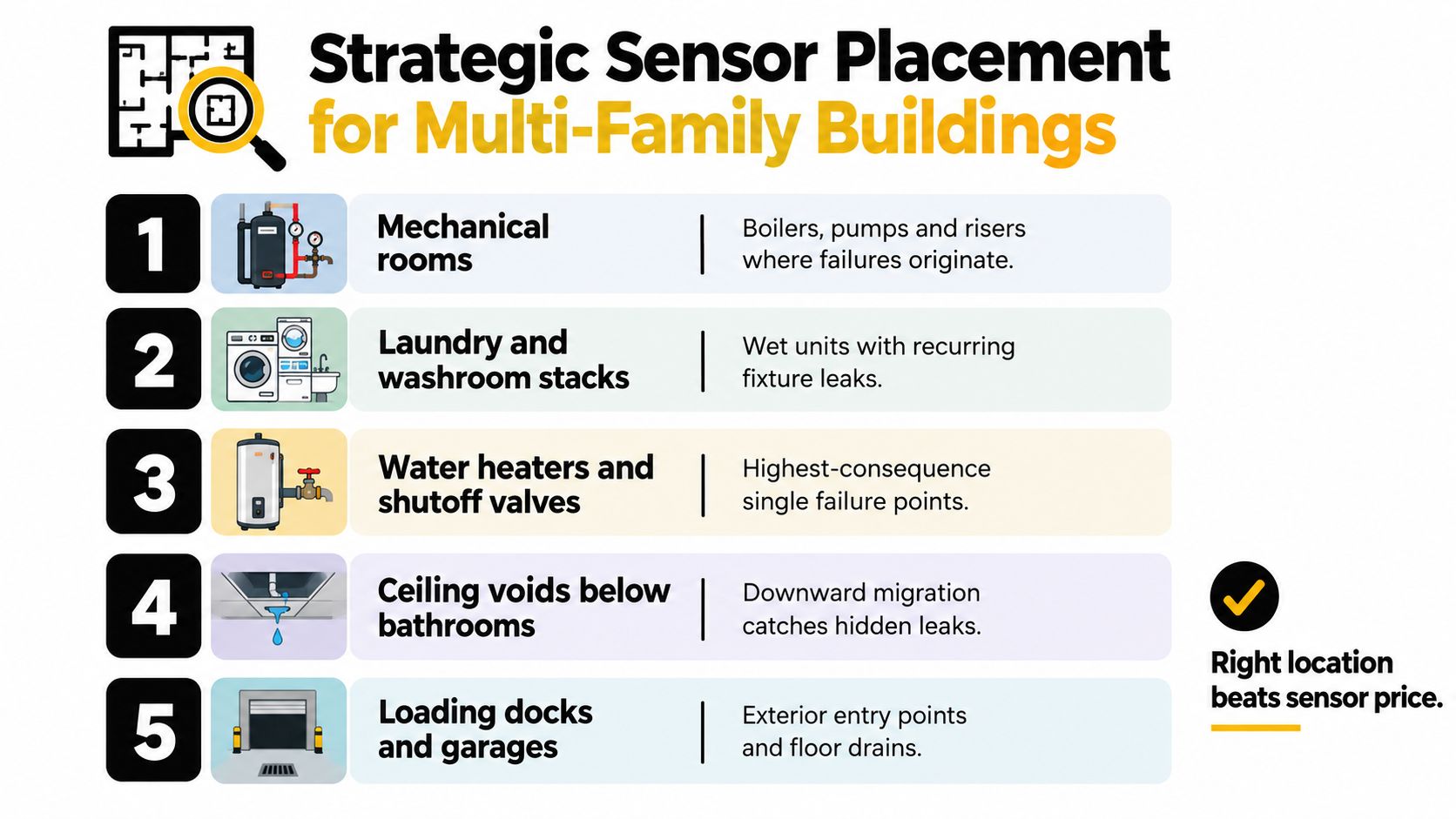
Start with the building's plumbing map. Mark domestic-water entry points, risers, mechanical rooms, pump assemblies, water heaters, branch shutoffs, fixture stacks, floor drains, and areas where a leak could migrate into occupied or electrical spaces.
Prioritize the first point of failure
Mechanical rooms and pump areas deserve early attention because one failed assembly can affect multiple units or common areas. Use point sensors beneath pumps, valves, and equipment, then consider cable coverage where water can travel across a broad floor.
Risers and service shafts are harder to inspect and often conceal the route between floors. A cable sensor or zone-based monitoring approach can provide earlier warning than waiting for staining below a bathroom stack.
Water heaters and domestic hot-water equipment need close protection because slow leaks can remain unnoticed until surrounding materials absorb enough water to show damage. Place sensing at the lowest likely collection point, while keeping access clear for inspection and service.
Laundry rooms, kitchens, and appliance locations require suite-level decisions. A sensor under a washing machine or dishwasher can identify a supply-line failure at the source, but it won't tell you about a running toilet on the other side of the suite.
Basements, garages, loading areas, and floor drains need a different design. These spaces may receive water from plumbing failures, snowmelt, backups, or exterior entry points. A single spot sensor can miss water that follows a slope, so route-based coverage or several labelled zones may be more appropriate.
Use the structure of the building to determine coverage. Don't distribute devices evenly by floor area if the plumbing risk is concentrated at specific junctions.
The scale of hidden water loss supports that approach. A CBC report on Ontario leakage found that leakage can account for approximately 10% to 33% of an average Ontario water bill, while estimated system leakage across Ontario ranged from 10% to 40%. In Toronto, the reported loss was approximately 10% to 15% of the drinking-water supply, or about 103 million litres per day. The same analysis indicated that a 1.5-millimetre hole could waste as much as 3,570 litres in 24 hours and cost approximately $14.54 per day.
Place sensors where the water starts, then connect them to the unit or zone that staff can act on.
Integrating Sensors with Monitoring and Alarm Systems
A notification isn't a response. The system reduces risk only when it moves a verified event to someone who can investigate and control the water.
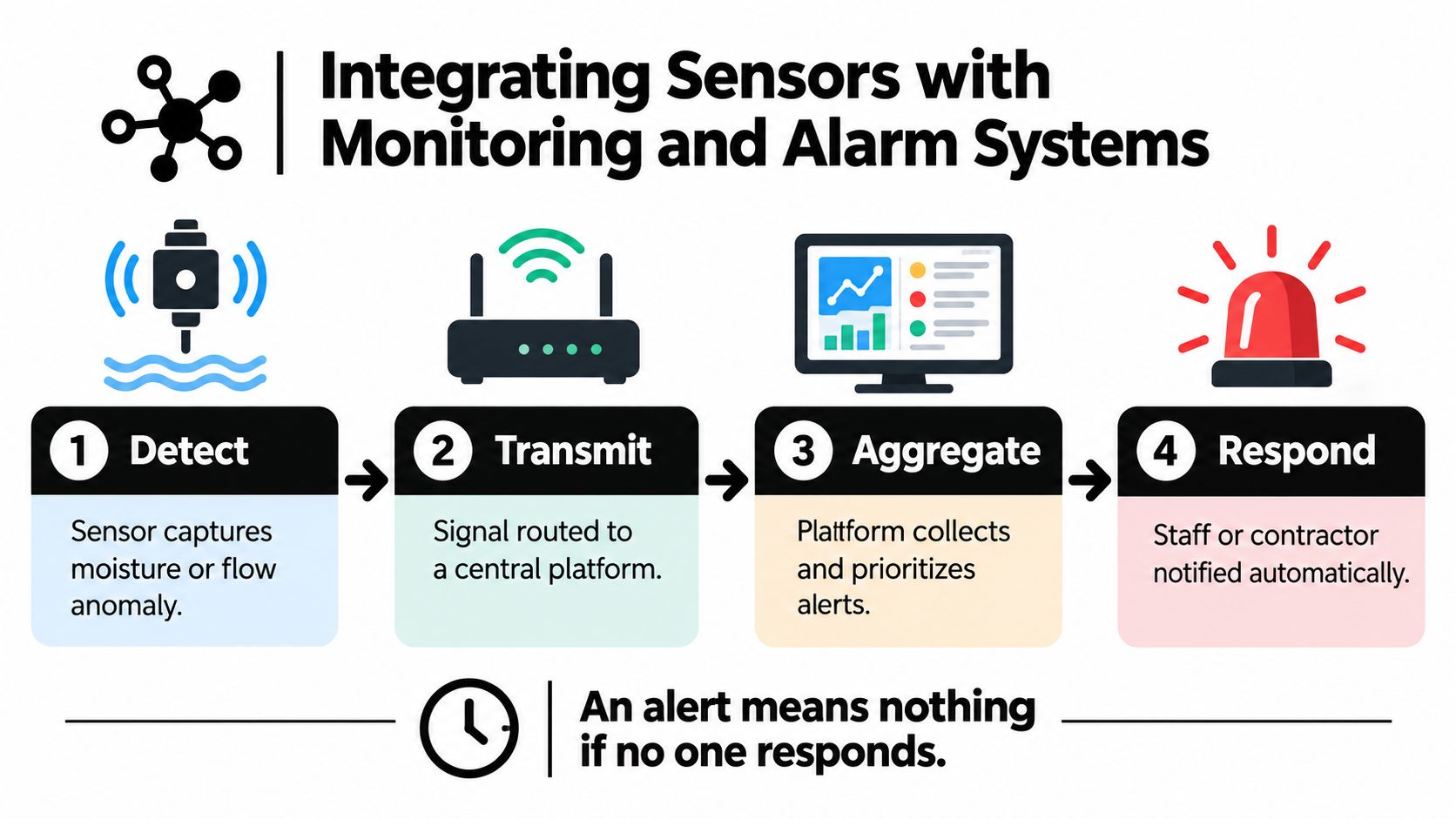
Build the alert path around the decisions staff need to make. A useful event record should identify the sensor, building, floor, unit or zone, time, severity, last communication, and available shutoff. It should also distinguish a sensor fault from detected water, because a dead battery and an active flood require different responses.
Design the escalation, don't just enable notifications
A small operation may begin with text or email alerts. Larger portfolios generally need a monitoring platform that aggregates alarms, sends them to the correct on-call person, creates a maintenance ticket, and escalates an unconfirmed event.
The process should answer practical questions:
- Who verifies the alarm? A building operator, security desk, superintendent, or contractor needs a named responsibility.
- What happens after hours? The escalation path must work when the property manager is asleep, travelling, or away from the building.
- How is the unit identified? A submeter or zone label should connect the event to a physical location.
- When is a valve closed? Remote shutoff can help where the building has compatible infrastructure, but automatic closure needs careful rules to avoid disrupting residents unnecessarily.
- How is the incident documented? Record the alert, verification, shutoff, repair, affected areas, and return-to-service test.
Submeter data adds the missing context. A building-wide flow anomaly tells you that something is wrong. Unit-level consumption and fixture-level sensors can help determine whether the event belongs to a suite, common area, riser, or mechanical branch.
Municipal and network-level evidence shows why continuous monitoring is valuable. A Canadian Society for Civil Engineering paper reports processed-water losses of 20% to 30% in existing systems, with losses exceeding 50% in poorly performing systems. It cites average network loss of 13% nationally, 21% in Quebec, and approximately 23% in Montreal. These are municipal figures, not building benchmarks, but they illustrate how much water can disappear without a visible event.
The same paper modelled acoustic-noise-logger expansion reducing leak-repair labour from 263,000 to 158,000 hours, about a 40% reduction, and reducing annual water-loss value from approximately $1.25 million to $600,000, about a 50% modelled saving. Those results shouldn't be copied into a property pro forma as a guarantee. They do support evaluating a system by response time and confirmed events, not by the number of devices installed.
For security and operations teams comparing communications paths, this overview of remote monitoring solutions provides relevant background. Property operators should then assess network redundancy, escalation ownership, service support, and integration with their existing building systems. A practical framework for water system monitoring should also include submeter data, alarm history, and maintenance follow-through.
The Layered Detection Strategy for Complete Coverage
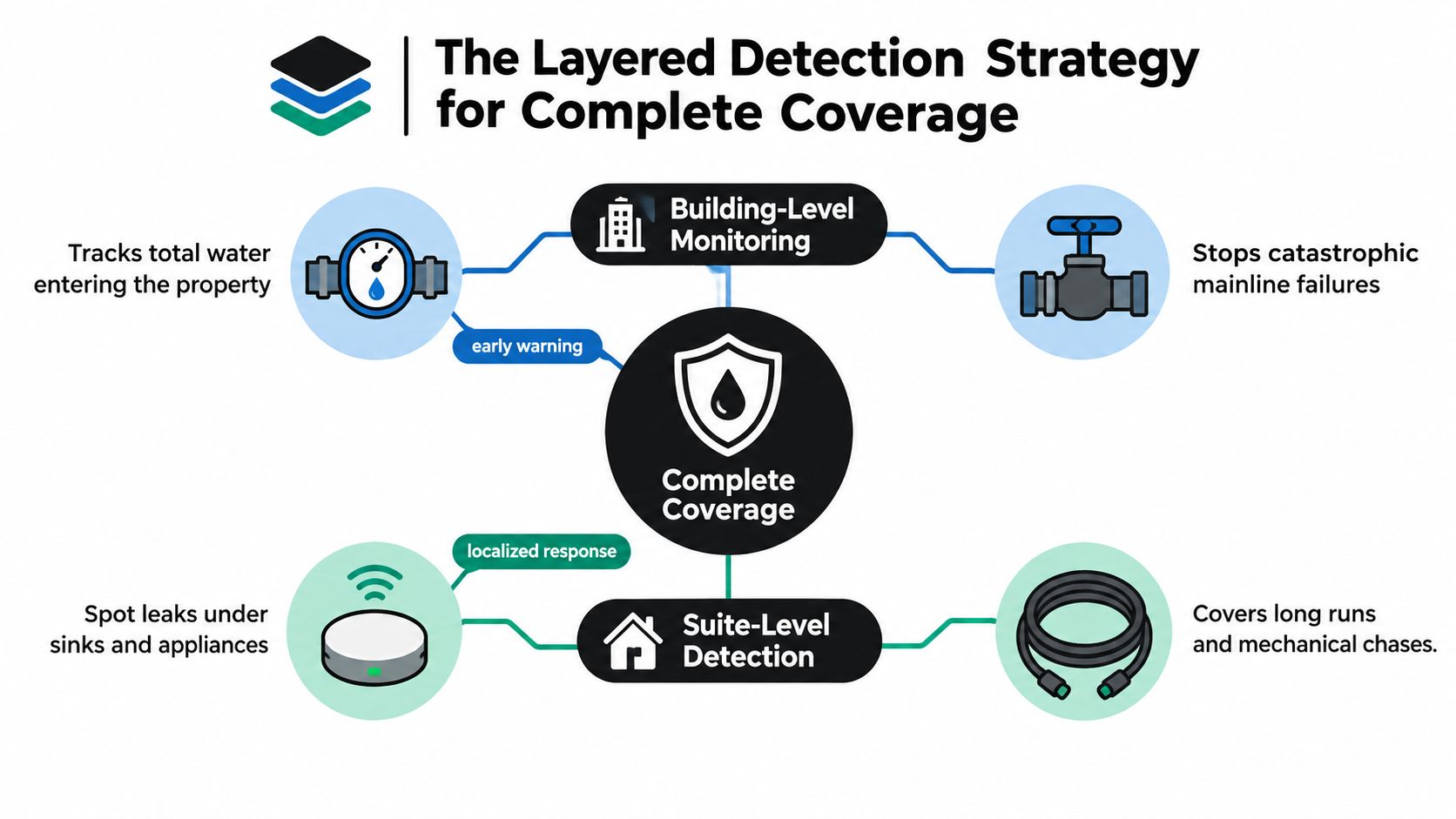
A single whole-building monitor can tell you that water use is abnormal. A single suite sensor can tell you that water reached one point. Neither answers every operational question, so multi-family buildings need a layered detection strategy.
Building-level monitoring provides early warning
A mainline or common-area monitor watches total water entering the property. It can identify a sustained abnormal draw, a significant branch failure, or a problem that individual point sensors haven't reached yet.
This layer is especially useful for unoccupied buildings, vacant suites, and concealed leaks. It also creates a baseline for comparing building demand with the sum of unit-level consumption. If the mainline shows continuous flow while suite submeters don't explain it, staff have a reason to investigate common areas, risers, irrigation, or a metering gap.
Suite-level sensors provide attribution
Suite sensors answer a different question. They can identify water under a toilet, sink, appliance, or water heater, helping staff contact the responsible resident or access the correct unit. Toilet-level devices and fixture monitors can be valuable where recurring failures create prolonged consumption but little visible flooding.
A 2025 multifamily pilot found that initial leakage represented 22% of water use, compared with the 12% U.S. residential average cited by the U.S. EPA in that pilot's report. The pilot concluded that combining technologies worked better than relying on either alone. Mainline monitors detected significant building-level leaks, while individual toilet monitors localized failures to particular units. It also found mainline monitoring particularly effective in buildings with up to 30 units, as reported in the multifamily pilot report.
The design choice isn't “one sensor per fixture” versus “one meter for the whole building.” It's a question of risk layers:
- Entry and mainline layer: Identify total-flow anomalies and major supply failures.
- Distribution layer: Monitor risers, mechanical rooms, branches, and common-area equipment.
- Suite layer: Localize fixture failures and assign events to a unit or zone.
- Response layer: Connect each alarm to a shutoff, access plan, and named responder.
This approach costs more to design than installing isolated alarms, but it addresses the operational problem that matters most: knowing where to send the person who must stop the water.
Measuring Success and Justifying Sensor Investment
Owners should treat installation as an operational trial with a baseline, not as a technology purchase that ends at commissioning. Record existing water consumption, emergency calls, visible water incidents, response times, recurring problem locations, and false alarms before expanding coverage.
Measure detection and response separately
A system can detect many events and still fail if staff don't act. Track:
- Alert-to-verification time: How quickly someone confirms whether water is present.
- Alert-to-shutoff time: How long it takes to control the source.
- Location accuracy: Whether the first alert identifies the correct unit, fixture, riser, or zone.
- Resolution time: How long the team takes to repair the cause and restore the sensor.
- Nuisance-alert rate: Whether staff trust the system or begin ignoring it.
- Avoided escalation: Whether incidents are contained before visible damage reaches another suite.
- Consumption anomalies: Whether continuous draws decline after repairs and resident communication.
- Maintenance completion: Whether batteries, communication paths, and devices receive scheduled testing.
A sensor program should produce an incident history that property managers can review with insurers, boards, asset managers, and maintenance contractors. The record is more useful when it separates water conservation from property protection. A running toilet may waste water without causing a flood. A failed riser valve may cause severe damage even if it produces little change in a single suite's consumption.
Use external benchmarks carefully
A California affordable-housing program reported 501 leak events across eight properties with nearly 2,000 smart sensors. Participating sites reduced average water bills by 10% in 2024 and recorded a 26% decline in toilet leaks compared with 2023, according to the HACLA case study.
A related Pacific Institute case study covering 2,900 toilet sensors across 15 affordable multifamily buildings in California and Arizona reported preliminary water-use reductions of approximately 10% to 15% and estimated 5,000 gallons of benefit per sensor annually. Those figures are useful benchmarks, not Canadian promises. Climate, plumbing design, utility rates, resident behaviour, and operating practices differ.
Use the benchmarks to build a measurement plan, not a guaranteed return. A decision framework for leak detection system cost should include equipment, installation, connectivity, batteries, monitoring, access coordination, staff time, valve integration, and ongoing testing.
For smaller properties, start with the highest-consequence locations and a mainline or common-area monitor if it can support attribution. For larger or more complex buildings, layer mainline, riser, mechanical-room, and suite-level detection. Axis Meter Solutions provides water submetering for multi-family and condominium properties, with leak and flood detection sensors included with its water-meter installations, connecting consumption visibility with alerts in high-risk areas.
Axis Meter Solutions can help property owners combine water submetering with leak and flood detection, unit-level consumption visibility, installation, commissioning, monitoring, and ongoing service. Visit Axis Meter Solutions to discuss a building-specific design that identifies responsible units or zones and gives your team a practical response path.
Ready to Optimize Your Utility Management?
Tell us about the property, utility, number of units, and your billing or monitoring goals. We'll help you identify the right next step.
Book a Call