Water Leak Detection Underground: Methods for Buildings
A water leak detection underground program has to assume the worst, because the first sign is often a soaked corridor, a sinking slab, or a water bill that doesn't match the building's usage. California's audit framework treats underground loss as a measurable operational problem, and that's the right mindset for property owners too, because the damage starts long before anyone sees a puddle (California Department of Water Resources audit data).
Table of Contents
- Why Underground Leaks Demand a Different Strategy
- How Underground Leak Detection Actually Works
- Acoustic Pressure Correlation and Tracer Gas Compared
- Inside Acoustic Correlation for Buried Service Lines
- Smart Sensors and Submetering Integration
- Permitting, Codes, and a Documented Detection Process
- A Real Acoustic Pilot and What It Actually Recovered
- Matching Detection to a Multi Unit Property Program
Why Underground Leaks Demand a Different Strategy
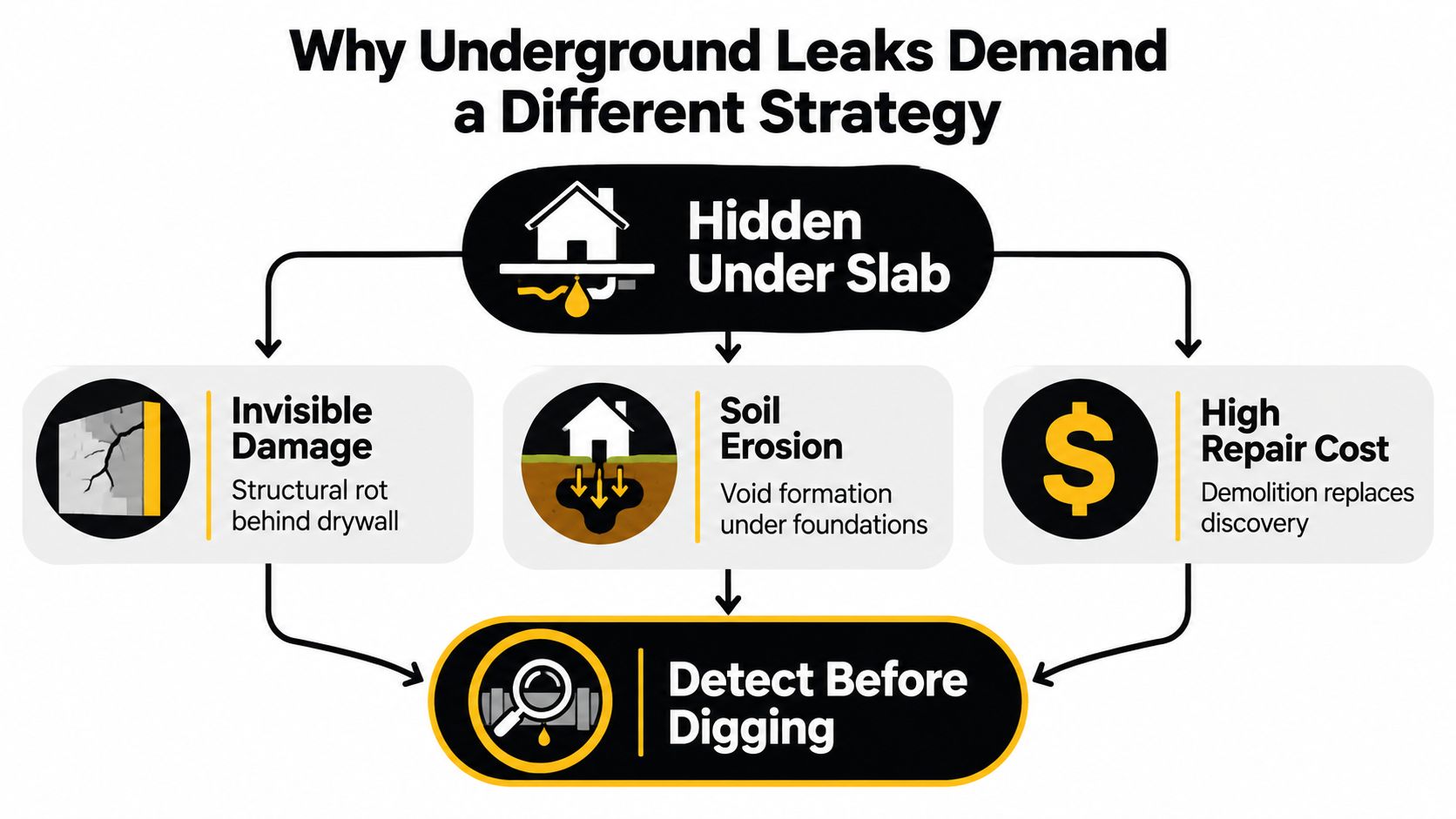
A midnight call about a damp garage ceiling rarely starts with the actual leak. More often, a manager is staring at damage that's far from the break itself, while the water has already moved through soil, chases, and structural voids. Underground leaks behave differently from exposed plumbing failures because they can keep wasting water after the source is hidden, and they can undermine finishes, framing, and foundations before anyone knows where to dig.
What makes underground damage so hard to spot
The problem isn't only the leak, it's the delay. California's Department of Water Resources explains that total leakage depends on how often leaks happen, how much they flow, and how long they stay active, which is why a small concealed leak can become a major annual loss if nobody shortens its run time (California Department of Water Resources audit data). That logic holds at building scale too.
Practical rule: underground leak detection is an asset-management task, not a one-off repair. The goal is to confirm, locate, and quantify the loss before excavation begins.
For owners and boards, the consequence is threefold. First, water can disappear before it reaches a visible failure point. Second, the damage may surface in a different room, suite, or utility area than the source. Third, every extra day before confirmation raises the odds of structural and tenant impact.
Why the age of the pipe matters
Los Angeles is a useful warning sign here. Its underground mains are extensive, and more than 30% of them are at least 80 years old (Los Angeles Times). Older buried pipe doesn't just raise leak risk, it raises the odds that a problem will be buried, intermittent, or slow enough to avoid casual detection.
That's why the question isn't whether a building with older underground service will ever need attention. The question is how quickly a leak will be confirmed, located, and kept from becoming a larger claim.
How Underground Leak Detection Actually Works
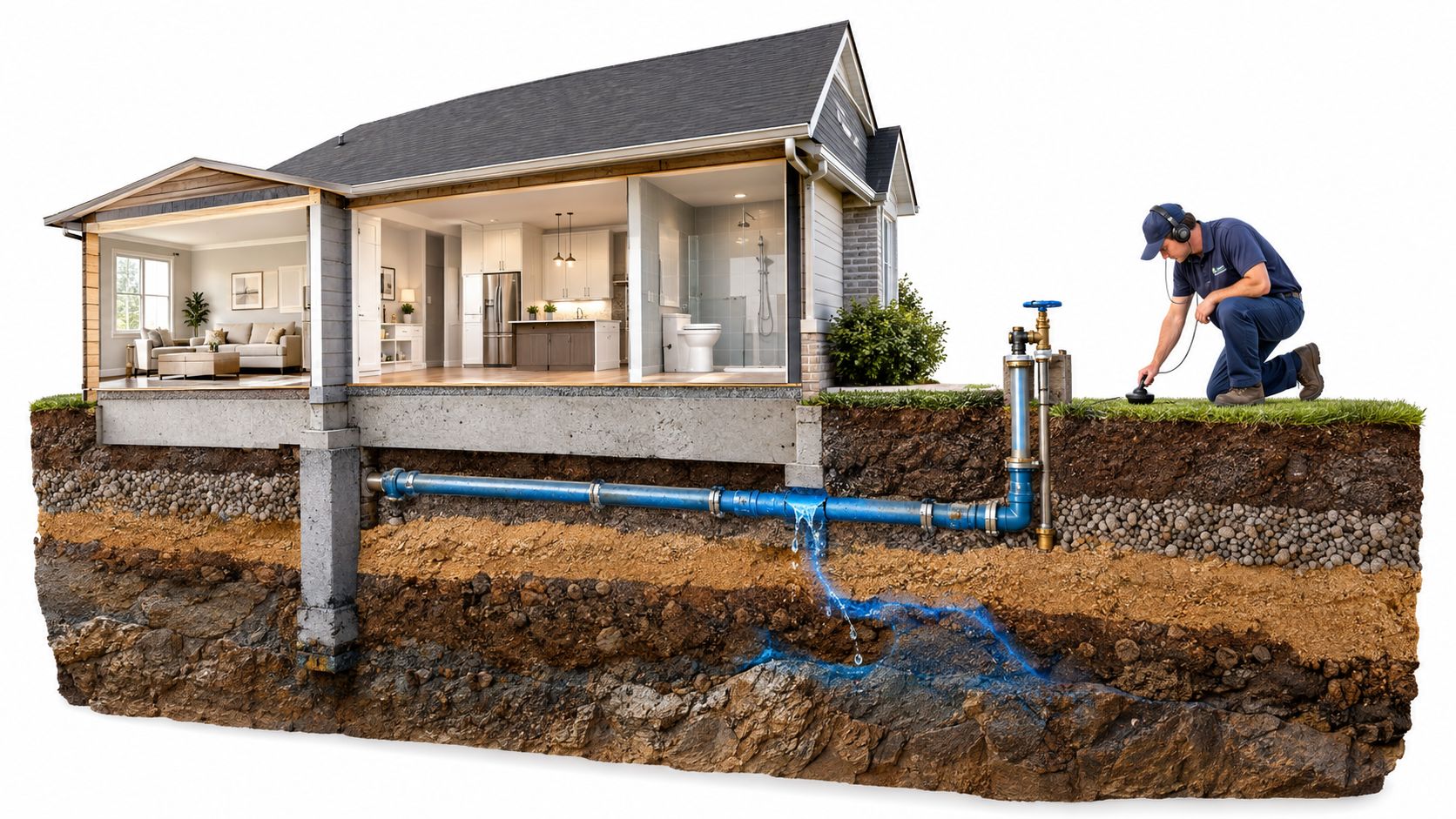
Underground leak detection usually starts with a broad screen, then tightens to a precise location. The tools differ, but they're all chasing one of three signals, acoustic noise from escaping pressurised water, pressure or flow change, or a tracer that reaches the surface where water itself won't.
Layer the methods instead of betting on one
The cleanest workflow is a stack, not a contest. Start with whatever already shows up in your metering or monitoring data, then use acoustic or correlation methods to narrow the target, and only then escalate to tracer gas or excavation if the signal stays ambiguous.
A leak becomes expensive when it's left running, not when it first forms.
That's why continuous or repeated monitoring matters more than a single visit. The California Energy Commission field project found that continuous correlating acoustic monitoring and satellite imagery each found subsurface leaks that weren't visible at the surface, and together they were associated with avoided water loss and energy savings (California Energy Commission field project PDF). The important lesson is operational, not dramatic, broad screening helps you avoid wasting time on the wrong branch line.
For a useful overview of how field crews think about the problem, a practical contractor explainer like concrete slab leak repair Florida can help owners understand how detection and repair are usually separated in practice.
What the layers do best
Pressure and flow anomalies are good at saying something is wrong somewhere in the network. Acoustic methods are better at pinpointing where the noise is strongest. Tracer gas helps when the site is too quiet, too deep, or too surface-sealed for acoustic confidence. A building with buried laterals, paved courtyards, or mixed pipe materials often needs more than one method before anyone cuts concrete.
That's the point most sales decks miss. Detection is a sequence, and the sequence is what saves time.
Acoustic Pressure Correlation and Tracer Gas Compared
The method choice usually comes down to what the site allows, not what the brochure promises. Buried metal pipe behaves differently from plastic pipe, a deep run behaves differently from a shallow one, and a quiet overnight survey behaves differently from a corridor full of compressors, traffic, and rooftop equipment.
Comparing the main options
Method
Best for
Typical smallest detectable leak
Site disruption
Best pipe conditions
Acoustic listening
Quick surface screening near buried runs
Not stated in the verified data
Low
Metal pipe, accessible routes
Pressure or flow testing
Network-level screening
Not stated in the verified data
Very low
Closed sections with good isolation
Correlation
Pinpointing between two access points
Not stated in the verified data
Low to moderate
Known pipe length and material
Tracer gas
Confirming difficult, ambiguous sites
Not stated in the verified data
Moderate
Cases where acoustic signal is weak
Where each method earns its keep
Acoustic listening is the workhorse when the pipe is conductive enough to carry sound and the crew can get close to the likely run. Correlation adds better location logic because it compares when the sound reaches two sensors. That makes it stronger for longer buried runs with known endpoints, and weaker when the layout is fuzzy or the pipe material eats the signal.
Tracer gas is the least glamorous option, and also the one that saves jobs when the site refuses to cooperate. It's useful where sound is muffled, the pipe is too deep, or the surface is sealed so tightly that acoustic readings aren't decisive. Pressure and flow testing sit at the top of the funnel, not the end of it, because they tell you the system is behaving oddly but not exactly where to cut.
If you're reviewing gear rather than hiring a field crew, this overview of leak detection equipment for water lines is a sensible companion to the method choice itself.
The trade-off that matters most
The best method is the one that matches your pipe, your access points, and your tolerance for disruption. On a clean, well-mapped site, acoustic and correlation work fast. On a mixed-material property with weak access, tracer gas may be the faster path to a defensible repair location.
Inside Acoustic Correlation for Buried Service Lines
Acoustic correlation is the method most owners hear about first because it's the one that usually turns a vague suspicion into a dig location. Two sensors are placed on accessible fittings, then the system compares how long the leak noise takes to reach each point. The difference helps triangulate the leak.
Why access points matter
Hydrants, valves, and meter assemblies give the technician a place to listen without opening the ground. That's one reason mapped systems perform better, the crew can work from known points instead of guessing where the service line bends, branches, or changes material. If the site owner already has a metering programme with a clean layout record, the survey starts with better information and less wasted time.
Field reality: a correlator is only as good as the pipe map and the access points you give it.
The pipe itself changes the result. Metal carries sound farther and more cleanly. Plastic, especially modern MDPE, dampens the signal, so correlation on long plastic runs can be unreliable or need tighter spacing and better prior knowledge of the route. Traffic, pumps, HVAC plant, and general daytime noise all raise the odds of a messy reading, which is why many crews work early or late.
Where correlation fails
A short buried lateral with uncertain fittings can defeat correlation even when the leak is real. So can a site where the leak is on the customer side of the system but the noise is masking a fixture issue rather than a buried defect. False positives are common enough that the operator needs to compare readings against the building's actual pipe layout, not just the sensor graph.
That's why I trust correlation most when I already know the material, depth, and likely connection points. Without that context, you can still get a result, but you're also more likely to overcut or send the repair crew to the wrong spot.
For a visual sense of the workflow, the embedded video below shows the general field logic used in leak location work.
What the sensors are doing
The technician isn't listening for water itself. They're listening for the vibration created as pressurised water escapes through a defect. The time difference between the two sensors is what turns sound into distance, which is why sensor placement and route knowledge matter as much as the electronics.
Smart Sensors and Submetering Integration
Surveys catch what's wrong today. Submetering catches what's changing all the time. That's the difference between a one-time leak hunt and an always-on detection layer that lives inside the billing and operations workflow a building already pays for.
What the owner actually sees
A useful setup combines suite meters, common-area meters, and dedicated leak or flood sensors. The owner sees consumption patterns, continuous low-flow behaviour, and alerts tied to specific spaces or circuits. The operations team sees a sharper signal, like a branch line that never really goes quiet or a mechanical room sensor that trips before damage spreads.
That's where a system such as Axis Meter Solutions fits as one option, because its water-submetering installations include leak and flood detection sensors and consumption monitoring for unusual or continuous water use. In practice, that means the same platform that handles usage visibility can also surface concealed leak behaviour instead of waiting for a visible failure.
What changes operationally
A permanent monitoring layer doesn't replace acoustic work, it reduces how often you need to hunt from scratch. If a suite meter shows abnormal continuous use, or a flood sensor fires under a sink or in a mechanical room, you already have a probable location before the contractor arrives. That shortens the path from suspicion to work order.
Here's the simple division of labour:
- Submetering: flags continuous or unusual use.
- Leak sensors: mark the place where water appears.
- Acoustic surveys: confirm what's happening underground or inside hidden runs.
- Repair crews: act once the location is narrow enough to cut with confidence.
Why billing data matters
Billing dashboards are not just for tenants arguing over usage. They also create an internal record of what normal looks like, which makes a new anomaly easier to spot. When the metering platform already maps the property, leak alerts become part of the operating history instead of a standalone alarm that gets ignored.
That's the practical advantage of integration. The owner isn't buying a second system to solve a second problem, the owner is extending a metering programme into leak detection.
Permitting, Codes, and a Documented Detection Process
Detection work lives inside local plumbing rules, access rules, and sometimes utility permissions. If the investigation isn't documented, the owner loses time on the next claim, the next repair, and sometimes the next insurer review.
What good documentation should capture
California's water-loss audit model is useful even for private properties because it treats losses as something you can measure, classify, and review. At building scale, that means a report should show what was tested, where the access points were, what the readings suggested, and how the leak was confirmed before anyone opened concrete or dug soil (California Department of Water Resources audit data).
A solid record usually includes:
- The suspected zone, not just the final hole.
- The method used, acoustic, pressure-based, tracer-based, or a combination.
- The confirmation step, so the repair isn't based on guesswork.
- The repair location, tied to the property plan.
- Photos and notes, for insurance and maintenance history.
Where permits show up
Road or right-of-way access may be needed for survey work near public land. Plumbing permits can come into play when the investigation turns into a cut-in or repair. Submetering upgrades may also need approvals when new meters are installed or billing data is being tied to unit-level allocation.
A turnkey provider can help here because the detection hardware, monitoring, and reporting can sit inside the same long-term agreement as the rest of the metering scope. That matters when the goal is not just one repair, but a repeatable process that doesn't keep reinventing itself every time a leak appears.
Keep the survey report with the repair invoice. If the same area ever fails again, that paper trail saves time.
A Real Acoustic Pilot and What It Actually Recovered
Riverside Public Utilities gives a good picture of what a real acoustic programme can find when it's used on buried assets rather than on a marketing slide. The pilot covered about 7.5 miles of pipeline, and a 2023 deployment used 40 sensors that were reported to detect leaks as small as 5 gallons per minute (Riverside Public Utilities documentation).
What the pilot found
The recovered leaks weren't limited to big main failures. The programme found non-surfacing water-main leaks, irrigation-valve leaks, facility tailpipe leaks, curb-stop leaks, and two leaking service laterals. Reported recovered water totalled about 25 acre-feet, and the service-lateral leaks alone were estimated at about 12 acre-feet of loss (Riverside Public Utilities documentation).
That pattern matters. The highest-value findings were not always on the largest pipe. They were often on buried components that can go undetected for a long time without any surface evidence.
What that means for buildings
For multifamily and mixed-use properties, the same logic points to buried laterals, valves, curb stops, and connection points as high-priority survey targets. Those are the places where water can escape continuously without flooding a visible room. Acoustic sensors placed at accessible fittings can help narrow the zone before anyone starts opening paving or slab.
Where the method still falls short
Acoustic coverage is not magic. Slow seeps in plastic service lines can be hard to hear, and private irrigation runs can complicate the signal if they're active at the wrong time. That's why a board should treat acoustic work as one layer in a larger detection stack, not as a universal answer.
The useful takeaway from Riverside is not the headline. It's the fact that buried components with no surface signal can still be found when the sensor layout is disciplined and the response is targeted.
Matching Detection to a Multi Unit Property Program
The right programme depends on the building, not on a favourite tool. A mid-rise multifamily property, a high-rise condominium, a mixed-use podium, and a commercial building each create different access limits, different leak histories, and different levels of tolerance for disruption.
A practical way to choose the mix
- Mid-rise multifamily: combine periodic acoustic surveys with suite-level metering and leak sensors on risers, mechanical rooms, and common areas.
- High-rise condominium: lean harder on submetering data and alarms because vertical distribution issues can hide for a long time.
- Mixed-use podium: separate tenant, common-area, and plant loads so a leak on one branch doesn't get buried in the whole-building total.
- Commercial property: prioritise metering around high-load and high-risk zones, especially where downtime or finish damage would be costly.
How the programme should be hosted
Detection works best when it sits inside a standing metering relationship instead of a one-off hire. A provider that already manages billing, meter maintenance, and leak sensors can keep the reporting chain intact, which matters when staff turnover is high or portfolios are spread across several jurisdictions. The long-term agreement is the point, because it keeps the hardware, monitoring, and response process from drifting apart.
The workflow also has to be realistic. Axis Meter Solutions, for example, runs turnkey submetering programmes with leak and flood detection included in water installations, and its standard implementation timeline is about 8 to 10 weeks from agreement to live meters. That kind of schedule works because it treats detection as part of the metering project, not an extra ad hoc task.
Questions to bring to the next vendor call
- What is already mapped? Pipe age, material, and access points matter more than sales language.
- Which alarms are continuous? A single survey won't catch everything.
- What happens after an alert? A good process ends with confirmation and repair.
- Who owns the data? You want a usable record, not a black box.
- How will repairs be documented? The paper trail protects the owner later.
The best programme is the one your staff can run after the first month, not the one that looks impressive on install day.
If you want a detection plan that fits into a real metering programme, Axis Meter Solutions can bundle water submetering, leak sensing, reporting, and ongoing service under one agreement. Visit Axis Meter Solutions to review how that approach can support underground leak detection on your property.
Ready to Optimize Your Utility Management?
Tell us about the property, utility, number of units, and your billing or monitoring goals. We'll help you identify the right next step.
Book a Call