What Is Central Metering and How Does It Work

A property owner opens one utility bill and sees the consumption for an entire apartment building, not for individual homes. The amount looks higher than expected, but the bill doesn't show which suite used more, whether a common area is responsible, or whether a leaking fixture has been running unnoticed. The next question is difficult but practical: how should that cost be divided fairly?
That situation is common in Canadian multi-family and mixed-use properties. Central metering can simplify the relationship with the utility, but it can also create challenges with cost recovery, tenant billing, leak detection, conservation and compliance. Understanding how the arrangement works helps owners decide whether to keep it, improve it or move toward submetering.
Table of Contents
- A Familiar Building Problem and a Simple Definition
- How a Central Metering System Actually Works
- Central Metering Compared to Unit Submetering
- Where Central Metering Works Well
- Hidden Costs and Common Misconceptions
- Real Scenarios From Multi-Family and Mixed-Use Buildings
- Regulatory and Compliance Considerations in Canada
- Choosing the Right Path for Your Building
A Familiar Building Problem and a Simple Definition
Central metering, also called master metering, means that one main meter measures utility consumption for an entire property or a defined group of buildings. The meter sits at the service entrance, where electricity, water or gas enters the property. The utility then bills the account holder for the combined consumption.
The owner, condominium corporation or property manager may keep that cost bundled into rent or condo fees. Alternatively, they may allocate part of the bill to residents using a formula based on suite size, unit type, occupant count or another agreed method. In either case, the meter records the building as one consumption point rather than recording each suite separately.
Many owners first expect the opposite arrangement. They assume every apartment should have its own utility meter, just as every home often has its own account. Central metering follows a different model. The building has one utility relationship, one main reading and one consolidated bill, while internal calculations determine how the cost is recovered.
Practical rule: A central meter tells you what the property consumed. It doesn't, by itself, tell you who consumed it.
This approach remains relevant in older Canadian apartment buildings, condominium properties and mixed-use developments, particularly where the original plumbing or electrical design grouped suites behind shared services. CMHC research on 34 Canadian multi-unit residential buildings found that 26 were bulk metered for electricity and 8 were electrically sub-metered, showing how common master-meter arrangements were in the housing stock studied. The same research recorded substantial building consumption and water use, including average water consumption of 209 m³ per suite per year, with a range of 92 to 313 m³, as documented in the CMHC multi-unit residential building research.
That scale matters operationally. A master bill may be simple to receive, but the owner still has to decide how to allocate the cost, investigate unusual consumption and respond when residents question the result. The right choice depends on the building's layout, leases, utility type, provincial rules and management priorities.
How a Central Metering System Actually Works
The easiest way to understand central metering is to think of one outdoor tap feeding an entire building. The water enters through a single main connection, passes through one meter and then travels through internal pipes that branch toward suites, common areas and mechanical equipment. The meter counts the total flow, but it doesn't identify which branch used each portion.
A typical arrangement includes:
- The service entrance, where the utility supply enters the property.
- A main shutoff, which allows the building or utility to isolate the incoming service.
- A revenue-grade meter, normally installed at the point where the utility measures the supply for billing.
- Internal distribution, such as piping, electrical buswork or gas lines that carry the supply to different parts of the property.
- Branch services, which feed suites, commercial areas, equipment rooms and common spaces.
The utility reads the main meter and sends one consolidated bill to the account holder. The owner or billing administrator then decides whether to absorb that bill, include it in rent or condo fees, or allocate it to occupants. Common allocation methods include dividing the cost by suite count, using floor area or applying a fixed charge. Those methods may be administratively easy, but they estimate each suite's responsibility rather than measuring it directly.
The same logic can apply to electricity and gas. In a condominium, one electricity meter may serve multiple residences and common areas. In an older apartment building, one water meter may capture every suite, laundry room, mechanical fixture and outdoor connection. A commercial tenant may have a dedicated meter while the residential portion remains centrally measured.
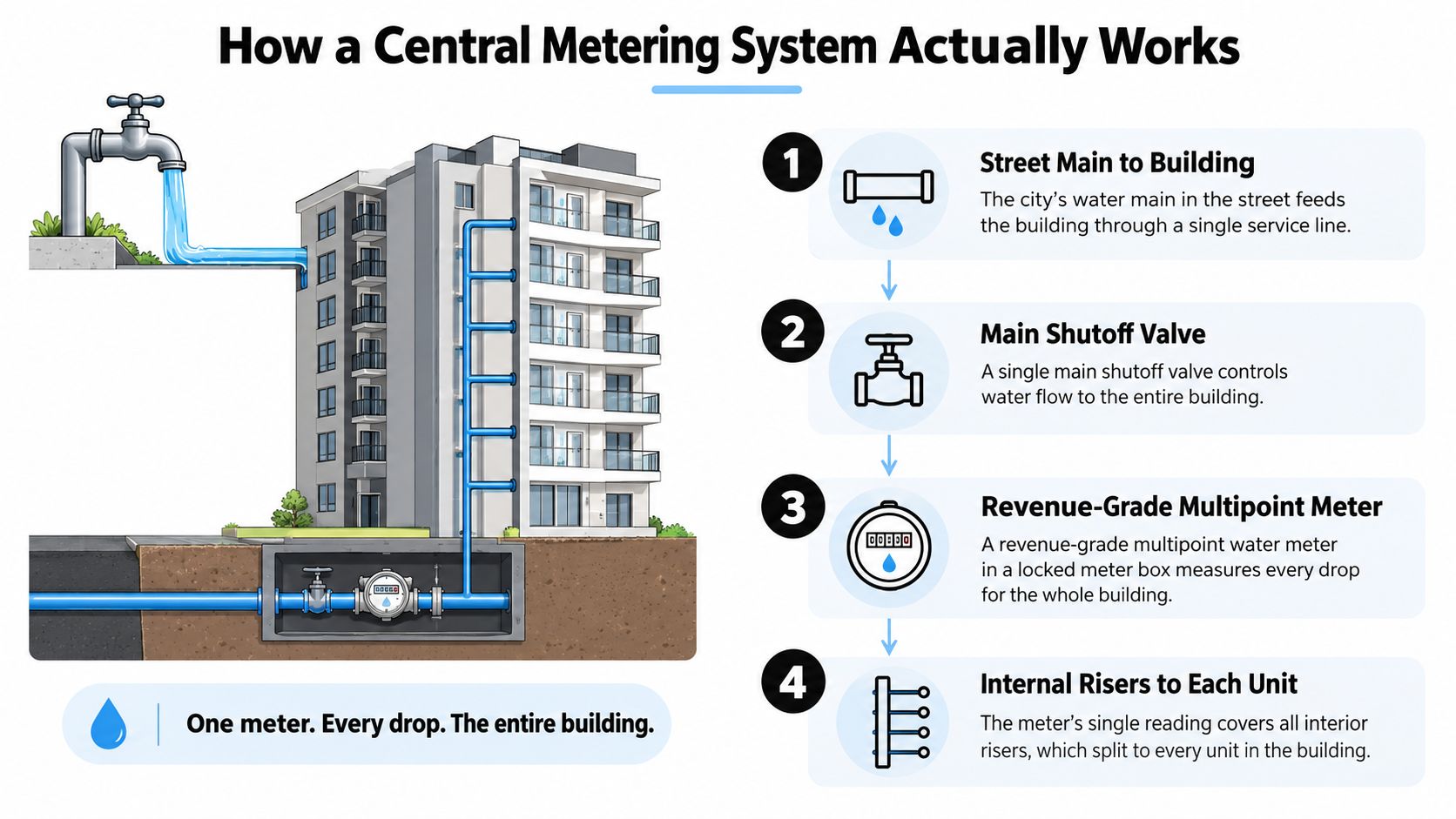
The important boundary is the meter's location. A utility meter at the service entrance measures the whole supply. A submeter installed farther downstream measures only part of that supply, such as a suite, retail unit, floor or common area. Owners evaluating how metering systems work should map the service entrance, distribution paths and intended billing points before choosing equipment.
For a broader explanation of how monitoring differs from ordinary utility measurement, owners can also compare home energy monitors with systems designed for formal allocation and billing. A monitoring device can help an operator understand usage without necessarily serving as the legal basis for a tenant charge.
Central Metering Compared to Unit Submetering
The practical difference is simple. Central metering measures the building as one customer, while unit submetering measures defined portions of that supply, often one suite at a time. The distinction affects more than hardware. It changes who receives the bill, how costs are recovered and how quickly an operator can identify unusual consumption.
Factor
Central Metering
Unit Submetering
Utility relationship
Usually one main account for the property or service
The utility supply may remain central, but internal meters record each defined unit
Measurement point
One meter at the service entrance
Meters downstream at suites, commercial units or selected common areas
Cost recovery
Often based on bundled charges, flat fees or an allocation formula
Charges can be tied more closely to measured unit consumption where permitted
Tenant visibility
Residents may see only an allocated amount or shared bill
Residents can receive usage information associated with their own suite
Leak detection
A building-wide change can be visible, but the source remains unclear
Unit-level changes can help narrow the location of a leak
Dispute exposure
Residents may challenge the fairness of the formula
Disputes may focus on meter accuracy, reading periods or billing rules
Conservation signal
Individual residents may have little connection between behaviour and cost
Consumption data can make the effect of behaviour easier to understand
Central metering can be a reasonable choice when the owner deliberately absorbs the utility cost or when a simple allocation is accepted by the building's governing documents. It becomes harder to defend when one small suite and one large suite pay the same share despite different usage patterns, or when residents have no way to understand an unexpected charge.
Submetering doesn't automatically solve every problem. The owner still needs suitable equipment, accurate commissioning, a lawful billing process and a clear explanation for residents. In Ontario, guidance distinguishes the utility meter that determines the bill from submeters that measure part of the supply inside the building. The distinction is explained in this resource on submetering electricity, and it should be reflected in contracts, notices and billing statements.
Leak management is another major difference. A central meter may show that the whole building is using more water, but it can't tell the operator whether the source is a suite toilet, a common-area washroom, a mechanical room or a buried service. A submetered property can compare unit patterns and common-area consumption, giving staff a narrower place to start an investigation.
Where Central Metering Works Well
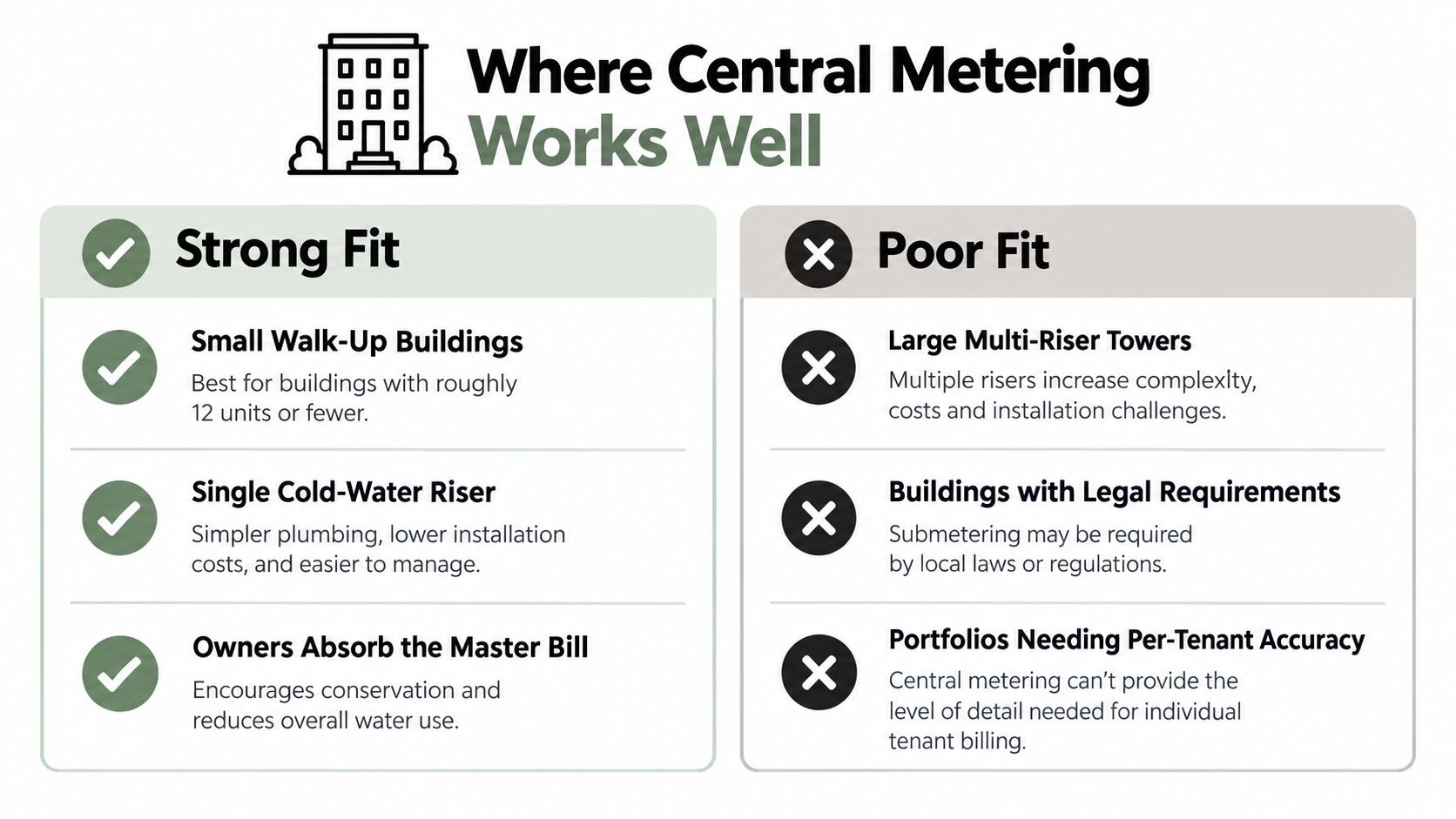
Central metering works best when its simplicity solves a real management problem without creating a larger fairness problem. The strongest fit is usually a small, straightforward building where the owner has limited distribution complexity, occupants accept bundled utilities and the cost of installing and maintaining individual meters wouldn't produce a useful operational return.
A small walk-up with shared services may fit this model. If the owner lives nearby, knows the plumbing layout and treats water as part of the rent, one reliable master meter can provide enough information to monitor the property as a whole. The arrangement is less attractive if residents expect detailed usage-based billing or if the building has several distinct commercial and residential loads.
Mixed-use properties need a more careful boundary. A retail tenant with its own dedicated meter may have a clear responsibility for its consumption, while the residential portion can remain centrally measured if the allocation method is transparent and accepted. The owner should still separate common areas, shared mechanical systems and any service that benefits both sides of the property.
The conditions that support a good fit
Central metering has a stronger case where:
- The distribution is simple: Suites share a main riser or service, and the owner can inspect the system without opening finished walls throughout the building.
- The bill is intentionally bundled: Rent, condo fees or an operating budget already covers the utility, so the owner isn't promising a precise usage charge.
- The property has limited internal variation: Similar suites and consistent occupancy make a basic allocation less contentious.
- The owner values administrative simplicity: One account and one reading may reduce coordination with multiple utility accounts and internal billing processes.
Older buildings can also favour central metering because retrofitting individual meters may require access to shared risers, electrical rooms or finished suite walls. That doesn't make central metering automatically better. It means the owner should compare the disruption, capital requirements and future operating benefits rather than assuming the existing arrangement is the right long-term design.
The model becomes a poor fit in a large tower with multiple risers, significant commercial loads, recurring tenant disputes or a strong need to recover actual consumption. It also becomes unsuitable if legislation, utility rules or condominium documents require a different arrangement. A central meter is a design choice, not a permanent exemption from those obligations.
Hidden Costs and Common Misconceptions
One building-wide bill isn't automatically the cheapest or simplest option. It removes some utility-account administration, but it can create work elsewhere. Staff may spend time explaining allocation formulas, reconciling estimated readings, investigating complaints and deciding whether unusual consumption reflects a leak or a change in occupancy.
A formula can also look neutral while producing a result residents consider unfair. Dividing the bill evenly treats different suites as though they have the same demand. Using floor area may be more consistent, but floor area still doesn't measure behaviour, fixture condition or occupancy. A landlord should document the method and explain its limits before the first dispute occurs.
Where the blind spots appear
Estimated billing can make residents suspicious, especially when the amount changes without a visible explanation. The owner may know that the total came from a utility bill, but the tenant wants to know how the building amount became their personal charge.
Leaks create another problem. A broken riser, running toilet or failed valve can increase the master reading without identifying the responsible location. The cost then spreads through the allocation method, while every resident has less incentive to report a problem that doesn't appear on their own meter.
Conservation is harder to manage when residents see no connection between usage and cost. Building staff can still promote efficient behaviour, but the central arrangement provides limited feedback at suite level.
The right response isn't to assume that every unusual reading requires immediate submetering. It is to treat the master bill as a starting point for diagnosis. Compare readings over time, inspect common areas and mechanical equipment, review maintenance calls and establish who is responsible for investigating unexplained changes.
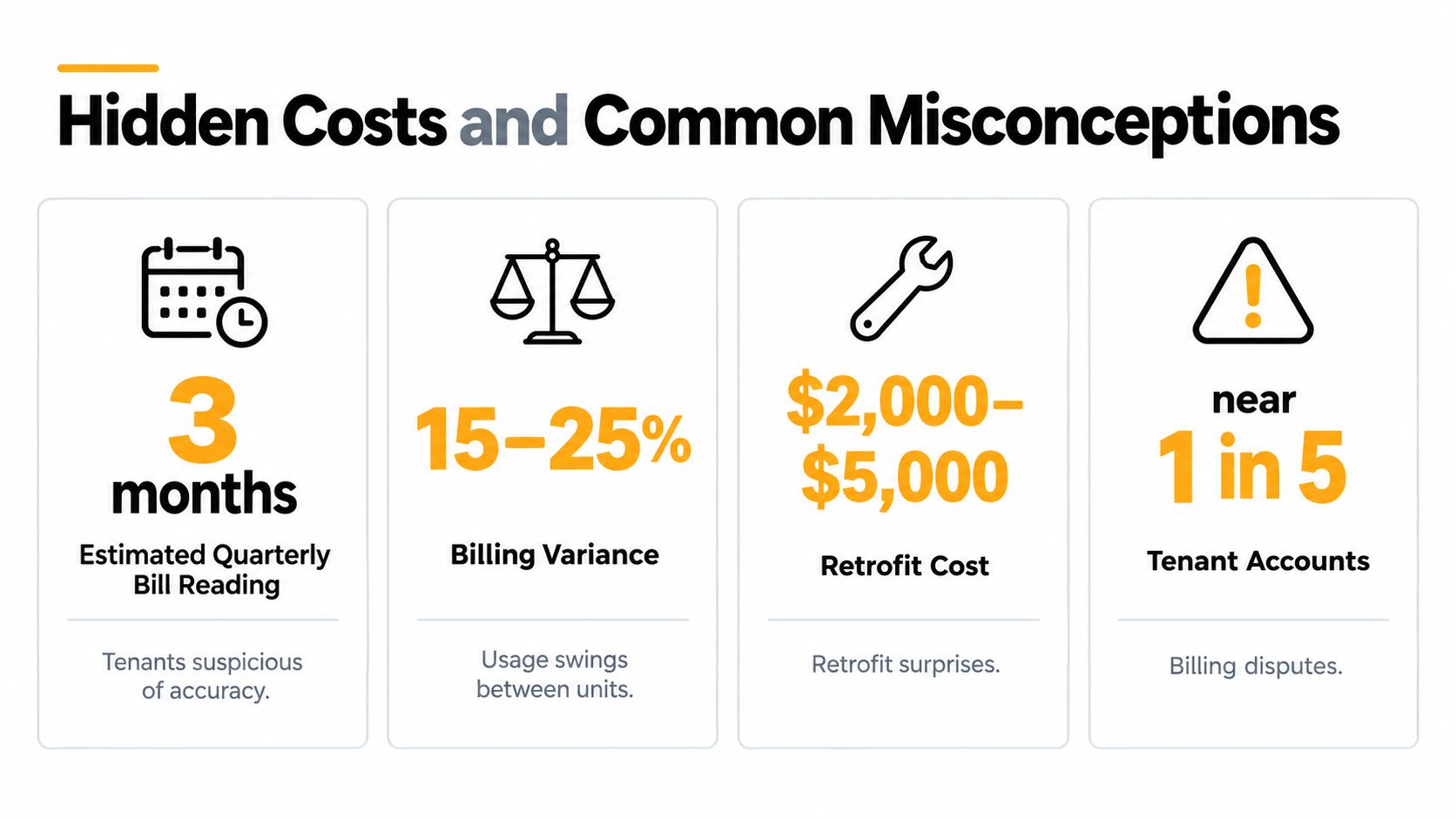
Operational warning: If the only available data is a single building total, the owner can confirm that consumption changed but may not be able to locate the cause.
A central arrangement can also conceal the difference between tenant consumption and base load. Common-area fixtures, irrigation, laundry equipment, heating systems and maintenance activities may all sit inside the same total. Without separate measurement points, the property team has to estimate which part of the bill is controllable and which part is unavoidable.
Real Scenarios From Multi-Family and Mixed-Use Buildings
Consider a mid-rise condominium where water is included in condo fees and one utility bill covers the property. Residents notice that some households appear to use much more water than others, but the corporation has no suite-level readings to support a detailed comparison. The immediate pressure point is fairness. The likely outcome is continued shared billing until repeated complaints, a major leak or a capital planning exercise makes better visibility worth pursuing.
A mixed-use tower presents a different challenge. The retail tenant has a dedicated meter, so the commercial load is easier to separate. The residential portion still relies on an allocation by unit count, however, and an unusual seasonal increase affects every household. Residents question why their charges changed when they can't see whether the increase came from suites, shared systems or a common-area issue.
A small walk-up can produce the opposite result. The owner may remain on site, understand the plumbing, respond quickly to maintenance calls and include water in the rent. If the building has few disputes and the shared system is in good condition, central metering can remain practical. The trigger for change would usually be a different operating reality, such as a leak that keeps returning, a change in tenancy expectations or a renovation that opens access to the service lines.
Building Type
Allocation Method
Main Pressure Point
Typical Outcome
Mid-rise condominium
Shared fees or a building allocation
Residents question unequal consumption
The corporation reviews submetering during a capital or governance discussion
Mixed-use tower
Separate commercial meter with an internal residential allocation
Seasonal changes affect residents without clear cause
The owner examines common-area and residential measurement boundaries
Small walk-up
Bundled utility cost or a simple owner-managed split
Low visibility is acceptable until maintenance problems grow
Central metering may continue while the system remains easy to manage
These examples show why building type alone doesn't determine the answer. The same master-meter arrangement can be sensible for one owner and operationally frustrating for another. The deciding factors are usually the quality of the allocation method, the owner's ability to investigate anomalies and the residents' expectations about paying for actual use.
Regulatory and Compliance Considerations in Canada
A meter can look accurate on a wall and still be unsuitable for recovering costs from a tenant. Owners need to separate three questions: Is the device measuring the utility supply for the utility's bill? Will its reading establish a charge to a tenant or purchaser? Does the proposed allocation fit the province or territory, utility tariff, lease and condominium documents?
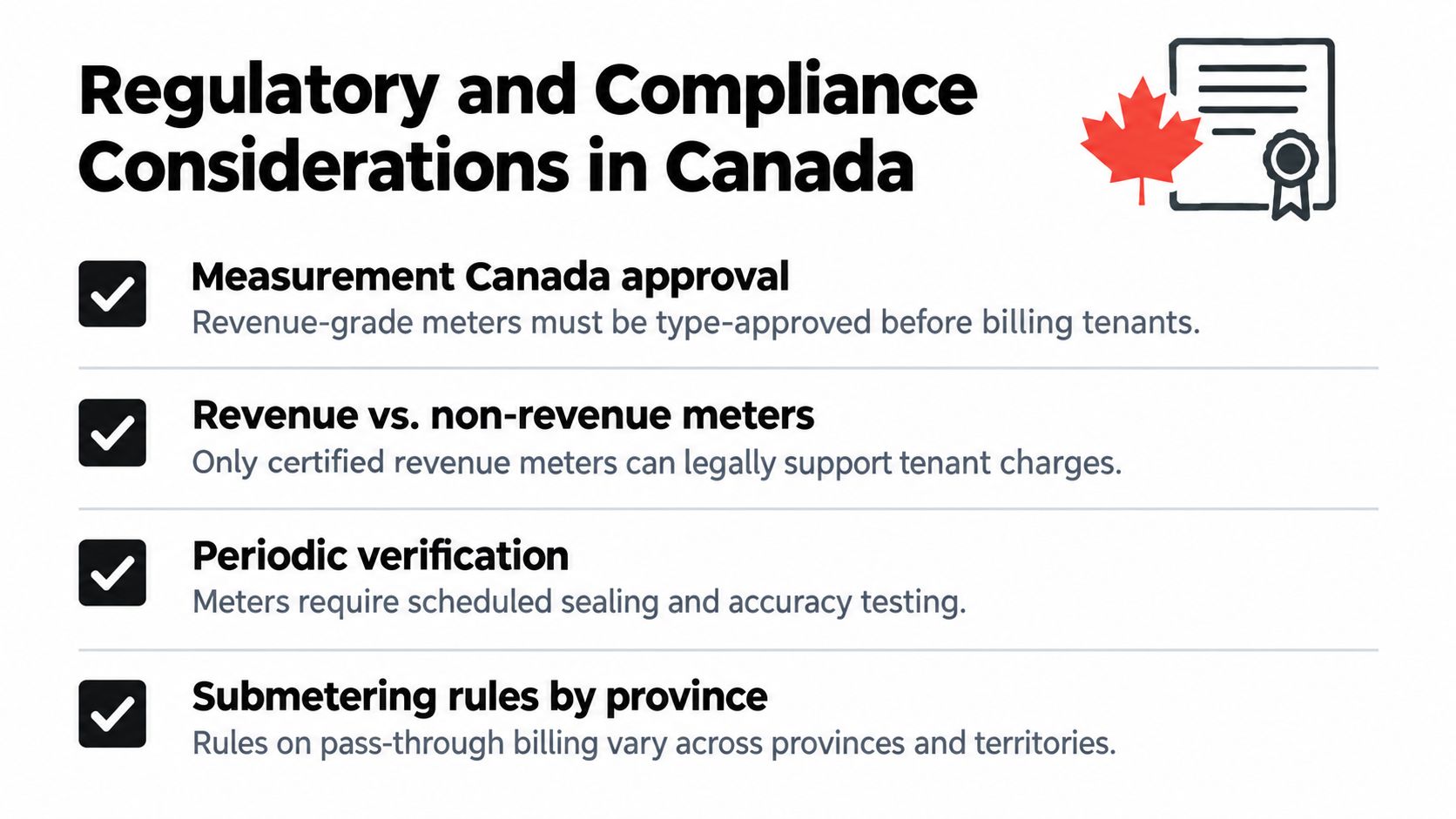
In Canada, a meter used to establish a charge for electricity or gas is treated as a revenue meter. Ontario guidance includes submetering and apportionment metering used to bill individual purchasers in a multi-unit complex. Where a meter supports trade measurement, the owner must consider approval, verification, sealing, maintenance and contractor registration requirements under Measurement Canada. Review the Measurement Canada requirements for revenue meters and this guide to Measurement Canada-approved meters before changing a billing system.
A monitoring device serves a different purpose. It can help building staff compare common-area demand, investigate a suspected leak or track equipment performance, yet that reading may not support a tenant invoice. Contracts and billing procedures should identify which devices provide operational information and which ones establish a charge. That distinction can prevent disputes when a dashboard reading and an invoice do not match.
Questions to resolve before changing the system
- Who owns the meter? Confirm whether the utility, owner, condominium corporation or service provider handles maintenance, testing and replacement.
- What establishes the charge? Record the exact meter reading, allocation formula and billing period used for tenant invoices.
- Which rules apply? Ask the utility and legal counsel whether provincial measurement, tenancy, condominium or consumer-protection requirements affect the proposed arrangement.
- How is accuracy maintained? Confirm approval status, verification procedures, seals, records and the process for investigating a disputed reading.
- How does whole-building reporting work? Natural Resources Canada explains that building performance systems need meters and service points that can be combined into complete whole-building usage. Its multifamily ENERGY STAR Portfolio Manager score has been available since August 2021, as described in the Canadian building performance research.
Toronto's reporting guidance shows why measurement boundaries affect operations. The city recommends separate utility meters where possible and identifies submeters or cost-sharing agreements as alternatives for prorating shared consumption. Ontario owners should also check utility service standards and applicable licensing requirements. Hydro One's retail metering guide describes central metering as a discretionary arrangement with limits on the number of buildings and the total calculated or anticipated load current. Those limits can affect a new design, even if the existing system has operated for years. Clear boundaries and documented meter responsibilities give owners a stronger basis for billing, leak investigations and compliance decisions.
Choosing the Right Path for Your Building
Start with the building's operating reality, not with a preference for one type of meter. Review the utility bills, allocation complaints, maintenance records, leak history, lease language and distribution layout. Then choose the arrangement that gives the property enough information for its actual decisions.
Keep central metering when the property is small, the utility is intentionally bundled and occupants accept the arrangement. This path makes sense when the owner can inspect the system, respond to abnormal readings and explain the allocation method without promising suite-level precision. It should still include regular review of the master reading, common-area demand and maintenance conditions.
Add or retrofit submetering when the owner needs stronger cost recovery, residents want charges linked to their own use or the property team can't locate unexplained consumption. Unit-level electricity, water, gas or thermal meters can be used selectively, subject to the utility and legal requirements that apply. The business case should include installation access, commissioning, tenant communication, billing administration, meter maintenance and the value of earlier leak detection.
Use a hybrid arrangement when the building has different loads that deserve different treatment. A central meter can continue to capture the bulk supply while submeters distinguish commercial units, high-load spaces, common areas or selected residential services. This approach can improve visibility without requiring every part of an older building to be redesigned at once.
A practical decision check
Before signing an agreement or approving construction, ask:
- What problem are we solving? Is it billing fairness, leak response, reporting, cost recovery or a combination?
- Where are the boundaries? Separate suites, common areas, mechanical systems and commercial loads on a clear site plan.
- What will residents receive? Define the reading period, charge calculation, dispute process and contact point.
- Who carries the ongoing responsibility? Confirm ownership, maintenance, verification, billing, collections and replacement obligations.
- What happens when the building changes? Account for renovations, new loads, changing tenancy rules and future utility requirements.
Central metering isn't automatically outdated, and submetering isn't automatically justified. The right question is whether the building has enough measurement detail to operate fairly, control losses and meet its obligations. Owners should revisit that decision as the property ages, systems change and residents expect clearer evidence behind every utility charge.
Axis Meter Solutions provides turnkey submetering for multi-family, condominium, mixed-use and commercial properties, including equipment, installation, commissioning, tenant billing and ongoing service. If you're assessing whether central metering still fits your building, visit Axis Meter Solutions to review options for electricity, water, gas and thermal energy measurement.
Ready to Optimize Your Utility Management?
Tell us about the property, utility, number of units, and your billing or monitoring goals. We'll help you identify the right next step.
Book a Call