Condo Board Responsibilities: A Practical Guide for Boards
You've just been elected to your condo board, and the first package lands in your inbox. There's a budget you didn't write, a leak complaint from the fourth floor, and a reserve report full of unfamiliar terms. Owners expect answers at the next meeting, even though you're still learning what the board can decide on its own. That's normal. Condo board responsibilities become manageable once you treat each one as a decision that needs a record you can show owners.
Table of Contents
- Core Board Responsibilities at a Glance
- Fiduciary Duty and How It Shapes Each Decision
- Budgets, Reserves and Owner Fees
- Reserve Studies and Capital Project Decisions
- Utility Submetering and How Costs Are Split
- Maintenance, Repairs and the Unit Boundary
- Insurance, Contracts and Rule Enforcement
- Records and Owner Communications That Hold Up
- Pick Your First Board Action This Quarter
Core Board Responsibilities at a Glance
A condo board is a group of elected owners who govern the corporation on behalf of all owners, set direction, and hold the property manager to account while the manager runs daily operations.
That distinction matters. The manager books trades, sends notices, and processes payments. The board approves the money, chooses priorities, and answers for the result. When owners challenge a fee increase or a repair delay, they rarely ask what the board intended. They ask what it decided, when, and on what information.
How to read the duty table
Read each row as a checklist item for an annual review. If you can't produce the record in the third column, the duty isn't finished, even if the work got done.
Duty area
What the board must do
Records to keep
Common failure
Financial oversight
Approve the annual budget and review monthly statements
Budget, ledgers, bank reconciliations
Spending that outruns income and forces a special assessment
Reserve planning
Commission a reserve study and fund reserves every year
Reserve study, funding plan, contribution records
Reserves that lag behind component ageing
Maintenance and repairs
Inspect common property, approve repairs and schedule upkeep
Maintenance log, inspection reports, contracts
Deferred repairs that grow into larger projects
Insurance
Maintain the master policy and review coverage each year
Policy, certificates, annual coverage review
Coverage gaps discovered after a loss
Contracts and vendors
Obtain competing bids and approve service contracts
Signed contracts, bid files, conflict declarations
Contracts awarded to connected parties
Rule enforcement
Adopt rules and apply them consistently
Rule register, notices, hearing minutes
Uneven enforcement that owners see as favouritism
Owner communications
Issue notices, hold meetings and report on finances
Minutes, notices, annual reports
Information gaps that turn routine decisions into disputes
The pattern is consistent. Financial oversight fails when spending drifts without monthly review. Reserve planning fails for years, then arrives as a large levy. Maintenance, insurance, and contracts fail in the gaps between renewals and inspections.
Start with money and long term planning, because those choices limit every other choice. Utility billing and the unit boundary come next, since they create the most day to day friction between neighbours. Records tie all of it together.
Fiduciary Duty and How It Shapes Each Decision
Fiduciary duty means you must act in good faith and in the best interests of the corporation as a whole. Not your floor, not your friends, and not yourself. It's a practical standard, not an abstract slogan, and it breaks into three working duties.
Duty of care means making an informed decision. Read the manager's report before the meeting. Ask the engineer why a component has five years left instead of ten. Get more than one quote before committing funds, and don't vote on a major contract you haven't seen.
Duty of loyalty means putting the corporation first when your interests overlap. Declare a conflict early, leave the discussion where required, and don't steer work to relatives or businesses you have a stake in.
Duty of compliance means staying inside your authority. Follow the declaration, bylaws, rules, and applicable legislation, even when a shortcut looks faster.
One conflict handled properly
Say a director's brother in law bids on the landscaping contract. The price may be fair, but fairness alone doesn't solve the problem. The director declares the relationship before discussion, leaves while the board compares bids, and abstains from the vote. The minutes record the declaration, the departure, and the abstention.
That short record protects everyone. Owners can see the contract wasn't steered, and the director can show they didn't influence the result.
A reasonable decision made after reasonable inquiry, and documented at the time, is far easier to defend than a good outcome nobody can reconstruct later.
Standards and remedies vary by province, state, and governing documents, so confirm local rules with counsel rather than relying on general guidance. This isn't legal advice for a specific corporation.
Before every vote, ask three questions out loud. Is this within our authority? Is the information sufficient? Does anyone here have a conflict? If any answer is unclear, pause and fill the gap first.
Budgets, Reserves and Owner Fees
The annual budget isn't a single vote. It's a cycle the board repeats, checks monthly, and explains in language owners can follow.
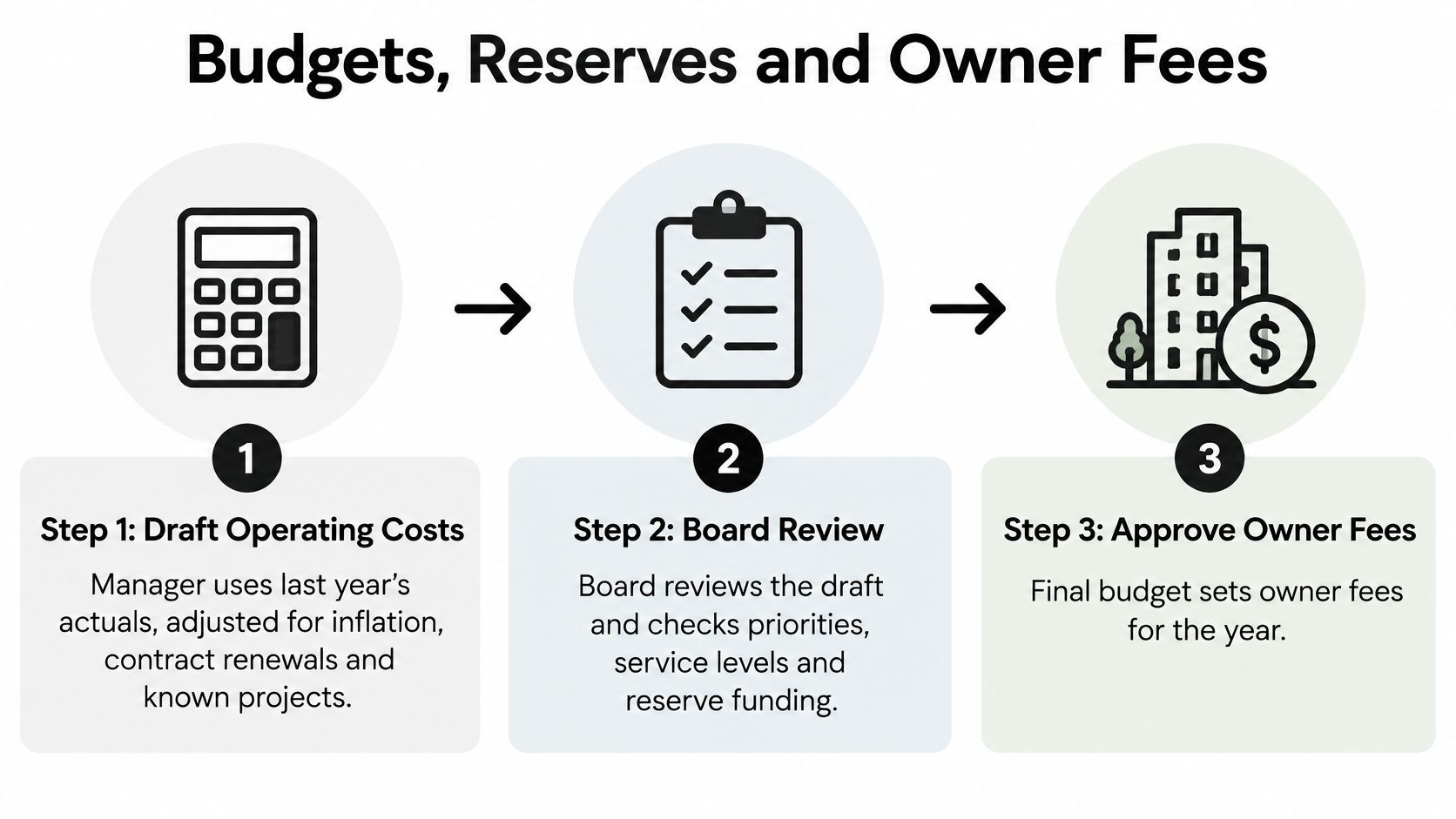
The four step cycle
- Draft from actuals. The manager builds operating costs from last year's results, adjusted for inflation, contract renewals, and known projects.
- Separate and test. The board separates operating expenses from reserve contributions and tests assumptions for utilities, insurance, and service contracts.
- Circulate and explain. Owners receive the budget within the timeline in the governing documents, with a plain explanation of any increase.
- Monitor monthly. The board reviews a variance report, flags lines running well over budget, and checks receivables from owners behind on fees.
That last step is where small problems stay small. A utility line creeping upward for three months may point to a leak, a rate change, or a billing error. Catching it early costs less than explaining a year end deficit.
Owners remember the opposite pattern. Say a roof reaches failure without enough money reserved, and the board levies several thousand dollars per unit on short notice. Comparing quotes helps, and repair pricing insights from Rooftop Solutions can give directors context for questions, but no quote fixes years of underfunding.
Use outside benchmarks only as a reality check. A Canadian Condominium Institute survey reported that approximately 63% of surveyed corporations contributed more than $2,000 per voting unit annually to reserve funds. That's a Canadian benchmark, not a target for your building. A California board, for example, anchors contributions to its own reserve study.
The same discipline applies when directors think about the building as a long term asset, a perspective covered in this guide to multifamily investing and operating decisions. Set contributions from your component list and funding plan, not from habit or last year's fee. Record why you changed the amount, what assumption changed, and when you'll review it again.
Reserve Studies and Capital Project Decisions
A reserve study gives the board an engineer's inventory of what will wear out, when, and at what cost. Done well, it turns a vague worry about ageing systems into a schedule owners can fund gradually.
The board package for a reserve discussion should look like a working session, not a rubber stamp.
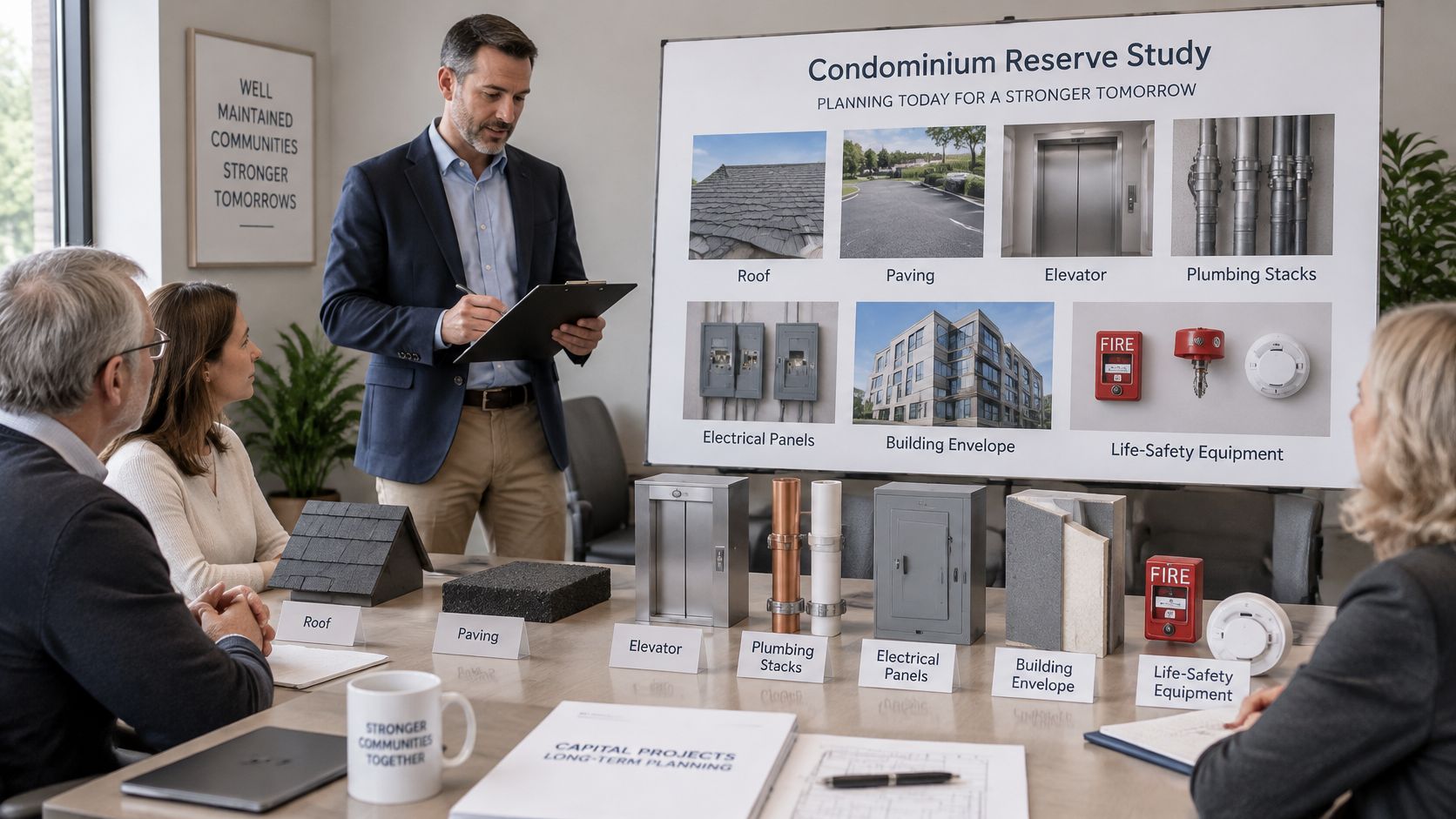
For each major component, including roofs, paving, elevators, plumbing stacks, electrical distribution, the building envelope, and life safety systems, the study records remaining useful life, replacement cost adjusted for inflation, and the annual contribution needed. Keep an asset register that links each item to inspection evidence and current funding.
California shows how specific this duty can get. Under California Civil Code section 5550, when the replacement value of major components equals or exceeds one-half of the association's gross budget, excluding reserves, the board must commission a visual inspection at least once every three years, the study must identify components with remaining useful lives of 30 years or less, and the board must review it annually. Your jurisdiction may differ, but the logic travels well.
A simple funding gap
Say a component will cost $100,000 to replace and has ten years of life left. Before interest and inflation, that's about $10,000 a year, less reserves already held for it. If the board contributes half that amount, it hasn't saved owners money. It has deferred the other half to a future levy, a loan, or both.
The video below walks through how boards discuss that kind of gap with professional advice in the room.
Capital project decisions in order
- Confirm condition. Rely on the engineer's report, photographs, and inspection notes, not age alone.
- Compare funding. Test reserves, a special assessment, and borrowing against the same project cost.
- Check approval rules. Review governing documents and legislation for owner vote thresholds.
- Set schedule and contingency. Allow for overruns instead of budgeting to the lowest quote.
- Report the reasons. Show owners the condition, the gap, the options considered, and the choice made.
Update assumptions after a major repair, sharp price increase, or new inspection finding. A board using old numbers isn't being conservative. It's deciding blind.
Utility Submetering and How Costs Are Split
Utility billing becomes contentious when the shared bill grows faster than fees and owners can't see any link between what they use and what they pay. A large household and a single retiree who keeps the thermostat low may pay the same amount under an even split. That feels unfair, but fairness alone doesn't tell you which method to choose.
Treat this as a cost recovery and accountability decision, not just bookkeeping. You're deciding who bears variable costs, who bears fixed system costs, and what evidence an owner receives with each bill. Background on how submetering works in practice helps directors separate the metering technology from the billing policy.
Method
How costs are split
Main benefit
Main risk
Bulk billing through common fees
Shared equally or by ownership share within the general fee
Simple to run and needs no meter installation
Heavy users subsidised by light users, with no link to use
Flat allocation by unit or floor area
Fixed share based on unit count, floor area or share entitlement
Predictable and easy to explain to owners
Ignores actual consumption, so low users may be overcharged
Submetered usage billing
Each unit pays its metered use plus a share of common-area costs
Costs follow use and encourage conservation
Meter installation, billing and dispute costs, plus a lawful rate and disclosure
Hybrid of fixed base and metered use
Fixed charge covers shared fixed costs; metered charge covers variable use
Balances predictability with fairness to light users
More complex to explain and to administer
Criteria before you vote
- Variable share. How much of the total bill changes with unit use, and how much is fixed or common area consumption?
- Administration cost. What will meter reading, billing, support, and dispute handling cost each year?
- Owner impact. Which units gain or lose under each model, and can you explain why in one page?
- Legal requirements. What do local rules require for rates, itemised bills, meter standards, and fees?
Fee pressure makes the choice harder to postpone. For 2024, a Canadian Condominium Institute treasurer's report showed a 10% increase in total condominium fees and an 18.9% increase in reserve-fund contributions. Present those Canadian figures as sector context only. They show pressure on fees, but they don't set a rule for splitting utilities in your building.
Practical rule: Don't vote on a billing method until you've modelled at least two methods against the same twelve months of bills.
Collect a full year of consumption and cost data first, since heating and water use are seasonal. Where the building layout allows it, pilot one riser or wing and compare estimated bills with actual metered results. Before adopting usage billing, confirm itemised billing, meter standards, permitted administrative fees, the dispute process, and common area treatment under local rules. Put those answers in writing, because owners will ask for them after the first bill, not before it.
Maintenance, Repairs and the Unit Boundary
Most maintenance disputes start with one question. Whose component is it? Boards need to sort every shared system into three layers before something fails.
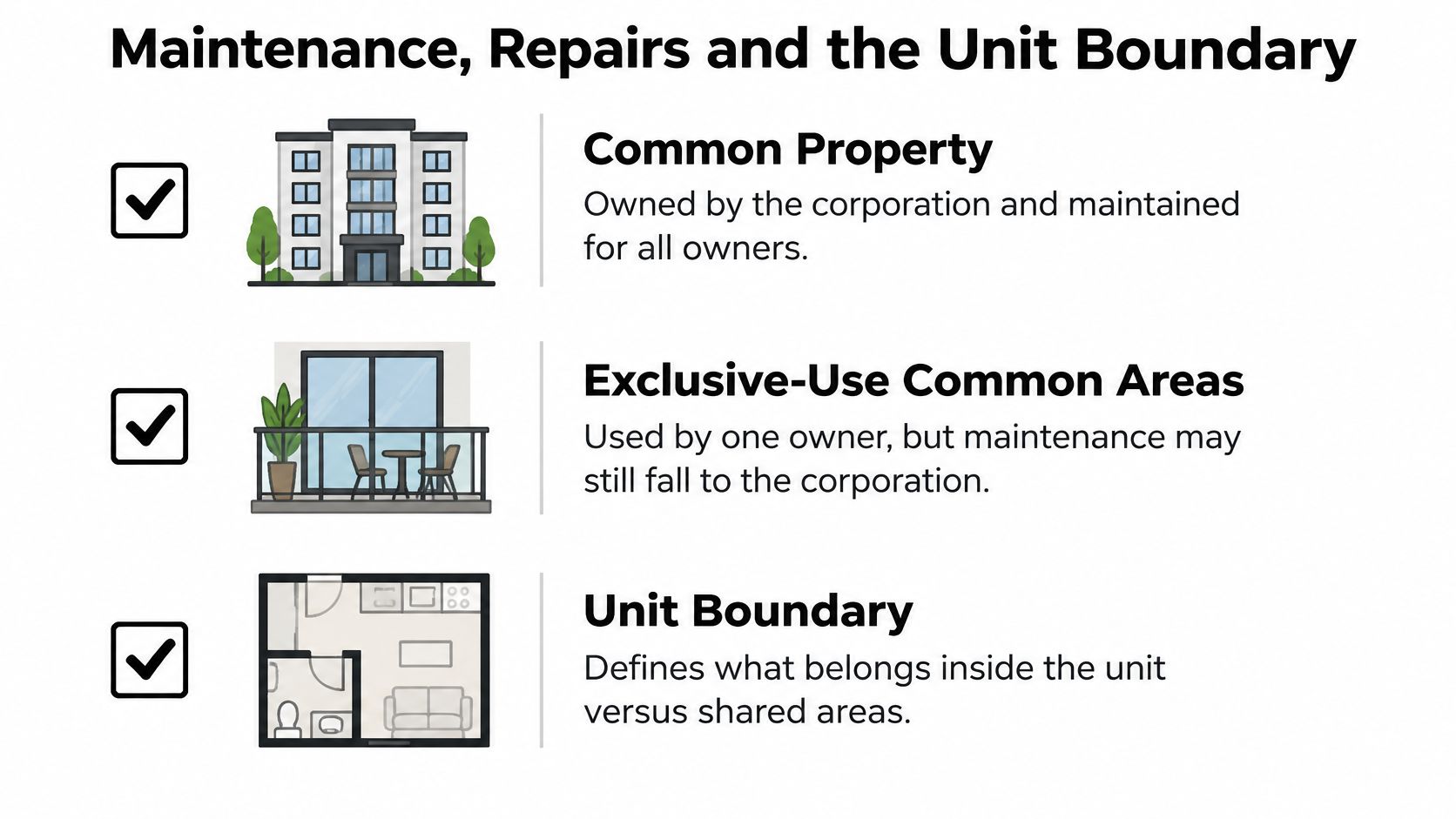
Common property belongs to the corporation and serves all owners. Exclusive use common areas are used by one owner, such as a balcony, but maintenance may still fall to the corporation. Unit owned components belong to the individual owner. The declaration and maintenance matrix, not the physical location alone, decide where an item sits.
Say a riser leaks inside a bathroom wall. A submeter sits on that riser inside the unit, and the shutoff valve is in the corridor. Those are three different record entries, even though one plumber may touch all three. The same mapping exercise applies to visible upkeep, and boards comparing exterior services can review what's involved in Professional Window Cleaning for condominiums before deciding frequency and access terms.
Component
Ownership layer
Responsible party
Test before an outage
Leaking riser through bathroom wall
Common property
Association
Map to declaration and maintenance matrix
Submeter on riser inside unit
Shared utility equipment inside a unit
Party named in the service agreement
Confirm owner and diagnosis cost in the service agreement
Shutoff valve in corridor
Common property
Association
Confirm after-hours emergency contact
California illustrates why location can mislead. Under California Civil Code section 4775, the association is generally responsible for repairs needed to restore gas, heat, water, or electrical service that begins in a common area, even when work extends into a separate interest, and must begin the repair process within 14 days of an interruption unless governing documents or a utility provider assign responsibility differently. Inside the unit doesn't automatically mean owner responsibility.
Build the operating system around that reality. Keep a preventive schedule, an emergency protocol with an after hours contact, tendered vendor approvals, and clear notice and access terms for entering units. Keep inspection logs with dated photographs, especially where early warning matters, such as a water leak detection system for shared plumbing.
Before an outage, test each shared system with four checks. Map it to the declaration. Name who pays for diagnosis. Record the access rule. Confirm the emergency contact. A board that answers those questions in advance spends the outage fixing the problem, not arguing about it.
Insurance, Contracts and Rule Enforcement
These three duties look administrative until something goes wrong. Then the board needs proof it reviewed, compared, and applied its own rules consistently.
Insurance you can verify
Confirm the master policy covers the building and common property at replacement cost. Obtain current certificates, then complete an annual review that compares limits, deductibles, and exclusions with the reserve study and recent claims. Ask what unit owner policies are expected to cover, including interior fixtures and damage after a common area failure, and tell owners where that boundary sits.
Contracts without surprises
Request competing written bids above the threshold in your governing documents. Score them in a bid file, collect a conflict declaration from each director, and approve the signed contract in an open vote. Keep a renewal register with expiry and notice dates, so a contract doesn't roll over because nobody diarised it.
Rules applied the same way
Keep a rule register with each rule, its adoption date, and the minutes that approved it. When you enforce a rule, send written notice that cites the rule, sets a compliance deadline, and offers the owner a chance to be heard. Record the hearing outcome. Enforcing one neighbour's parking breach while ignoring another's creates a favouritism complaint you can't answer without that paper trail.
Records and Owner Communications That Hold Up
Minutes are the board's main defence, but only if they capture more than the result. For each motion, record the exact wording, the vote, the reasons, any declared conflict, and any abstention. A reader two years later should understand why the board acted without calling a former director.
Records to keep organised
- Governance records. Minutes, bylaws, rules, and conflict declarations.
- Financial records. Budgets, statements, ledgers, reconciliations, and reserve studies.
- Property records. Inspection reports, maintenance logs, photographs, and warranties.
- Commercial records. Signed contracts, bid files, and insurance certificates.
- Owner records. Notices, complaints, hearing outcomes, and written responses.
Keep each category for at least the period your legislation or governing documents require, and store it where a new director or manager can find it. A record nobody can retrieve doesn't help in a dispute.
Owners also need regular information before there's a dispute. Provide a monthly financial package, or make one available on request, and issue an annual report that compares spending with budget. Write notices in plain language, state the reason and deadline, and answer written complaints in writing within a set period. Boards refining their routine messages can compare their approach with email best practices for HOA boards and adopt a consistent format for subject lines, deadlines, and follow up.
Say an owner disputes a water charge. Don't resolve it with a hallway explanation. Send a one page summary showing the meter reading, billing period, rate, common area share, and allocation formula. Attach the relevant reading history if there's an error to correct.
Owners don't need every invoice. They need to see the number, the method, and the reason in the same document.
That habit changes hard meetings. Owners may still dislike a fee increase or a special assessment, but they're more likely to accept it when the board shows its work without being forced to.
Pick Your First Board Action This Quarter
Don't try to fix all seven duty areas in one meeting. Run a sixty minute audit and mark each row as current, due, or overdue. You'll leave with a short list instead of a general sense that everything needs attention.
Check the reserve row first. Is the study current, does your jurisdiction require one, and when was the last inspection? If either answer is missing, make that your priority, because capital decisions built on stale condition data affect fees for years.
If utilities are the pressure point, gather twelve months of bills and model two allocation methods before any vote. If you're considering submetering, prepare the property location, unit count, piping configuration, current billing method, and whether you want remote readings, leak alerts, or resident billing. We cover property and existing system assessment, meter selection and system design coordination, installation, commissioning and data validation, recurring billing, account lifecycle support, and ongoing reporting, maintenance, and monitoring, so compare any proposals on that same written scope.
Confirm tenant payment responsibility in writing too. An owner who rents a unit can have the tenant open an account, but the owner remains responsible if the tenant fails to pay. Record the decision, reasons, and data in the minutes, then set the review date.
If your audit shows utility costs are driving fee pressure, Axis Meter Solutions can assess your property, coordinate submetering design and installation, and handle resident billing, inquiries, reporting, and ongoing maintenance so your board has clear consumption records to support its decisions. Share your property location, utility types, unit count, construction stage, and needed services to confirm fit and next steps. Visit Axis Meter Solutions to request a property specific assessment.
Ready to Optimize Your Utility Management?
Tell us about the property, utility, number of units, and your billing or monitoring goals. We'll help you identify the right next step.
Book a Call