Multifamily Investing: NOI, Cap Rates and Utility Costs

You're reviewing an apartment listing, and the broker's summary looks convincing. The rents seem reasonable, the building is mostly occupied, and the advertised return clears your target. Then you open the operating statement and find a master-meter utility bill that the seller has treated as a routine expense, even though you'll be responsible for every increase after closing.
That's where multifamily investing becomes an exercise in checking assumptions rather than admiring headline returns. Start with the income the property produces, work out what you're paying for it, and test whether financing and operating improvements leave enough cash for the risk you're taking.
Table of Contents
- The Core Metrics Behind Multifamily Investing
- How Net Operating Income Works, Step by Step
- How Cap Rates Convert Income Into Property Value
- Why Utility Bills Quietly Erode Your NOI
- How Submetering and Cost Recovery Change Returns
- Vacancy, Supply and Underwriting Checks to Run
- Confirm the Numbers Before You Make an Offer
The Core Metrics Behind Multifamily Investing
Multifamily investing means buying rental housing with multiple dwellings in one property. For this walkthrough, think of a larger apartment building rather than a house with a secondary suite. Several residents contribute rent, so an individual vacancy affects only part of the income, although shared repairs can still affect the entire property.
You don't need a complicated spreadsheet to begin. You need consistent definitions and a clear distinction between property performance and investor performance.
Core multifamily metrics, formulas and what they tell you
Metric
Formula
What It Tells You
Main Use
Net operating income (NOI)
Effective gross income minus operating expenses
Cash the property earns before debt payments
Valuation and lender sizing
Cap rate
NOI divided by purchase price
Unlevered income yield on the price
Quick pricing and market comparison
Cash-on-cash return
Annual cash flow after debt divided by cash invested
Cash return on your actual equity
Judging leverage and income
Debt service coverage ratio (DSCR)
NOI divided by annual debt payments
Cushion against loan payments
Lender approval and stress tests
Occupancy
Occupied units divided by total units
How fully the rent roll is working
Testing rent and lease-up assumptions
Read the metrics in the right order
Begin with NOI and cap rate to judge the property's income relative to its price. Then calculate cash-on-cash return and DSCR using an actual financing proposal, not an assumed loan that may be unavailable.
Finally, examine occupancy to test whether the rental income is believable. Physical occupancy tells you whether residents occupy the apartments. It doesn't tell you whether they're paying in full, receiving concessions, or approaching lease expiry.
Practical rule: A favourable financing structure can't repair an overstated operating income.
These metrics share much of the same underlying income. If you omit an expense, the property can appear more valuable, easier to finance, and more profitable to own at the same time.
Pull the rent roll and trailing annual operating statement for a listed property. Calculate the metrics yourself before reading the broker's interpretation, and record which inputs are actual, estimated, or projected.
How Net Operating Income Works, Step by Step
Treat NOI as the building's paycheque before the mortgage is paid. It measures the income from operating the property, independent of how you finance the purchase.
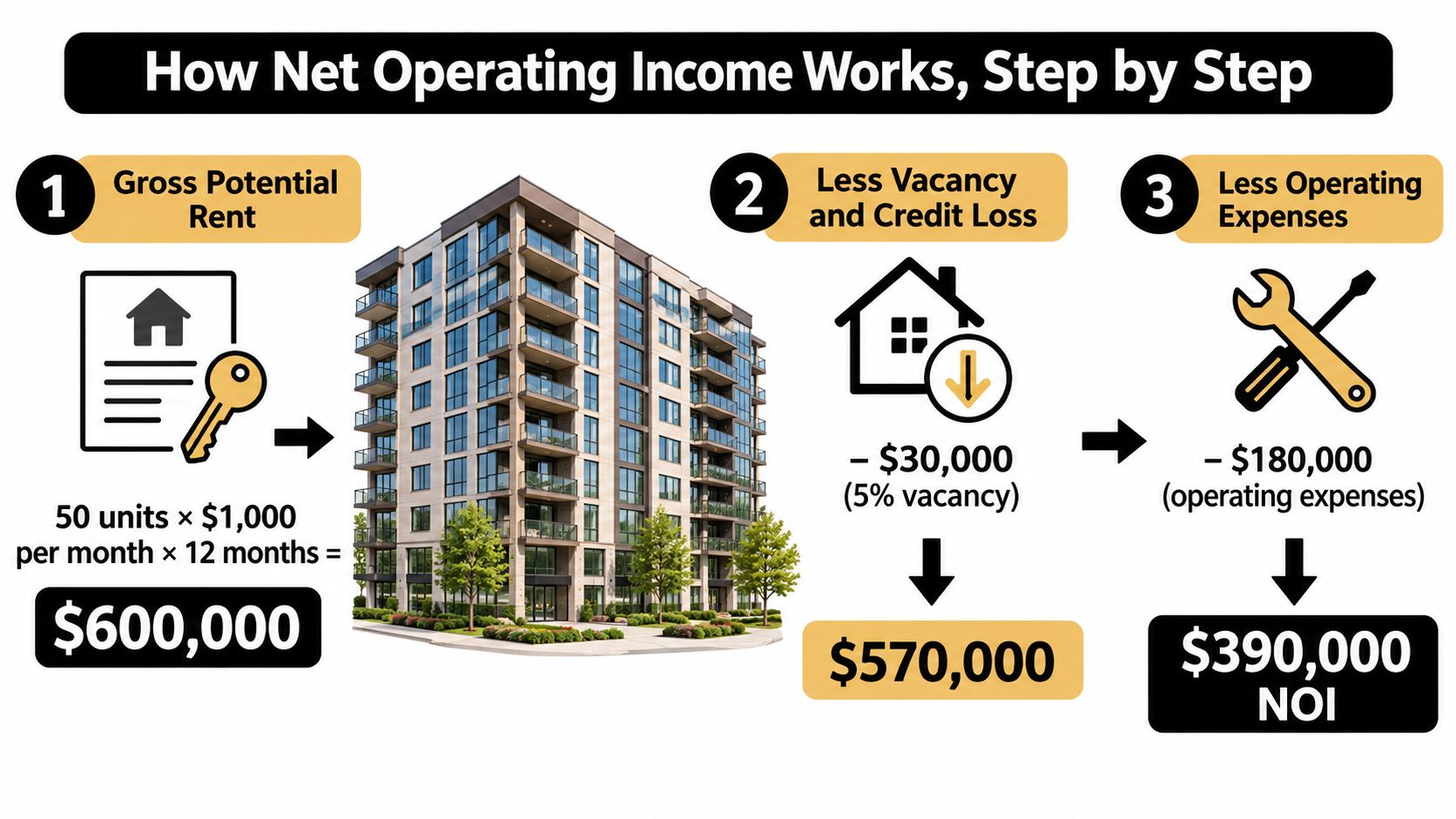
For a clearly hypothetical worked example, suppose a 50-unit building rents every apartment at $1,000 per month. These are teaching assumptions, not market rent estimates.
- Calculate gross potential rent.
The calculation is 50 × $1,000 × 12 = $600,000 annually. This represents full rental income before allowing for empty apartments or unpaid rent. - Deduct vacancy and credit loss.
Assume a 5% allowance, equal to $30,000, leaving $570,000. Vacancy covers income lost while apartments are empty; credit loss covers amounts billed but not collected. - Add other operating income.
Assume parking, laundry, and permitted fees contribute $20,000 annually. Effective gross income becomes $590,000, provided those amounts are collectible and aren't already included in rent. - Subtract operating expenses.
Assume property taxes, insurance, management, routine repairs, utilities, and other operating costs total $240,000. The resulting NOI is $350,000.
The diagram provides a visual check on the calculation sequence.
Separate operations from ownership cash flow
Mortgage payments sit below NOI. Subtracting them as operating expenses mixes the building's performance with your financing decision and understates its operating income.
Major roof or boiler replacements also need separate treatment from ordinary maintenance. Show capital expenditure and replacement reserves explicitly in your cash-flow model, and confirm how the lender treats reserves when sizing the loan.
An owner's distribution isn't an operating expense. However, if you manage the building yourself, include a realistic management expense rather than assuming your labour is free. LendingXpress's explanation of evaluating rental earnings before borrowing offers a useful companion to this distinction.
In this hypothetical example, the operating expense ratio is approximately 41%, calculated by dividing operating expenses by effective gross income. That isn't a target: compare the expense categories with similar buildings and investigate omissions, deferred maintenance, and costs likely to change after acquisition.
How Cap Rates Convert Income Into Property Value
A capitalisation rate, usually shortened to cap rate, expresses annual NOI relative to purchase price. Rearrange that relationship and you get the valuation formula:
Property value = annual NOI ÷ cap rate
The illustration shows why an unchanged income can support different prices.
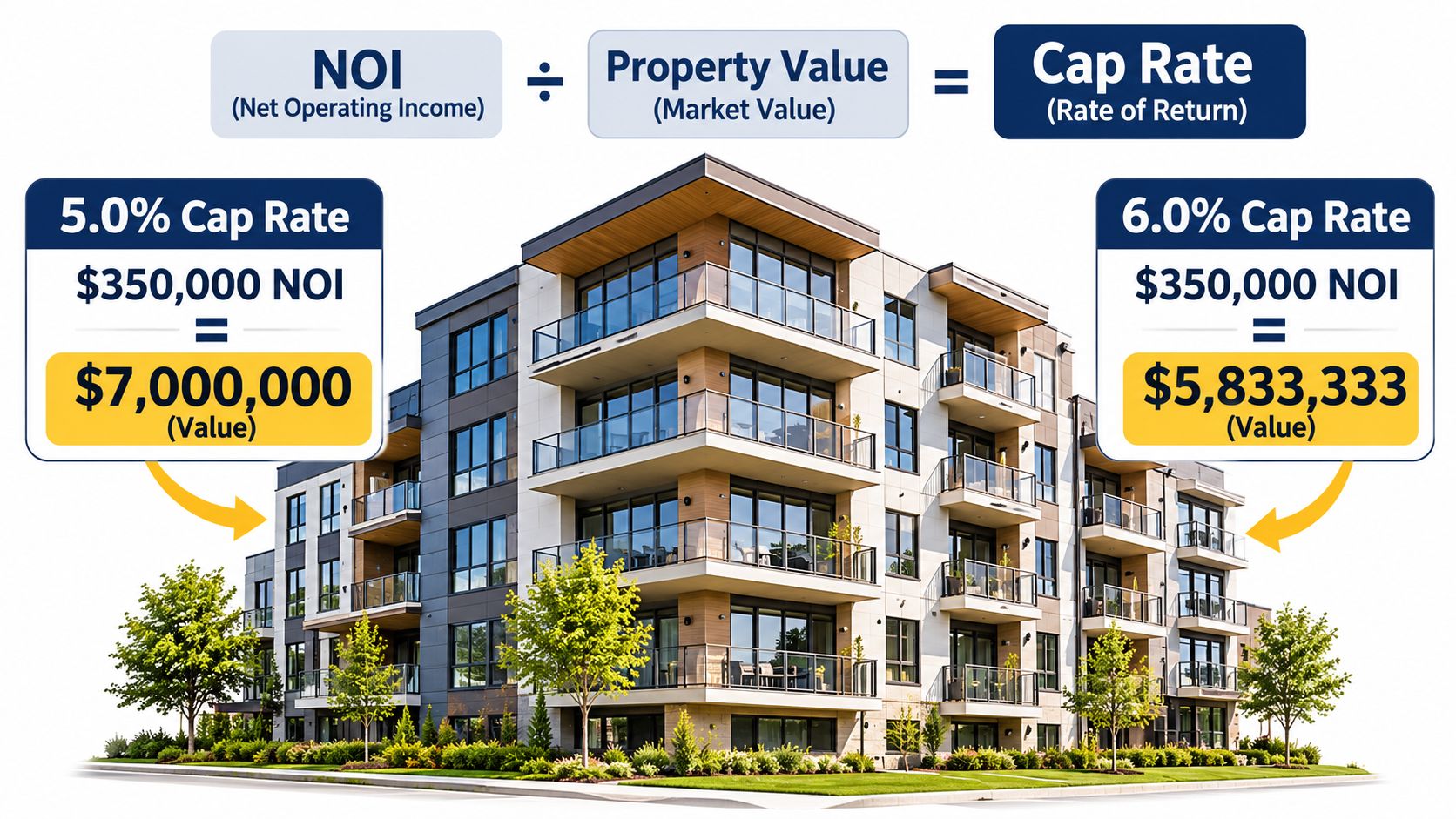
Using the hypothetical building, $350,000 ÷ 0.05 = $7,000,000. If a buyer instead requires a hypothetical 6.0% cap rate, the same income supports approximately $5,833,000.
Nothing changed in the apartments. The buyer required more annual income for each dollar invested.
Compare the price and the income together
A bond yield offers a useful analogy: the cap rate reflects the income yield a buyer accepts. Unlike a contractual bond payment, however, apartment NOI can change with collections, expenses, maintenance, and management decisions.
Lower cap rates mean buyers pay more for each dollar of current income. Buyers may accept that pricing for perceived stability, stronger growth prospects, or a preferred location, but those expectations still need testing.
California multifamily reference points, 2025
Market
Period
Price per Unit
Cap Rate
Orange County
Q1 2025
$442,000
4.5%
Orange County
Q3 2025
$447,000
About 4.4%
Los Angeles
Q4 2025
$355,000
5.0%
The Orange County figures come from Matthews Real Estate Investment Services' Q1 2025 report, which reports $442,000 per unit and a 4.5% cap rate, and its Q3 2025 report, which reports an average $447,000 per unit and cap rates around 4.4%. Matthews' Los Angeles Q4 2025 report reports $355,000 per unit and a 5.0% cap rate.
These published market figures aren't your deal's yield. Compare similar locations, building ages, conditions, and operating profiles, and check whether the seller's NOI is historical or projected.
Price per unit helps you compare acquisition cost, but it doesn't reveal expense efficiency. A cheaper apartment can still be expensive relative to the income left after operations.
For an additional visual explanation of the relationship, watch the following video.
Calculate the cap rate using your own defensible NOI, then compare it with the closest credible submarket transactions. Don't force your expense assumptions to match an advertised yield.
Why Utility Bills Quietly Erode Your NOI
With a master water meter, you receive a building-wide bill without necessarily knowing how much each household consumed. Ventura's 2025 rate-study materials describe multifamily properties as typically master-metered, with water included in rent or allocated among residents, and proposed charges combining recurring fixed fees and usage charges.
That distinction matters. If rents and other expenses remain unchanged, a higher owner-paid utility bill reduces NOI by the amount of the increase.
Identify what you're actually paying for
Don't treat the entire invoice as a consumption charge. Separate these categories before estimating savings or recovery:
- Consumption charges reflect measured water, electricity, or gas use. Reducing consumption can reduce this portion of the bill.
- Fixed meter or service charges apply independently of some or all consumption. Installing submeters doesn't automatically remove the building's underlying service charges.
- Common-area loads include shared lighting, irrigation, pools, parking, and amenity spaces. Measure or estimate these separately from household use.
Next, reconcile invoices with meter readings and maintenance records. Water used during vacant-unit cleaning, irrigation faults, running toilets, and concealed plumbing leaks can explain charges that don't match occupied-unit demand.
Older garden-style buildings deserve particular attention to buried lines and shared irrigation. Estimated readings can also delay recognition of unusual consumption, so check whether each invoice uses actual readings.
Recovering a bill and reducing a bill are different operating strategies. Evaluate both before deciding who should pay.
For electricity, a practical consumption-reduction review can help you organise equipment and usage checks. Airtight Spray Foam Insulation's guide to energy-saving upgrades for South Florida homes provides a separate residential retrofit perspective, but climate, construction, and tariff differences mean it isn't a California apartment savings estimate.
Before underwriting recovery, ask: What does each utility cost per apartment? What can the lease and applicable requirements support? Where is the consumption occurring? Keep fixed charges, resident consumption, and shared loads visible in the answers.
How Submetering and Cost Recovery Change Returns
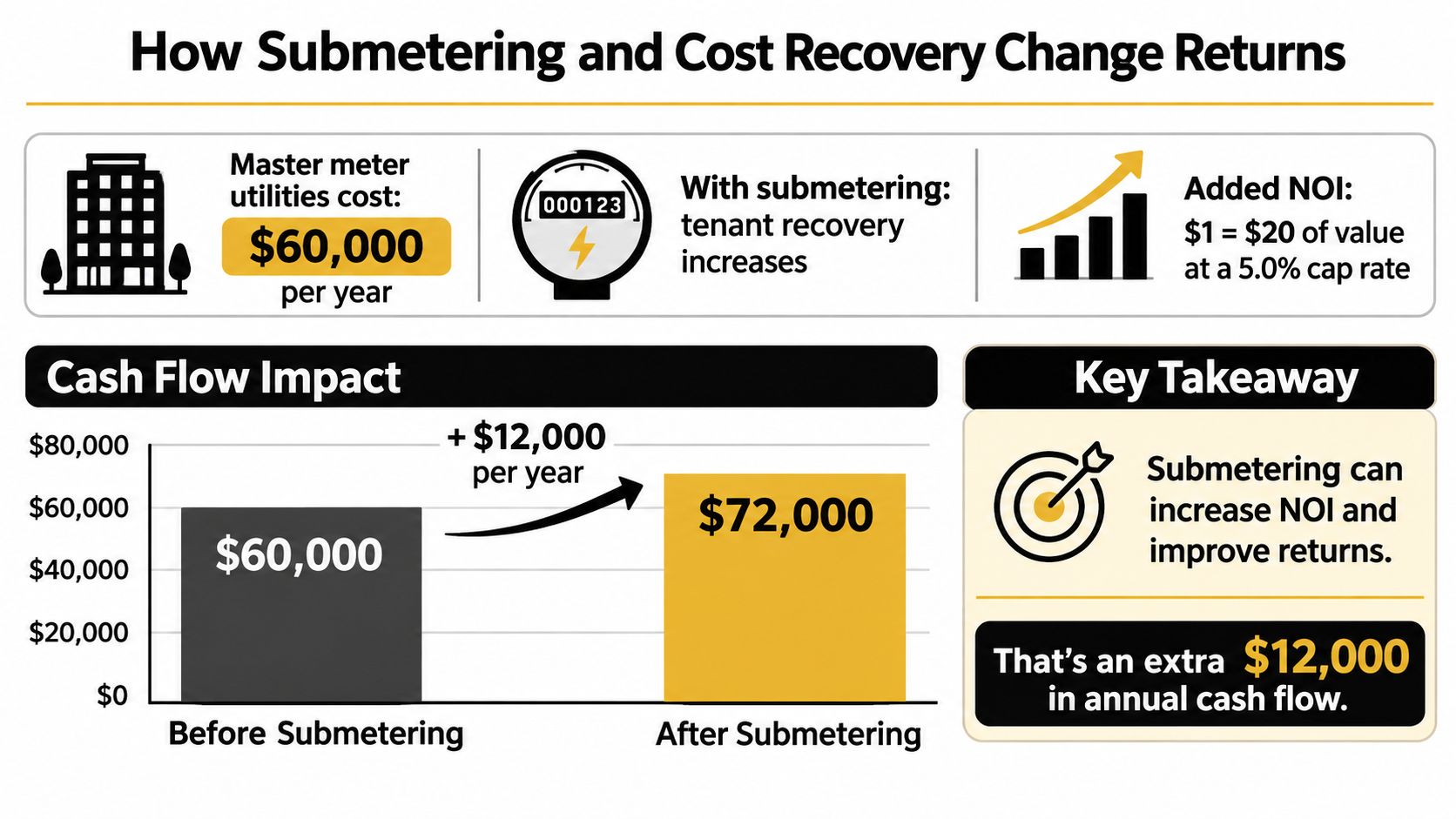
Suppose the hypothetical apartment building has an annual master-meter utility bill of $60,000. The scenarios below isolate recovery effects; they aren't forecasts or promises of achievable collections.
Utility cost recovery scenarios for a 50-unit building
Scenario
NOI Change
Master meter, no recovery
No change from baseline; no value change
Allocated billing, 50% recovered
$30,000 added annually before incremental costs; $600,000 indicated value increase at an assumed 5.0% cap rate
Submetering after program fees
Annual recovered amount minus annual program fee; indicated value change equals that net amount divided by 0.05
Under these assumptions, each dollar of sustainable additional NOI supports twenty dollars of indicated value. The calculation is a valuation sensitivity, not cash deposited into your account or a guaranteed sale premium.
Count net recovery, not invoices issued
Allocated billing distributes costs through an allocation method. Submetering measures unit-level use, although the permitted billing treatment still requires review. A water-submetering assessment for apartments should examine plumbing layout, shared consumption, meter placement, and the intended billing model.
A meter reading doesn't itself establish a right to charge a resident. Before including recovery in NOI, confirm lease terms, disclosures, tenant protections, applicable approvals, billing rules, and responsibility for unpaid amounts.
Then subtract programme fees, administration, collection losses, and any remaining owner-paid charges. Include installation capital in the investment cash-flow analysis where applicable, rather than treating every project cost as a recurring NOI expense.
The graphic summarises the hypothetical income-to-value relationship.
Test affordability alongside investment returns
The California Energy Commission's 2025 multifamily retrofit study reported that almost all participating residents used California Alternate Rates for Energy, which discounts electricity bills by 30% to 35% and also discounts natural-gas bills. That finding describes the study participants, not every California renter.
Residents receiving discounted tariffs may save fewer dollars from a given consumption reduction than an unsubsidised-rate calculation suggests. Owner savings also depend on who pays the original bill and which loads remain on the owner's account.
Model market-rate, deed-restricted, student, and affordable units separately. Test subsidised and unsubsidised tariffs where relevant, and keep water, gas, electricity, and common-area loads distinct.
Investment test: Resident affordability and owner cash flow should appear in the same model, not in separate sales presentations.
For a hypothetical downside case, reduce expected collections by 20% and increase the programme fee. If the investment only works with full collection and minimal charges, don't treat the base-case recovery as dependable acquisition income.
Vacancy, Supply and Underwriting Checks to Run
Long-term housing need doesn't guarantee immediate demand for your apartments at your asking rent. Rental vacancy and permit activity vary widely by region, and both shift faster than a statewide or national narrative can capture. Check current local data for the specific market, submarket, and rent band your units sit in.
A shortage and leasing pressure can sit in the same city at the same time. New supply may target higher rents than yours, or one overbuilt corridor can push concessions into buildings that otherwise look full. Your underwriting needs local competition, current financing terms, and realistic resident purchasing power.
Write down the assumptions that could break the deal
- Compare local and property vacancy.
Check competing buildings with similar rents, condition, and amenities. Investigate whether the subject property's empty apartments reflect market conditions, unfinished repairs, or weak leasing execution. - Map competing supply.
Review nearby construction and permits, separating approved proposals from buildings approaching delivery. New competitors may offer concessions even when their advertised rents stay high. - Test rent growth against household budgets.
Compare proposed rents with local incomes and competing listings. A renovation earns its cost only when residents can and will pay the increase it needs. - Read the restrictions.
Have qualified counsel review rent regulation, affordability covenants, and lease provisions. A market rent estimate isn't permission to charge it. - Verify utility recovery.
This is the check that turns a master-meter bill into a cap-rate question. Every dollar of cost that stays on the owner's account reduces NOI, and since value equals NOI divided by the cap rate, each dollar of unrecovered expense can multiply into a much larger reduction in the price you can justify. Identify the billing arrangement, confirm which loads remain with ownership, and model implementation delays rather than assuming recovery begins at closing. - Budget for physical replacements.
Obtain condition assessments for roofs, plumbing, boilers, and other major systems. Keep replacement funding separate from routine maintenance. - Stress the exit valuation.
As an illustrative test, widen the exit cap rate by a quarter to half a percentage point above the entry assumption. Treat it as a modelling choice that reveals how sensitive the resale price is to your yield assumption.
The checklist graphic highlights the market conditions to keep beside the property calculations.
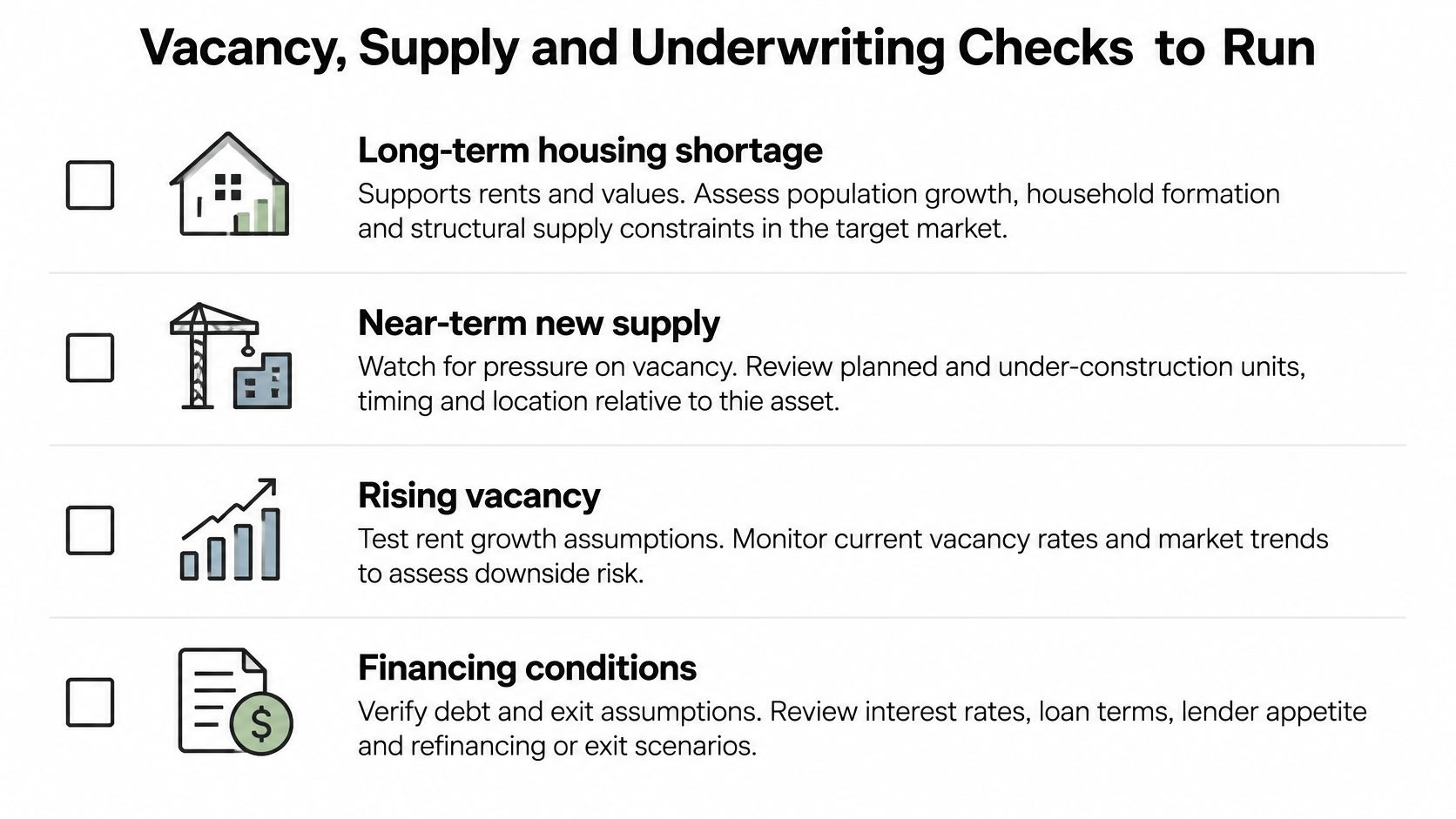
A multifamily property management review helps you judge whether staffing, maintenance, and resident administration can support your assumptions. Record an expected outcome and a failure condition for every checklist item, and note what evidence would change the answer when a check comes back negative.
Confirm the Numbers Before You Make an Offer
A defensible offer requires operating income, purchase yield, and debt coverage to work together. Don't approve the deal because an attractive result in one category distracts from a weakness elsewhere.
- Rebuilt NOI: Use the rent roll, historical operating statement, realistic collection losses, and supportable utility recovery. Exclude improvements that haven't been validated.
- Purchase cap rate: Compare your calculated yield with relevant local transactions. Document why differences in condition, restrictions, or operating risk justify a pricing gap.
- Financed DSCR: Use the loan terms you can realistically obtain and the lender's actual coverage requirements. Resize the debt or renegotiate the price if coverage is insufficient.
For a separate residential budgeting perspective, Royal LePage Brookside Realty's rental investment planning for Maple Ridge can help organise cash-flow inputs. It isn't a substitute for California-specific underwriting or lender terms.
Validate the utility assumptions
Gather the historical operating statement, current rent roll, and complete annual utility invoices. Separate master-meter charges, shared loads, and unit-level bills before modelling recovery.
For an existing apartment building, a site survey is the appropriate first step for water submetering. We review the intended billing model and applicable requirements before implementing tenant billing based on water-submeter readings.
Share the property location, utility types, unit count, construction stage, and needed services with us. We then confirm project fit and outline the next step, including the billing model, applicable approvals, tenant terms, and treatment of fixed and common-area charges. Record those answers beside your underwriting before committing to an offer.
Axis Meter Solutions offers turnkey utility submetering, including equipment, installation, billing, maintenance, and project-specific compliance planning. Visit Axis Meter Solutions to arrange a free, no-obligation consultation and identify a suitable combination of solutions for your property before including utility recovery in your investment assumptions.
Ready to Optimize Your Utility Management?
Tell us about the property, utility, number of units, and your billing or monitoring goals. We'll help you identify the right next step.
Book a Call