Multifamily Property Management Operations Guide

It's Tuesday, the monthly close is still open, and the site lead is holding three problems at once. A suite is mid-move-out, a third-floor resident has no hot water, and the water bill is well above last month with no change in occupancy to explain it. Leasing can fill the unit. Maintenance can get the boiler back. Neither task tells you whether the extra water is a leak, a common-area load, or a charge you can't defend on paper.
That split is the heart of multifamily property management. Occupancy and repairs keep the building open. Utility data, fair charges, and leak response decide whether bulk utilities sit inside operating expenses or get split in a way a resident can check.
Table of Contents
- Multifamily Property Management Responsibilities at a Glance
- How a Multifamily Community Actually Runs
- Utility Accounts Tenant Billing and Fair Charges
- Vendor Coordination Without Losing the Week
- Leaks Benchmarking and Data Managers Can Defend
- Why Turnkey Submetering Changes the Operating Load
- Choose the Next Utility Move for Your Portfolio
Multifamily Property Management Responsibilities at a Glance
Start the week with a six-row scan, before anyone explains the bill. If a duty has no owner and no cadence, it shows up later as lost rent, a complaint, or a number nobody can trace.
Duty area
Manager owns
Typical cadence
If it slips
Leasing and occupancy
Applications, renewals, notices, vacancy loss
Weekly
Empty units and lost rent
Maintenance
Work orders, life safety, unit turns
Daily
Complaints, violations, longer vacancies
Utilities
Master meters, common-area loads, cost recovery
Monthly close
Bulk costs stay in operating expenses
Resident billing
Reads, rates, adjustments, disputes
Monthly
Estimated charges and resident friction
Vendors
Contracts, site access, insurance
Before each project
Rework, unsafe work, missed deadlines
Compliance
Energy reports, licences, local utility-charge rules
Statutory calendar
Fines and unauditable data
Leasing and occupancy is weekly because an empty suite stops earning the day the keys come back. Maintenance is daily because a life-safety miss and a slow turn both stretch vacancy. Utilities wait for monthly close, which is when a mismatched master bill becomes an expense you can't pass on. Resident billing breaks when reads, rates, and adjustments live in different files. Vendors break when insurance is checked after the crew is on site. Compliance breaks when the energy report or the local charge rule is remembered after the deadline.
Mark which rows still live only in a spreadsheet. A sheet can carry a four-plex. It thins out once one decision reaches every household in the stack. In 2024, Los Angeles County had the state's highest share of housing units in structures with five or more units, 36.3%, compared with 19.5% nationally, in the Southern California Association of Governments summary of American Community Survey estimates.
Pair the scan with facility safety and budget strategies so life-safety checks and controllable costs sit on the same weekly list as leasing. The utility, billing, and vendor rows are where net operating income usually slips, so they get the rest of this briefing.
How a Multifamily Community Actually Runs
Treat the community like a ship for a minute, then get back to the bills. The hull is structure and life safety. The engine room is boilers, pumps, and electrical service. The cabins are the suites. The bridge is the manager, matching what residents use with what the building pays.

Three money paths run through every property, a 12-suite walk-up and a large stacked building alike.
The building pays one bill. On a master-metered property the utility sends a single invoice. You then decide how much, if any, comes back from residents. Recover nothing, and the full amount stays in operating expenses even when suites sit empty.
Shared loads never become a suite charge on their own. Common-area lighting, amenities, and the mechanical plant are building costs even when every suite has its own meter. Mix them into resident bills and you spend the next month explaining a charge the resident didn't cause.
Unit meters make the leftover visible. Once suite consumption becomes a resident charge, the unrecovered common load is what remains for the budget. That's the number owners should see, not a blended guess.
A master meter is the utility's meter for the whole building. A unit meter measures one suite, or one defined load, so resident use can be separated from what the building itself burns.
Bulk utilities compress net operating income because the expense hits the statement whether occupancy is full or not. Estimated allocations then create disputes, and leasing staff inherit the argument at renewal. The walk-up and the tower share the same three paths. What changes is how many households one bad allocation touches, and how hard it is to see the engine room apart from the cabins.
Managers comparing pressure in other markets can skim a Utah multifamily housing outlook and still come home to the same question. Who can see tenant use, common load, and mechanical load separately, without putting a resident's private data in front of neighbours?
Utility Accounts Tenant Billing and Fair Charges
Run this sequence every month. Keep vendor scheduling out of it.
- Build the inventory. List every suite meter, house meter, and common load against a utility account.
- Split the loads first. Separate resident use from common-area and mechanical loads before you allocate a dollar.
- Bill actual cost only. Don't add a markup on top of the utility invoice.
- Itemize electricity and gas. Show the meter reading, the rate, and the quantity in each rate block.
- Disclose water math up front. If water goes through a submeter, explain the calculation in plain language before the first bill.
- Write the vacancy rule. Say who pays a vacant suite, and how an estimated read is replaced by an actual one.
- Open a correction path. Give a stated window, a human contact, and a record of the adjusted bill.
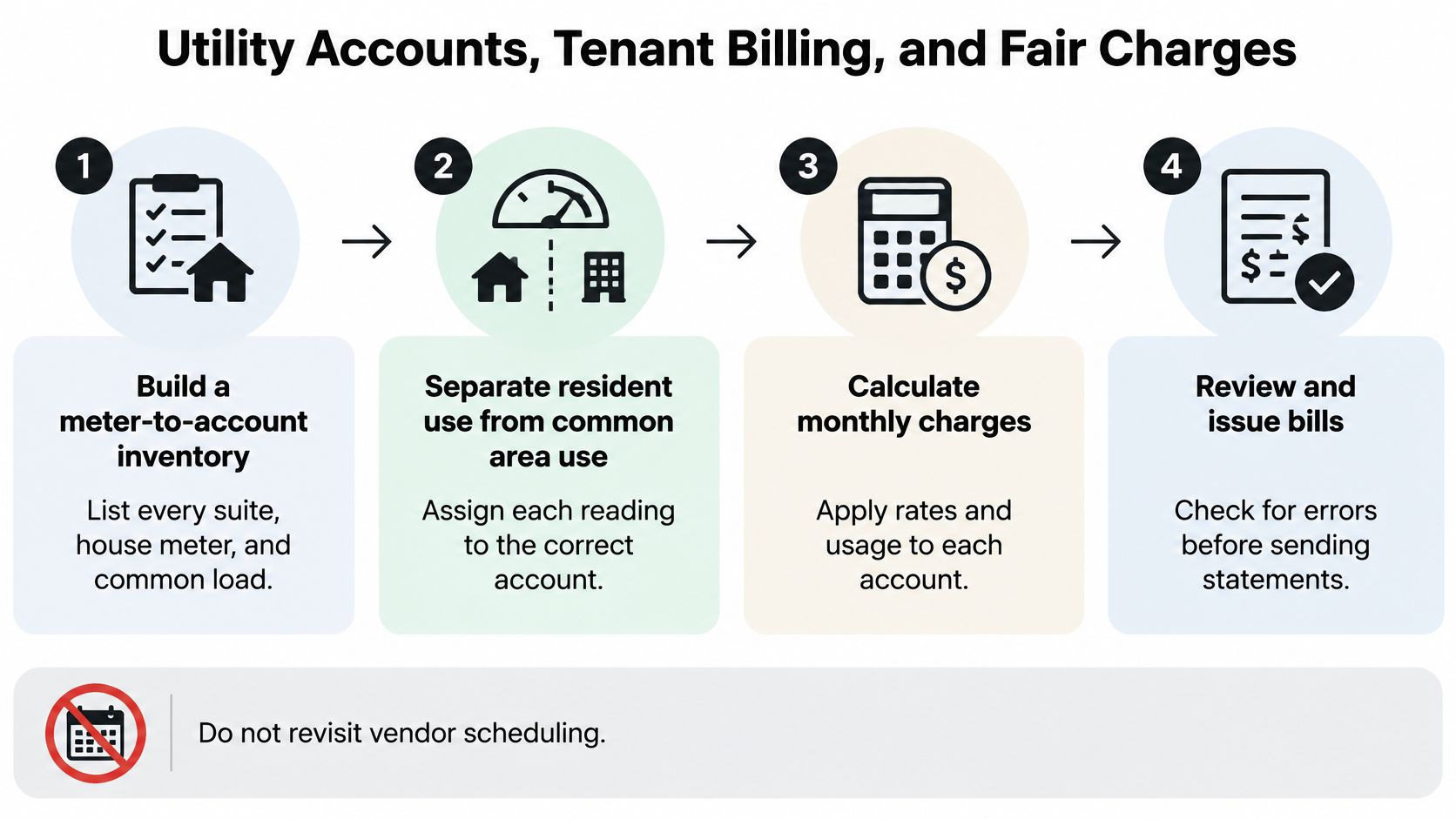
What a fair charge has to show
California's official landlord-tenant guidance says landlords cannot charge more than the actual utility cost and must disclose how water charges are calculated when tenants are billed through a submeter. State law also requires itemized master-meter electricity or gas billing, including meter readings, applicable rates, and quantities attributable to rate blocks.
Charge
Resident must see
Typical failure
Water through a submeter
How the charge is calculated
A flat fee with no method
Electricity on a master meter
Reading, rate and quantity by rate block
One lump sum
Gas on a master meter
Reading, rate and quantity by rate block
Estimated use with no note
Common-area share
What is excluded from the suite charge
Amenities buried in the resident bill
Vacant suite
Who pays and how an estimate is replaced
Silent vacancy rule
Dispute or correction
Window, contact and adjusted amount
No audit trail
Pull one recent bill and set it beside that table. A flat water fee, a lump-sum electric line, or a silent vacancy rule means the bill isn't ready to send. A practical walkthrough of how to bill tenants for utilities is worth reading before you rewrite the addendum.
The first invoice is the fairness test
Owners often pay for the equipment while residents keep the lower bill. Households that are already stretched will judge the program by this month's charge, not by a saving that shows up over years. Publish the method. Put hardship and correction rules in the lease addendum. Don't launch a new charge that spikes a low-income household's first invoice. A conservation change that raises the immediate bill will stall, even if the annual total would have dropped.
Vendor Coordination Without Losing the Week
Treat the crew as a relay, not a phone list. On a utility project the usual cast is the property manager, the site superintendent, a licensed electrician, a plumber, and the metering contractor. Each person should leave with one job finished and the next person able to start.
The manager sets the loads. Say which meters must be separated, which suites can be entered, and which common rooms stay off the resident bill. If that brief is vague, the trades will meter whatever is easy to reach.
The superintendent books access. One or two days per stack beats weeks of open units. Residents get a notice with a date, a window, and a contact. Keys, pets, and occupied bedrooms are planned before the van arrives.
The electrician or plumber installs to the approved design. They don't invent a new one on the ladder. Mixed tariffs, a boiler room, and a house panel each need a labelled point.
The metering firm commissions. Meters have to talk to the billing file before anyone signs off. A meter that reads on a handheld and never reaches the invoice is not finished work.
Before work starts, demand proof of insurance and bonding, a unit-access plan, the resident notice, a named site lead, and a punch list tied to payment. Hold the last draw until the punch list is closed. A crew that is paid in full on the install day has little reason to come back for a dead meter.
Three buildings change the paperwork, not the relay. A mixed-use property may need commercial and residential reads on different tariffs, so don't put a shop and a suite on the same rate block. A condominium or strata needs the corporation or council to authorise entry and billing before anyone drills. A five-to-ten-unit building still needs the same insurance, notice, and punch list, even though the site day is short.
If the vendor leaves tomorrow, the owner should still hold meter IDs, as-built locations, and a support number.
That file is the control test. Photos of the panel help, but they don't replace an ID that matches the billing account. Coordinate the site day through a clear scope for utility metering installation and maintenance, then keep the as-builts with the property, not only in the contractor's inbox.
Leaks Benchmarking and Data Managers Can Defend
A slow toilet or a weeping riser rarely announces itself. Months later the water bill is huge, a ceiling is stained, and the suite below wants a hotel. By then the gallons are gone and the argument is about who pays.
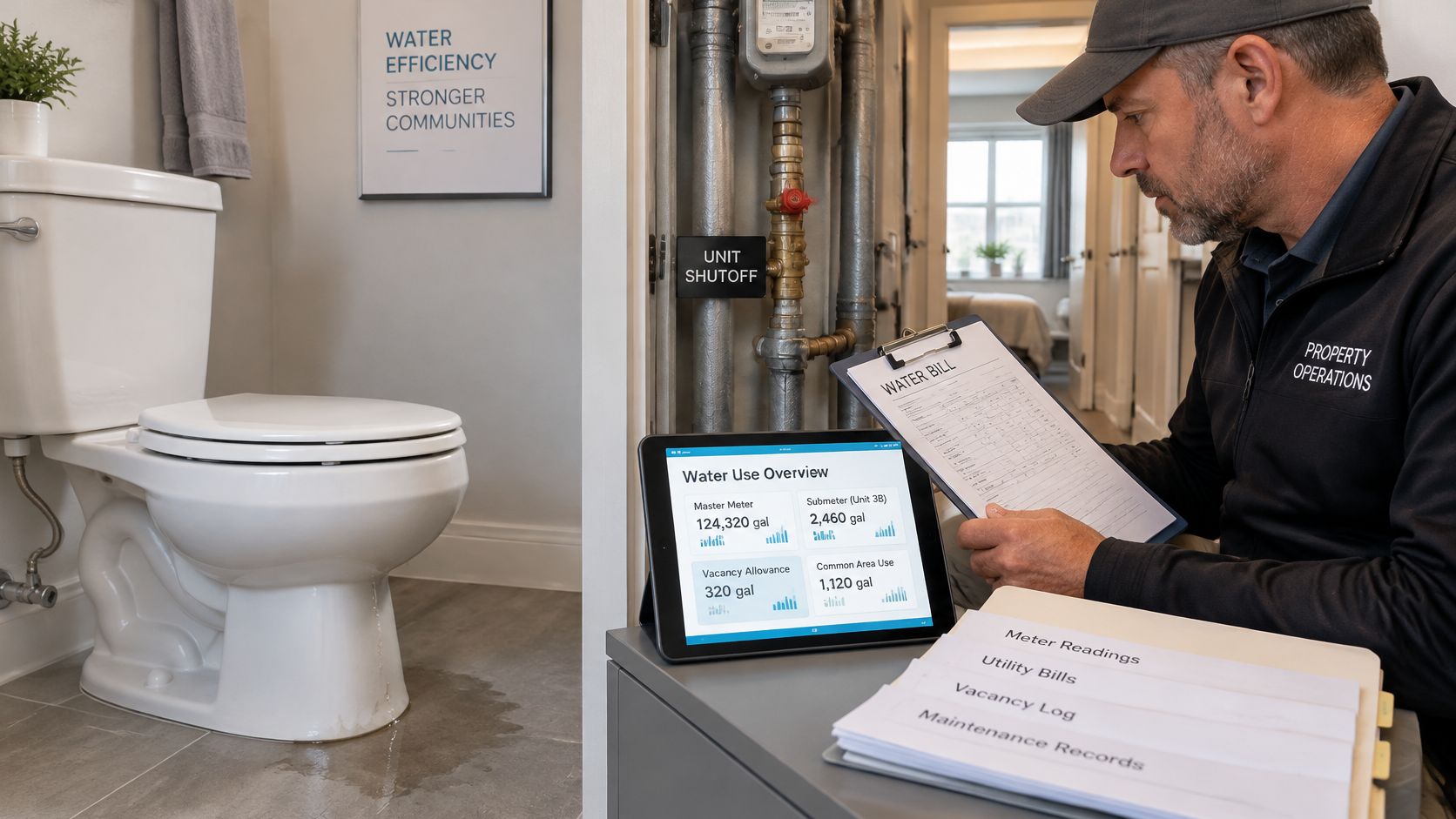
Run the checks in this order
Reconcile the master meter to the sum of the suite meters plus common area, for the same billing period. A gap is a missing meter, a mislabelled account, or a leak. It isn't a rounding error you write off.
Ask the utility for interval or whole-building data, and plan for a refusal. When the utility won't share it, the unit meters and house meters the property controls become the record. You can't defend a baseload you never measured.
Keep resident-level reads out of board packages. Report aggregates and anomalies. That matches the push toward anonymised energy-use data, and it stops one household's consumption from circulating among neighbours.
A 2025 California Energy Commission report identifies more than 3 million existing multifamily units, about 25% of California households, as candidates for major energy retrofits, while market-level integration and workforce capacity remain insufficient. Access to San Francisco Water interval data enabled operators to identify leaks within days rather than months, saving hundreds of thousands of gallons and thousands of dollars. Where you don't have that feed, property-owned meters and a flood sensor are the substitute, not a hope that the utility portal improves.
Park benchmarking beside the same file
Owners of buildings with more than 50,000 square feet of gross floor area generally report annual energy use to the California Energy Commission by June 1 through ENERGY STAR Portfolio Manager. The multifamily benchmarking fact sheet excludes residential properties with 1 to 16 units and condominiums. Prep is an account inventory, a floor-area check, a hunt for estimated bills, and a saved audit trail.
California multifamily retrofit demonstrations cut energy-use intensity by 7% to 50%, excluding photovoltaic generation, when packages combined equipment and envelope work, according to a California Energy Commission benchmarking briefing. Don't promise a single savings figure. Baseline at least 12 months, and separate common loads, before you tell an owner what the project will return.
A wet ceiling isn't always a pipe. A failed membrane can dump water that never touches a meter, so a commercial roof inspection checklist belongs in the same habit as the meter reconciliation. For the pipe side, water leak detection at the meter is the workflow that turns a baseload spike into a same-week work order.
The short video below walks through why a leak found in days costs less than one found on the next quarterly bill.
Write the escalation card before you need it. The site lead calls maintenance the day a flood sensor trips or a baseload jumps. Maintenance isolates the stack. The manager tells the resident, logs the gallons, and decides whether insurance or the utility dispute file comes next. A card with no names on it is a poster.
Why Turnkey Submetering Changes the Operating Load
You can buy the meters and staff the billing, or you can contract a provider that owns the system and runs the charges. The operating load is different even when the end state, a separated suite bill, looks the same.
Operating need
In-house
Turnkey program
Capital
Owner buys meters and spares
No upfront capital; provider owns the equipment
Timeline
Owner manages lead time and trades
About 8-10 weeks to live meters
Billing
Staff invoice, collect and explain charges
Provider billing and resident support
Leaks
Separate sensors and monitoring
Flood and leak detection included on water installs
Compliance
Owner tracks meter and billing rules
Design checked to province or state rules
Upkeep
Owner replaces failed meters
Maintenance and replacements during the term
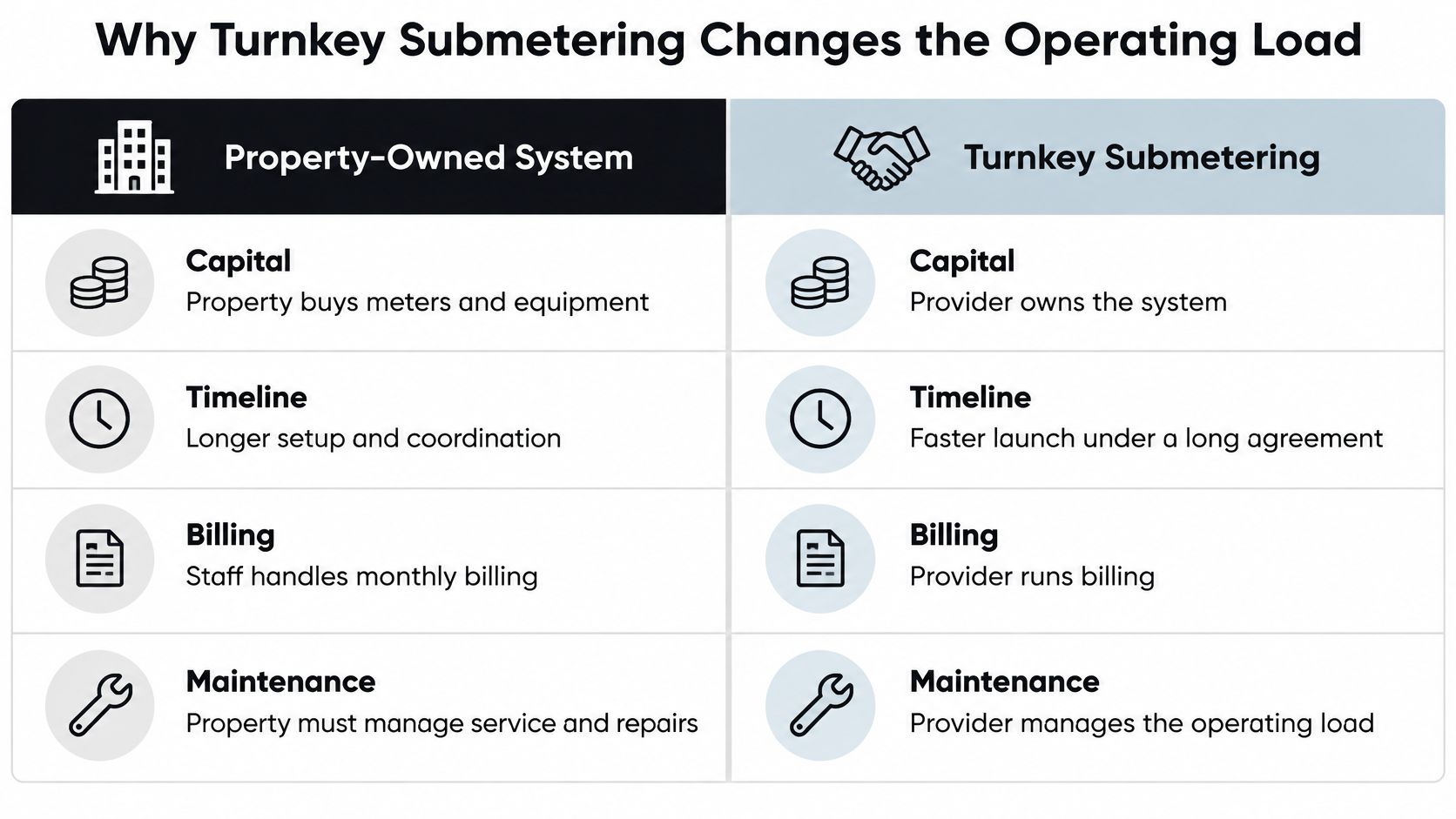
What the turnkey column looks like in practice
Take Axis Meter Solutions as the worked example of that right-hand column, not as a slogan. Equipment, install, commissioning, tenant billing, and service sit in one program. Owners pay no upfront capital. The provider owns and maintains the gear on a standard 20-year term. A typical path from agreement to live meters is 8 to 10 weeks, including equipment lead time, with on-site access often limited to one or two days.
Electricity, water, gas where it's permitted, thermal energy, and common-area meters can be scoped together. Water installs include leak and flood sensors at no added charge. In Ontario, electricity unit submetering is done under Ontario Energy Board licence ES-2022-0268, and equipment is chosen to meet Measurement Canada or U.S. rules before kickoff. The same pattern covers buildings of about 5 to 10 units and larger portfolios across Canada and the United States.
A long agreement swaps capital and staffing for a contracted operating cost. It's a poor fit if the owner wants to self-perform billing and already has licensed in-house metering staff.
If your team can replace failed meters, explain rate blocks, and keep the audit file for a decade, stay in the left column. If that work would land on the same person who already runs leasing and turns, the right column is the lighter operating load. The next section is the fork, not another list of features.
Choose the Next Utility Move for Your Portfolio
Make one decision with the map you already have. If suite and common loads are metered, bills are itemized, and disputes are rare, keep the current process. Fix only the weak row from the duty scan, whether that's vacancy loss, vendor insurance, or the energy-report calendar.
If the building is still master-metered, charges are estimated, or leaks show up as damage, move utility recovery out of the spreadsheet. I would not spend another close season allocating a bulk bill by unit count.
Use this order, and stop when the answer is no.
Confirm the fuels. Check which fuels your jurisdiction lets the owner allocate. A fuel you can't pass through stays a building cost.
Check the licence. See whether electricity submetering must be done by a licensed unit-submeter provider. Don't assume a general electrical contractor covers the billing rules.
Count the scope. Count suites and common loads so the proposal matches the building, not a sample stack.
Test the decade. Decide whether your staff can run billing and meter replacement for the next ten years. If they can't, ask for a turnkey proposal that includes equipment, install, commissioning, resident notices, monthly billing, and leak detection, with no upfront capital.
Axis Meter Solutions builds that package for multifamily, condominium, mixed-use, and commercial buildings in Canada and the United States, including smaller properties. Bring one recent utility bill, a unit count, and a note on recurring leaks. The first call should test the operating problem, not a brochure.
Axis Meter Solutions runs turnkey utility submetering for multifamily and mixed-use buildings, covering equipment, installation, commissioning, resident billing, and leak detection without an upfront capital bill. If bulk utilities are still sitting in your operating expenses, or estimated charges are creating disputes your leasing staff have to inherit, that package is built for the close you just lived through. Visit Axis Meter Solutions and bring one recent bill, your unit count, and a note on where water keeps showing up.
Ready to Optimize Your Utility Management?
Tell us about the property, utility, number of units, and your billing or monitoring goals. We'll help you identify the right next step.
Book a Call