Water Leak Detection Meter: Protect Multi-Unit Buildings
Water-damage claims represent more than 50% of all insurance claims in Canada, and Rogers Business reported annual losses of roughly $4 billion to $6 billion. In multi-unit buildings, a water leak detection meter is not a nice extra, it's a control point that helps stop a hidden leak before it turns into a claims file.
Table of Contents
- The Hidden Crisis in Multi-Unit Buildings
- What Is a Water Leak Detection Meter
- Key Detection Technologies and Features
- Flow Meters vs Point Sensors vs Acoustic Detection
- Integrating Leak Detection with Tenant Billing
- Calculating ROI and Reducing Insurance Exposure
- Implementation Checklist for Property Owners
The Hidden Crisis in Multi-Unit Buildings
A condo board can spend months debating reserves, but one failed toilet supply line can create an immediate mess in several directions at once. Rogers Business reported that water-damage claims made up more than 50% of all insurance claims in Canada and generated about $4 billion to $6 billion in annual losses in 2021, with losses doubling since 2015 and tripling for high-rise buildings since 2013 (Rogers Business reporting on Canadian water-damage losses).
The hardest part is that most leaks are not discovered by a system. They're discovered by a person seeing water. That visual discovery model is weak in apartment towers, where water can run through neighbouring suites, corridors, mechanical rooms, and structural assemblies before anyone notices the source. A leak that starts in one unit rarely stays there.
Why the usual response fails
If a resident is away, asleep, or not paying attention, the water keeps moving. A failed appliance hose can wet a cabinet, then a wall cavity, then the suite below. By the time someone spots staining or a ceiling drip, the event has usually moved well beyond the original failure point.
That's why owners should treat leak detection as an operating function, not a convenience feature. A practical response also means reviewing insurance coverage with the same seriousness as maintenance planning, which is why many boards and managers look to resources like find the right strata policy when they are comparing risk controls.
The key issue isn't whether a building has water. It's whether it knows about abnormal water use before the damage spreads.
A water leak detection meter changes the default condition. Instead of waiting for visible damage, it watches for abnormal continuous consumption, unexpected nighttime flow, and unusual unit-level use. That turns leak response from a cleanup exercise into a risk-control process.
What Is a Water Leak Detection Meter
A water leak detection meter is a monitoring device that goes beyond billing. A normal submeter tells you how much water was used. A leak-detection meter looks for patterns that don't fit normal occupancy, then flags them before the damage becomes obvious.
The difference from a basic submeter
Think of a standard meter like a fuel gauge. It tells you how much has gone through the system, but it doesn't warn you that something is wrong. A leak-detection meter is closer to having the fuel gauge plus warning lights, because it watches for flow behaviour that shouldn't be there.
That matters in multi-unit buildings, where normal usage is cyclical. Showers, laundry, dishwashers, and irrigation all create bursts of consumption. A detection meter has to separate those legitimate events from continuous flow that points to a running toilet, a failed appliance hose, or a concealed line issue.
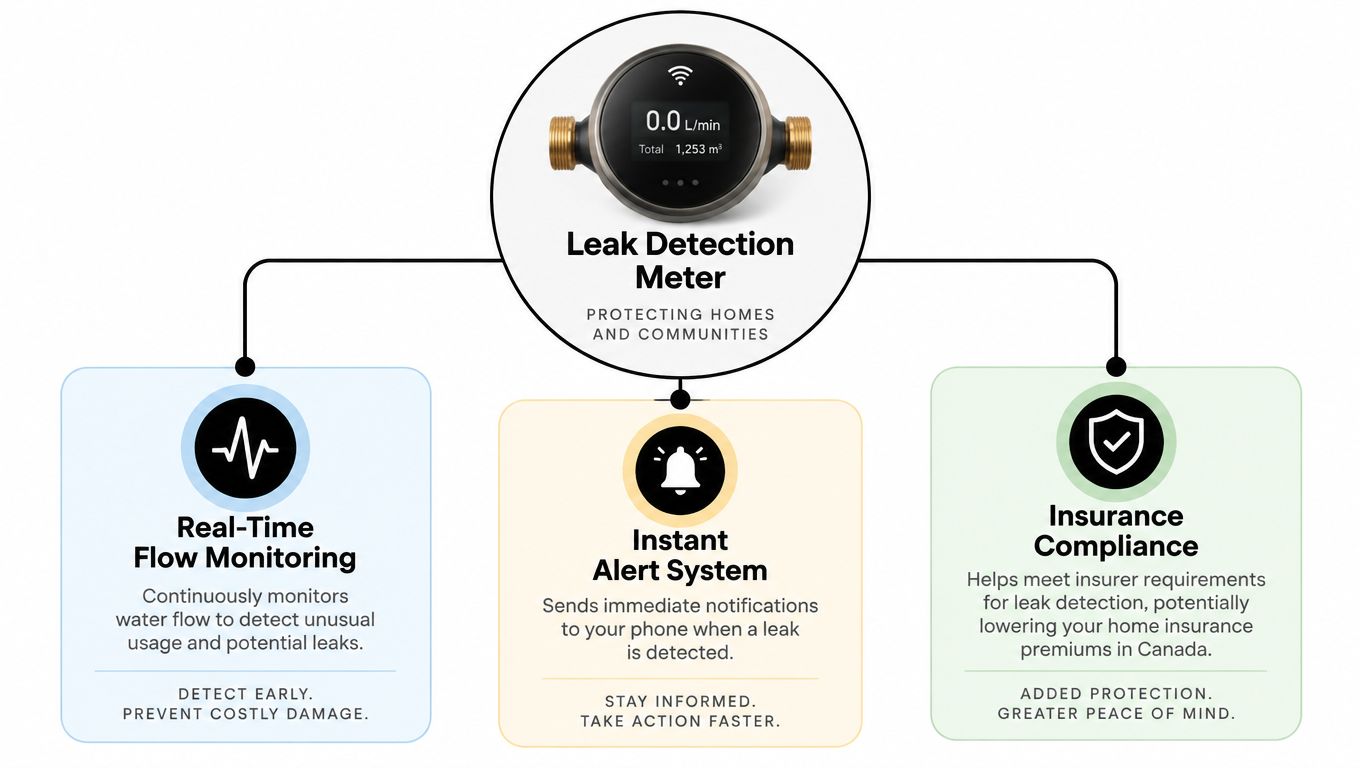
A useful system usually includes three pieces working together. First, a flow sensor measures movement through the line. Second, a communication module sends the reading out. Third, an alert layer applies rules so the system can flag continuous or repeated abnormal use.
What the meter is really watching for
The strongest value comes from interval data. Short snapshots can miss the problem, but time-series readings reveal the shape of use. If a unit shows water movement when it should be empty, or a flow pattern that stays on too long, the system can raise a flag before walls, floors, or cabinets are visibly affected.
A good meter doesn't just record usage, it creates a decision point for staff.
That's why the best installations are tied to response procedures. The goal is not to generate more data. The goal is to create a clean alert, a fast investigation, and a documented outcome that helps the building act before the loss spreads.
Key Detection Technologies and Features
In multi-unit buildings, the useful devices act like monitoring tools, not just counters. California's leak-reporting framework treats advanced metering infrastructure, pattern recognition, ultrasonic methods, acoustic detection, thermal imaging, visual inspection, and customer reports as separate approaches, which is a good reminder that leak detection usually works in layers, not as a single device (California Water Boards leak registry specifications).
What the meter should be able to do
A strong system separates continuous flow from normal use. It should distinguish a shower from a toilet that keeps refilling, and it should hold synchronized time-series data so staff can see when the event started, how long it ran, and whether it stopped after intervention.
The practical features matter more than the sales language:
- Real-time alerts, so property staff hear about the event while the leak is still active.
- Timestamp accuracy, so the building can document when discovery happened and compare it with maintenance action.
- Event logs, so supervisors can verify whether an alert was investigated and closed.
- Location metadata, so the issue can be tied to a suite, zone, or common area.
- Communication resilience, so alerts still reach someone if a network or power issue interrupts normal reporting.
- Discovery time and location logging, so reportable leaks meet registry documentation standards.
Those functions matter because a meter is only useful if it creates a record that staff can act on. In practice, that means the device has to support response procedures, not just collect readings. If the event starts in the middle of the night, the system still has to tell someone, keep the time stamp intact, and preserve the location history for follow-up and insurance files.
Where detection goes wrong
Most weak installs fail at the alert layer. If the meter can detect a problem but nobody gets the message, the system has not protected anything. Battery backup, reliable messaging, and clear thresholds matter as much as the measurement hardware itself.
If the data can't be trusted at the moment of failure, the system is just a record of the loss.
For technical buyers, the right question is not only what the meter measures. It is whether the system can prove when the event started, where it happened, and whether staff acted on it. For a practical comparison of hardware approaches, this internal guide on water leak detection sensor options is a useful reference point.
Flow Meters vs Point Sensors vs Acoustic Detection
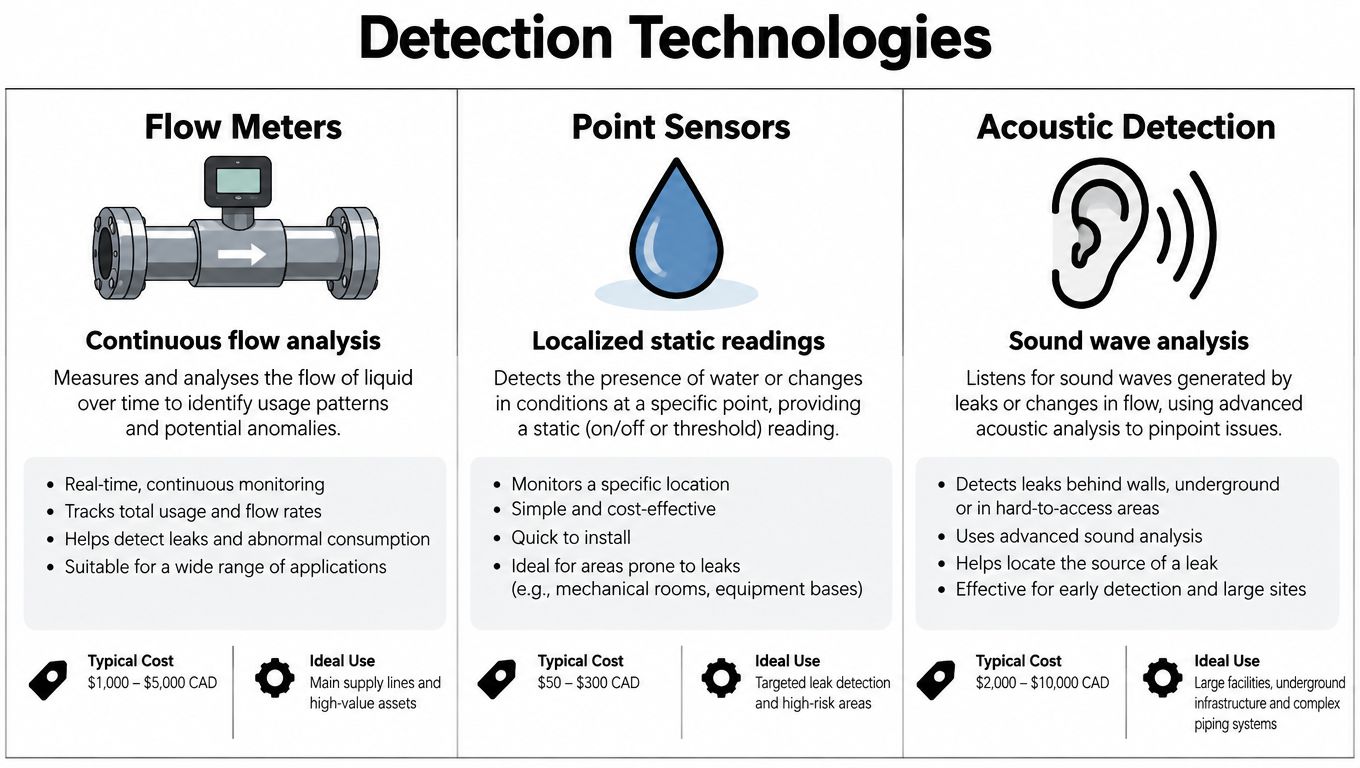
These three tools solve different problems, and treating them as interchangeable creates blind spots. A flow meter watches the water moving through a line. A point sensor notices water where it lands. An acoustic device listens for leak noise in the piping or behind surfaces.
Where each approach fits
A flow meter is the right first line when you want to catch running toilets, failed appliance hoses, and slow concealed leaks through abnormal consumption. A point sensor belongs under sinks, beside water heaters, in mechanical rooms, and anywhere a leak would first appear on the floor. Acoustic detection is better when you need to trace a concealed failure after another tool has already said something is wrong.
That layering is the core strength. Use interval meter data to identify the abnormal pattern, then use localized sensors or inspection to pinpoint the source. If you rely on only one method, you'll miss some failure modes.
The hidden trade-off
Marketing often uses the phrase “real-time monitoring” too loosely. Real-time does not automatically mean whole-building protection. Coverage depends on hydraulic design, sensor placement, and whether the system can isolate a suite without shutting down the entire building.
Real-time is only useful when the alert reaches the right person and the right place is covered.
That's especially true in older buildings or properties with complex risers and branches. A good design puts the detection method where the risk is highest. For a technical comparison of submetering approaches, this overview on digital flow meters is worth reading.
Integrating Leak Detection with Tenant Billing
Leak detection becomes much more operationally useful when it connects to billing. If a meter flags abnormal use in one suite, property staff can compare that event with billing records and see whether the pattern matches a legitimate occupancy change, a billing anomaly, or a likely leak.
Why billing integration matters
Most resident complaints start with confusion. A tenant sees a larger bill, or management sees unexplained consumption, and both sides want proof. When leak detection data sits inside the billing workflow, staff can use objective readings instead of guesswork. That reduces disputes and shortens the time from alert to action.
A building with common-area metering gets a second benefit. Shared loads stop getting mixed up with suite use. That matters for fair allocation, but it also helps isolate the source of waste. If common-area consumption stays stable while one unit shows abnormal continuous flow, the staff know where to focus.
Good billing data doesn't replace leak detection, it makes the leak easier to assign and easier to defend.
What the workflow looks like
A practical process usually runs in a clean sequence:
- Alert arrives for continuous or unusual flow.
- Staff verify whether the event matches normal occupancy or scheduled use.
- Work order opens if the usage looks persistent or unexplained.
- Repair outcome gets logged, so the record shows what was found.
- Billing records stay aligned with the event history.
That loop matters because it gives the building an audit trail. If you can show when the alert fired, who responded, and what was fixed, you've turned water monitoring into a management tool rather than a standalone device.
For a closer look at the billing side of the equation, this guide on sub-metered water is a useful companion.
Calculating ROI and Reducing Insurance Exposure
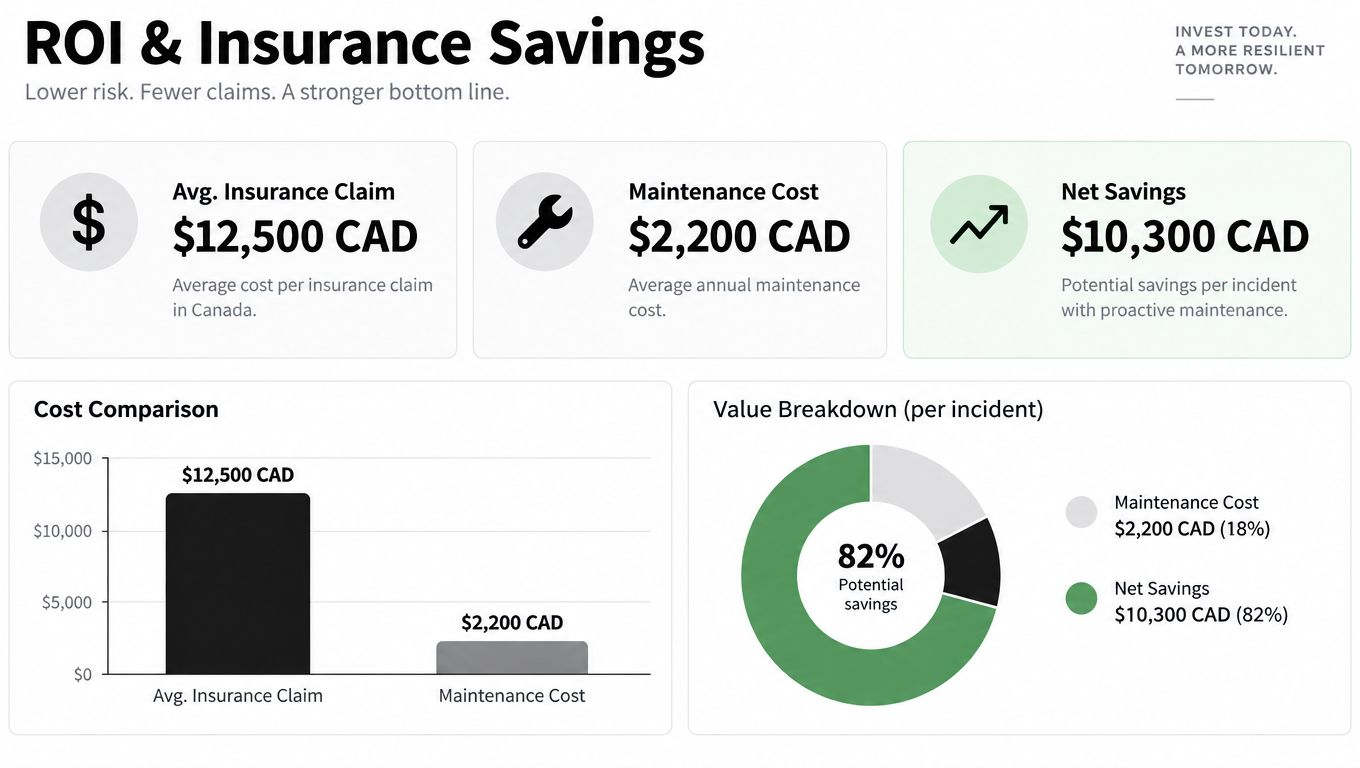
The economic case is straightforward once you stop thinking about leak detection as a gadget. The Canadian Condominium Institute reported that water-related insurance claims accounted for approximately 60% of total residential losses and that the average water-damage claim exceeded $70,000 in 2024 (Canadian Condominium Institute report). Early detection matters because it reduces the amount of property damage, the repair scope, and the disruption tied to each event.
How to think about ROI
The cleanest way to calculate return is to compare what you spend on prevention against what you avoid in loss. That means tracking a baseline period, then measuring alert frequency, response time, confirmed leak volume, false alarms, and maintenance effort after installation. A system that creates early, actionable alerts can justify itself even if it prevents only a small number of serious incidents.
Not every component does the same job. Detection finds the abnormal event. Submetering helps allocate use and spot irregular patterns. Shutoff controls limit the scale of a failure once the event is confirmed. Together, they reduce exposure, but each one contributes differently.
Regulatory alignment matters too
In Ontario, unit sub-metering has to sit inside the licensing and measurement framework, including Ontario Energy Board licensing for electricity unit sub-metering under ES-2022-0268, and equipment should align with Measurement Canada and U.S. requirements where applicable. That's not just paperwork. It affects whether the project is defensible, billable, and supported over the full agreement term.
A building owner doesn't need perfect precision to justify the investment. It needs a repeatable method for showing fewer unresolved events, faster response, and lower exposure to the kind of claim that can become very expensive very quickly.
Implementation Checklist for Property Owners
Start with the building, not the product sheet. The right installation depends on where the risk is concentrated, what the jurisdiction allows, and how your staff will respond when an alert arrives.
What to verify before kickoff
- Confirm jurisdictional billing rules, including Ontario Energy Board licensing requirements where electricity submetering is involved.
- Check measurement standards early, especially if the system will feed tenant billing or formal consumption allocation.
- Map the riskiest locations, such as suites with historic incidents, mechanical rooms, water heaters, and common plumbing choke points.
- Decide how alerts will route, so someone receives them even when the site office is closed.
- Document who closes the loop, meaning who inspects, who orders repairs, and who signs off on resolution.
Typical projects take 8 to 10 weeks from agreement to live meters, including equipment lead time, so boards should plan around procurement and access windows rather than expecting an instant turn-on. Axis Meter Solutions is one option that provides water submetering with leak and flood detection included, along with commissioning and ongoing service under a long-term agreement, but the important point is to choose a setup that matches the building's operating reality.
What to build into the system
The monitoring rules should be set before anyone relies on the data. Establish a baseline period first, then configure alerts for persistent low-volume flow and repeated anomalies. If alarms are too sensitive, staff will ignore them. If they're too loose, the first real leak will still do its damage.
A good rollout is boring on purpose. The hardware works, the alerts land in the right inbox, and the staff know exactly what to do next.
After installation, keep the records clean. Make sure time stamps are synced, event logs are retained, and maintenance actions are documented against each alert. If the building ever needs to prove what happened, that history is far more valuable than a generic monthly consumption report.
Axis Meter Solutions helps owners connect water submetering, leak detection, and billing into one operating workflow for multi-unit and mixed-use buildings. If you're planning a retrofit or want a clearer way to reduce water-loss exposure, visit Axis Meter Solutions to review how their installation, commissioning, and ongoing service model fits your property.
Ready to Optimize Your Utility Management?
Tell us about the property, utility, number of units, and your billing or monitoring goals. We'll help you identify the right next step.
Book a Call