Flow Meters Digital: Property Owner Guide

The popular advice is simple: install a smart meter, connect it to a dashboard, and billing and leak detection will take care of themselves. That advice is incomplete. A digital flow meter can provide useful interval data without being legally suitable for tenant billing, and a remotely readable device can still produce poor results if it's installed in the wrong pipe conditions or nobody responds to its alarms.
For Canadian property owners, the critical question isn't which meter has the most features. It's whether the complete system can produce accurate, auditable measurements, support the applicable billing arrangement, identify abnormal flow early, and operate without adding avoidable administration. That distinction matters to net operating income because utility costs, disputed charges, water damage, and maintenance time all affect the asset differently.
Table of Contents
- The Reality of Digital Utility Submetering
- Comparing Mechanical and Ultrasonic Flow Meters
- Field Accuracy and Installation Requirements
- Navigating Measurement Canada Compliance
- Transforming Interval Data into Leak Intelligence
- Structuring a Turnkey Submetering Partnership
The Reality of Digital Utility Submetering
A digital meter isn't automatically a revenue meter. In Canada, the legal status of the instrument, its approved pattern, verification, sealing, software configuration, and the rules governing the specific utility and jurisdiction all matter. A device that's excellent for building monitoring may not be suitable for allocating charges to tenants.
That's why I separate every project into two questions. Can the meter measure the flow? And can the owner defend the charge generated from that measurement? The first is technical. The second involves compliance, commissioning records, leases, municipal or provincial requirements, and a controlled billing process.
The economic case for measurement is still strong. A federal Canadian survey found that 72.1% of single-family residences and 86.8% of commercial buildings receiving municipal water were metered in the research published in 2009, although adoption varied widely by municipality. In municipalities using volume-based pricing, average residential consumption was 229 litres per capita per day, and Measurement Canada reported that households on volume-based pricing used 73% less water than households paying flat rates. These findings are documented in the Canadian federal water-metering survey.
For a multi-unit building, the shift from a bundled utility expense to measured consumption changes more than the invoice. Time-stamped usage can support tenant allocation, conservation, maintenance triage, and operating reports. It can also make conversations with residents clearer, provided the owner explains the billing method and uses a defensible meter.
Practical rule: Treat the meter, data platform, billing rules, and response process as one project. Buying hardware first usually creates avoidable gaps later.
A property manager may also need software for tenant communication, invoice generation, and collections. A resource on billing automation for rental utilities can help clarify the administrative layer, while Axis's overview of a digital water meter illustrates how metering hardware fits into a broader submetering workflow. Neither replaces the need to confirm local requirements.
Comparing Mechanical and Ultrasonic Flow Meters
Canadian utilities are using both established mechanical equipment and newer digital technologies. Measurement Canada consultation findings show that 84% of manufacturers reported producing ultrasonic water meters, while 52% produced positive-displacement meters. Utility installations looked different, with positive-displacement meters reported as the most common technology at 85%, followed by magnetic meters at 59%, compound meters at 58%, and ultrasonic meters at 38%. The results show a market in transition, not a clean replacement cycle. See the Measurement Canada consultation findings.
Positive-displacement meters measure volume through moving internal components. That design is familiar, practical, and often well suited to established utility infrastructure. It can be attractive where the installation space, connection arrangement, or existing verification process favours a conventional meter.
Ultrasonic meters calculate velocity from the difference between upstream and downstream acoustic transit times. They have no equivalent mechanical measuring assembly turning in the water stream, which can simplify electronic reading and reduce dependence on moving parts. They still need appropriate installation, calibration, and operating conditions. Solid-state construction doesn't remove field risks.
Feature
Positive-Displacement Mechanical
Ultrasonic Digital
Measurement principle
Captures and releases known volumes using moving components
Calculates flow velocity from acoustic transit-time differences
Reading method
Often requires local reading or an added communications module
Designed for electronic registers, telemetry, and interval data
Low-flow behaviour
Can be effective, but wear and internal leakage must be considered over time
Can expose low-rate flow when the model and installation support the range
Maintenance focus
Mechanical wear, debris, register condition, and verification
Sensor alignment, signal quality, temperature, firmware, and communications
Installation sensitivity
Often more tolerant of compact layouts, depending on the model
Requires attention to pipe-full conditions, straight runs, and alignment
Lifecycle planning
Familiar legacy technology with established servicing practices
A digital infrastructure choice requiring configuration and data governance
Best fit
Existing systems, straightforward totalization, and applications with suitable mechanical access
Interval monitoring, remote reading, leak analysis, and integrated reporting
The lifecycle evidence also deserves a careful reading. 41% of utilities considered ultrasonic meters to have the longest service life, typically 16 to 20 years, while 54% planned to upgrade metering infrastructure within five years, according to the same Canadian consultation. That doesn't guarantee a particular meter will last for that period. It does support treating procurement as a long-term infrastructure decision rather than a short-term technology purchase.
Quality assurance is part of the choice. 95% of manufacturers and utilities said they test meter quality before service, and utilities reported testing 95% of meters before installation, according to Measurement Canada's findings. Owners should ask what testing means for the selected device, who performs it, and which records remain available when a tenant challenges a charge. More detail on selection criteria appears in this guide to ultrasonic flow meters.
Field Accuracy and Installation Requirements
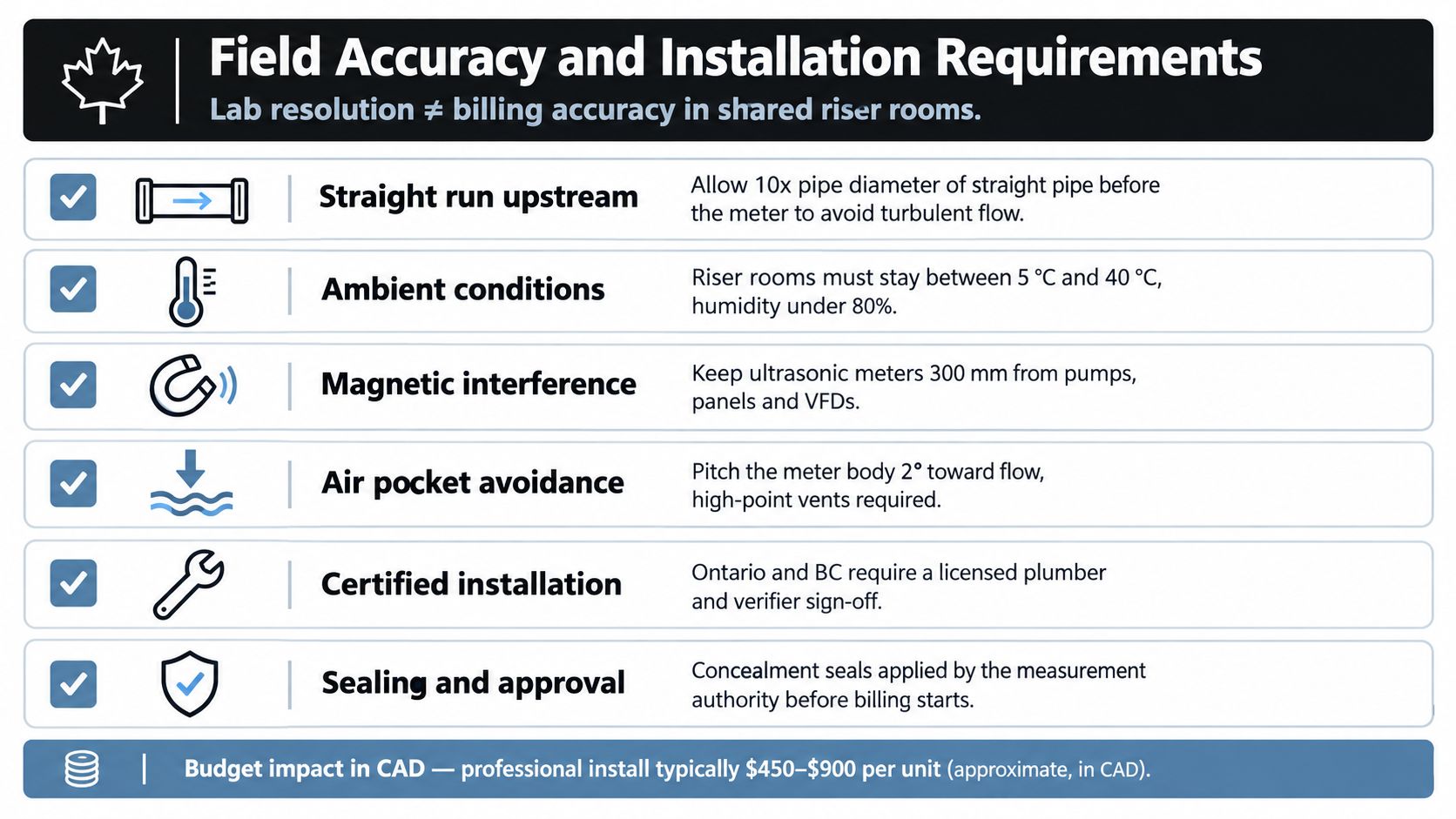
A laboratory result doesn't guarantee billing accuracy in a shared riser room. Ultrasonic meters depend on acoustic signals travelling through water, so temperature, pipe geometry, air, turbulence, and sensor alignment affect the field result. Canadian National Research Council work describes transit-time resolution on the order of 1 nanosecond under laboratory conditions and a linear relationship between transit-time difference and flow speed. The same research supports a practical conclusion: electronic resolution is valuable, but it isn't a substitute for correct installation and calibration. Review the NRC research on ultrasonic flow measurement.
What the installer must verify
The pipe must remain full where the meter measures. A partially filled pipe, trapped air, or a high point near the sensing area can distort the signal and make an apparent communications problem look like a metering problem. The contractor should also document the available straight run, nearby valves and pumps, pipe orientation, sensor placement, and any bypass arrangement.
Temperature deserves specific attention. Acoustic propagation changes with temperature, so calibration and commissioning should reflect the water conditions the building experiences. A meter that performs well in a room-temperature test may need a different evaluation in a building with significant seasonal or domestic hot-water variation.
The commissioning file should include:
- Installation geometry: Record pipe size, orientation, straight-run conditions, sensor position, and whether the pipe was full during testing.
- Signal evidence: Preserve signal quality, diagnostic status, and initial readings rather than recording only the final total.
- Configuration details: Note pulse scaling, register units, communications settings, and alarm parameters.
- Operating conditions: Document water temperature and any factors that could affect acoustic propagation.
- Handover records: Give the owner a serial number, installation date, test result, and responsible contractor contact.
A common failure is to treat the network connection as the commissioning milestone. The gateway may be online while the meter is poorly aligned, the register scale is wrong, or the alarm threshold is too sensitive for the building. Those errors can produce a clean dashboard and unreliable decisions.
Field lesson: A digital meter should leave the riser room with evidence, not just a signal. If the installation cannot be reconstructed later, disputed consumption becomes harder to resolve.
Navigating Measurement Canada Compliance
For tenant billing, a digital flow meter must be treated as a legally traceable measurement instrument, not merely as a sensor with a communications module. Measurement Canada requirements state that a meter must conform to its approved pattern, including its design, functions, features, and markings, before it can be verified or reverified. Applicable electronic meters also require accuracy testing at a minimum resolution of 0.01%, compared with 0.1% for electromechanical meters, under the requirements described in the Measurement Canada meter document.
The practical consequence is straightforward. A device's firmware, legally relevant parameters, pulse outputs, and communication registers can't be changed casually after verification. A remotely configurable meter may reduce site visits, but a software change that affects measurement data can compromise the approved configuration.
Build the evidence before billing starts
Owners should ask the provider or installer for a compliance package that identifies the exact instrument placed in service. The file should contain:
- Notice of Approval: Confirm the approved pattern and ensure the installed model matches it.
- Verification status: Record verification or reverification information and the date it applies.
- Sealing provisions: Document physical or electronic seals and identify who controls them.
- Firmware version: Preserve the version active at commissioning and control subsequent changes.
- Register and pulse data: Record display readings, units, pulse scale, and relevant communications registers.
- Installation identity: Link the meter serial number to the suite, riser, common area, or billing account.
- Test results: Keep the commissioning readings and any corrective work in the same project file.
This record protects both sides. If a resident disputes consumption, the owner can reconstruct which meter served the space, what configuration was active, and what readings were captured. If a meter is mishandled or found nonconforming, Measurement Canada states that it must not remain in service until it's reverified.
The framework isn't identical across utilities. Measurement Canada's published requirements cover specific regulated measurement contexts, while water billing can also depend on municipal, provincial, lease, condominium, or strata rules. Before signing a contract, confirm whether the proposed instrument and allocation method are acceptable for the property's jurisdiction and tenant arrangement. A focused reference on Measurement Canada approved meters can help owners prepare questions, but it isn't a substitute for jurisdiction-specific confirmation.
Transforming Interval Data into Leak Intelligence
Monthly totals are useful for allocation. They're not enough for active water-risk management. The most valuable part of a digital network may be its ability to show when flow occurs, not just how much water passed through the meter by the end of the billing period.
Calgary reported that leaks represented 23% of its water loss in 2025 and is expanding Advanced Metering Infrastructure so more frequent data can help identify customer-side leaks earlier. The city also surveyed 1,176 kilometres of mains and found 54 leaks in 2025, showing that better data supports physical investigation rather than replacing it. Those figures come from Calgary's water-loss management programme.
Read-only data versus a response system
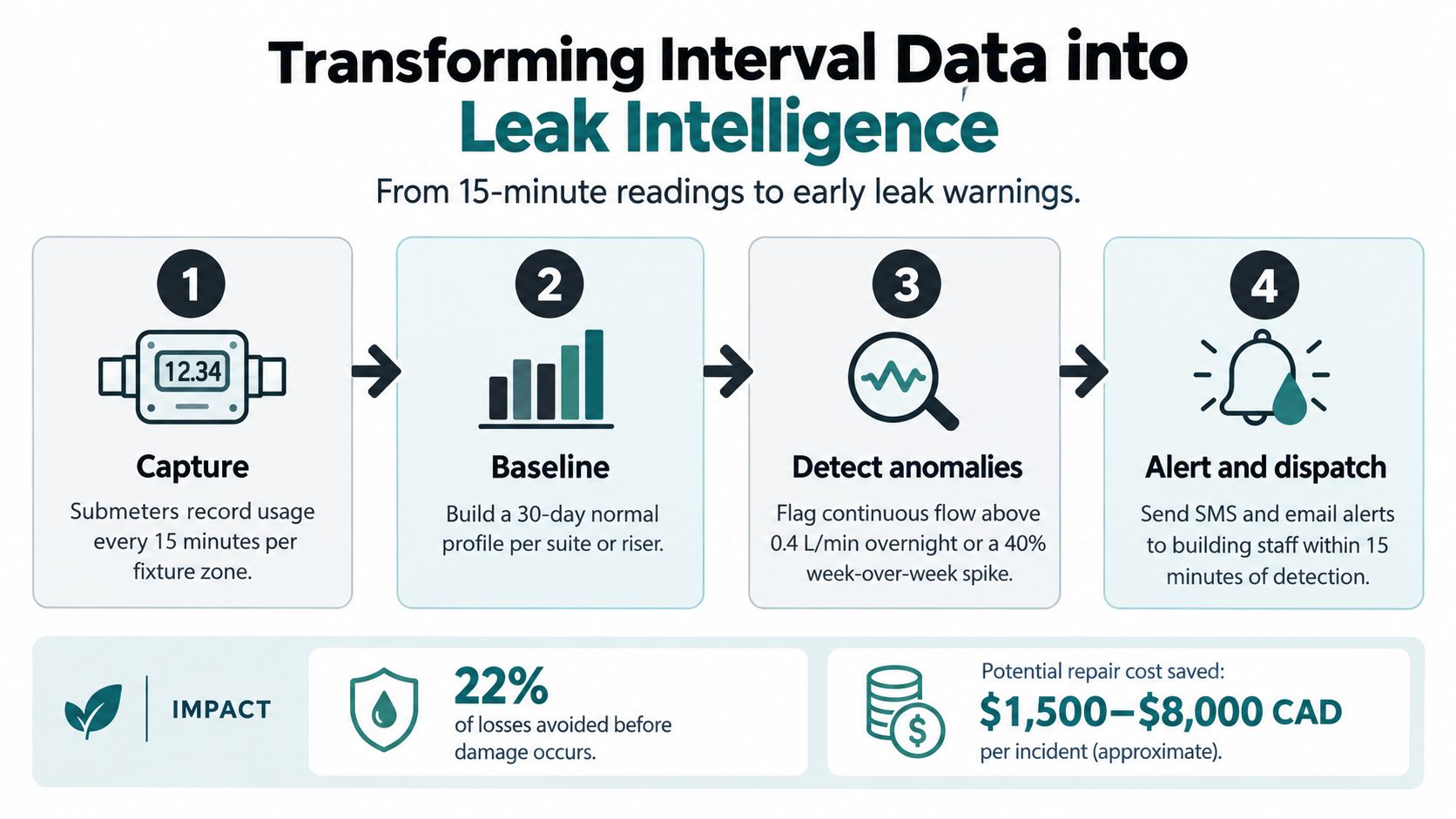
Basic automated meter reading can collect readings for billing. Advanced metering infrastructure can support more frequent analysis, but the hardware alone doesn't protect a building. The owner needs a baseline, an alert recipient, a response standard, and a way to distinguish a suite issue from a common-area fault.
A workable operating model has four parts:
- Capture: Collect readings at an interval appropriate to the meter's low-flow performance and the building's communications coverage.
- Baseline: Learn normal patterns for suites, risers, fixtures, and common areas. Overnight behaviour often reveals persistent flow that daytime totals conceal.
- Detect: Flag sustained low-rate flow, unusual duration, or a sharp change from the building's own pattern. Avoid copying a generic threshold across every property.
- Dispatch: Send alerts to a named person, define the first inspection, and escalate to shutoff or emergency response when the circumstances warrant it.
False positives create alert fatigue. If the system warns about ordinary cleaning, irrigation, or a predictable occupancy pattern, staff will stop treating alarms as urgent. Thresholds should therefore reflect fixture types, occupancy, seasonal use, meter resolution, and the cost of a missed event.
The response plan should assign responsibility clearly. A suite alarm may go to the property manager or resident, while a common-area alarm may require maintenance attendance. The plan should also state who can authorize isolation, how access is obtained, and how the incident is documented for insurance and tenant communication.
The same data can support maintenance without triggering an emergency response. A persistent small flow may indicate a leaking toilet or valve, while a sudden sustained increase may justify immediate inspection. The distinction is operational, and the owner must configure it deliberately.
The following video offers additional visual context on flow measurement and monitoring:
Structuring a Turnkey Submetering Partnership
Turnkey submetering is less about buying digital hardware and more about assigning responsibility for a regulated revenue process. Owners who purchase meters piecemeal usually inherit every loose end afterward: design coordination, permits, installation access, commissioning records, tenant notices, billing setup, collections, maintenance calls, and replacement planning. In practice, NOI gets hurt by the gaps between those tasks, not by the meter body itself.
A well-structured agreement shifts the question to performance. Who is accountable if a suite meter is installed in the wrong location, if opening reads are missed at billing cutover, or if a resident disputes a charge months later? The right partner should spell out the equipment standard, installation method, commissioning proof, billing workflow, maintenance scope, alarm routing, and failure handling before the first installer enters the building.
Where the model creates value
A zero-upfront-cost structure can preserve capital reserves when the provider owns and maintains the equipment over a standard 20-year term, as stated by Axis Meter Solutions. That only works for the owner if the contract is read like an operating agreement, not a sales brochure. Review the 20-year term for fee escalation, vacancy credit treatment, common-area allocation, and who funds a meter replacement after year 12. Ask for a sample resident invoice and a sample owner report so you can see how suite charges, common consumption, and adjustments are presented.
The value shows up in day-to-day operations:
- Capital planning: The owner avoids carrying the metering system as an upfront project cost.
- Single accountability: One partner handles equipment, installation, commissioning, billing, and service.
- Compliance control: The provider can maintain records, seals, and administrative procedures needed for the applicable jurisdiction.
- Resident administration: Standardized invoices, support, and collections reduce pressure on site staff.
- Risk response: Leak and flood alerts go to a defined maintenance path instead of sitting unreviewed in software.
- Portfolio consistency: Similar assets can follow one operating model while still getting property-specific layouts and meter counts.
This structure fits more than conventional apartments. Condominium corporations, mixed-use properties, student housing, affordable housing, and commercial sites all need a clean line between common-area use and occupant use. Even vacation rental property managers deal with the same operating problem when utility recovery, maintenance response, and occupant communication affect margin.
Questions to ask before signing
Before signing, get direct written answers to these points:
- Who owns the equipment, and who pays for replacement? Confirm responsibility for failed meters, damaged communication devices, and work triggered by renovations or access issues.
- What exactly is included? Separate installation, verification, gateways, software, billing, collections, resident support, leak detection, and after-hours response.
- Which charges are legally recoverable? Check the allocation method against leases, condo declarations, local rules, provincial requirements, and utility type.
- What records will the owner receive? Require serial numbers, firmware details, read histories, test results, seal records, and a retention process you can audit later.
- How are alarms handled? Name recipients, review response times, define false-positive review, and confirm who can authorize a shutoff.
- How does the agreement affect NOI? Model service fees, recoverable utility cost, vacancy treatment, disputed accounts, bad-debt handling, and common-area consumption.
- What happens during transition? Set tenant notice timing, opening-read responsibility, billing cutover rules, estimated-read treatment, and complaint handling.
The strongest partnership gives the owner a defensible measurement process, a billing operation that stands up under scrutiny, and clear responsibility over the life of the building. Axis Meter Solutions provides turnkey utility submetering for Canadian multi-family, condominium, mixed-use, and commercial properties, including equipment, installation, commissioning, billing workflows, ongoing service, and leak and flood detection.
Ready to Optimize Your Utility Management?
Tell us about the property, utility, number of units, and your billing or monitoring goals. We'll help you identify the right next step.
Book a Call