ESG Real Estate: The Metrics, Reporting and Metering Guide

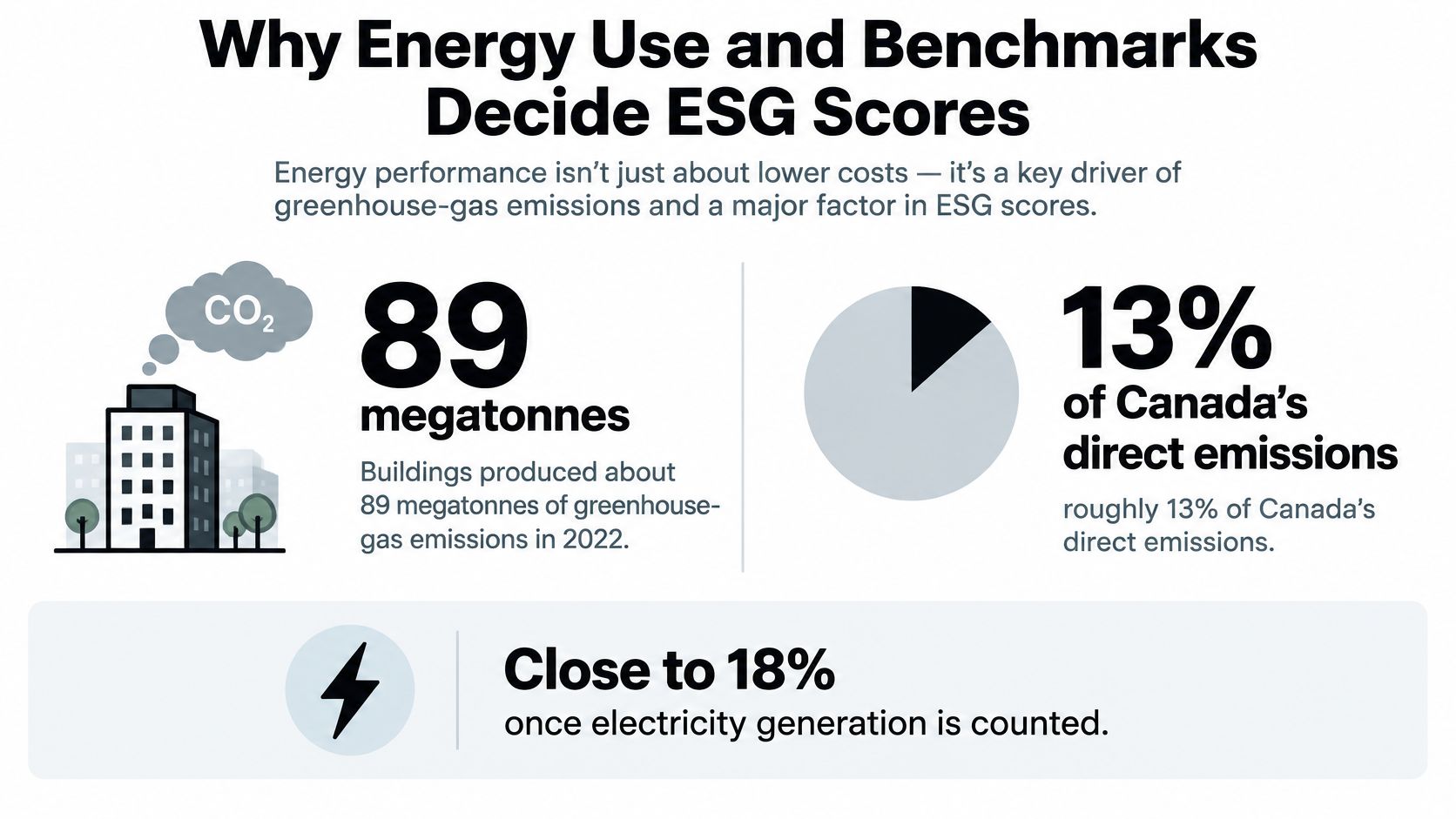
Buildings produced approximately 89 megatonnes of greenhouse-gas emissions in 2022, about 13% of Canada's direct emissions, according to the federal Canada Green Buildings Strategy. For property owners, that makes ESG real estate reporting a question of operational evidence, not just sustainability commitments. A retrofit plan describes what you intend to change. Utility meters, tenant consumption records and leak-response logs establish what changed.
Table of Contents
- What ESG Means for Property Owners
- ESG Metrics Real Estate Teams Report
- Why Energy Use and Benchmarks Decide ESG Scores
- Metering Energy in the Right Order
- Closing Data Gaps and Stopping Water Loss
- Tenant Affordability as Part of ESG Performance
- Confirm Your Metering Data Before the Next Report
What ESG Means for Property Owners
ESG in real estate is an evidence problem before it is a branding exercise. Environmental, social and governance performance gives owners three connected questions for each asset: does the building use less energy and water in measured terms, do occupants experience affordable and reliable service, and can a named person verify the numbers behind the claim?
- Environmental performance concerns energy consumption, associated emissions, water use and avoidable losses. The practical test is which loads the property team can measure, influence and recheck after a project.
- Social performance concerns residents and other occupants, including affordability, comfort, accessibility and service continuity. Efficient equipment can coexist with high bills, uneven comfort or poor access.
- Governance performance concerns accountability: who collects the readings, approves estimates, handles personal information and signs off on reported results.
Accessibility should get its own operational review alongside environmental priorities; for general ESG context, Waymap's explainer is linking accessibility to funded ESG risks.
Where the pillars meet
A condominium heating-plant replacement shows the split. Environmental review tests gas and electricity consumption before and after. Social review checks comfort, outages and occupant costs. Governance review documents who read the meters, which periods were estimated and who approved the reported savings.
The evidence layer is where many claims weaken. If tenants pay their own utilities, owner-led reporting can lose whole-building consumption unless the metering arrangement captures suite data or documents a defensible estimate. A completed installation proves work occurred; metered outcomes show whether consumption, leakage or costs changed. Credible ESG reporting separates intervention from outcome, then assigns responsibility for checking each.
ESG Metrics Real Estate Teams Report
Most property ESG reports rest on a manageable set of metrics. Establish their definitions before selecting software or publishing targets.
Core ESG metrics for real estate reporting
Metric
Unit
What It Shows
Data Source
Scope 1 emissions
tCO2e per year
Direct combustion on site, such as natural-gas boilers and furnaces
Gas invoices and boiler logs
Scope 2 emissions
tCO2e per year
Emissions from purchased electricity and district heat
Electricity and district-energy bills, with applicable emission factors
Scope 3 tenant energy
tCO2e per year
Tenant utility emissions outside the owner's organisational reporting boundary
Tenant submeter data or documented estimates
Energy use intensity
kWh/m² per year
Energy use per square metre, supporting comparison across buildings
Whole-building consumption records converted to kWh and divided by floor area
Water use intensity
m³ per unit or m² per year
Water use relative to building size or unit count
Water bills and suite and common-area meter records
Water loss incidents
Count and m³ lost per year
Detected leaks and floods, with measured or estimated loss volume
Leak sensor alerts, flow records and work orders
Metered share of floor area
% of floor area
Floor area covered by the defined metering arrangement
Meter inventory checked against floor plans
Renewable energy share
% of total energy
Portion of energy supplied from documented renewable sources
Supplier contracts, generation records and certificates
tCO2e means tonnes of carbon-dioxide equivalent. Keep the underlying consumption, conversion factors and calculation version with each emissions result so a reviewer can reproduce it.
The scope labels require a boundary decision. Tenant-paid energy isn't automatically Scope 3 merely because the tenant receives the invoice; classify it using the organisational boundary and reporting approach you've adopted. Document that decision consistently across the portfolio to avoid omitting or double-counting consumption.
Make comparisons meaningful
Intensity metrics help distinguish building size from operating performance. However, comparing an apartment building with a hospital on floor area alone won't provide a fair performance assessment. Record property use, occupancy, reporting period and relevant weather adjustments alongside the result.
Also distinguish consumption from cost. Calculate energy intensity from energy quantities, not invoice dollars, because tariffs and fixed charges can change without any change in demand. For mixed fuels, retain the original units and document the conversion to a common energy unit.
Metered floor-area coverage is a useful confidence indicator, but it isn't proof of complete consumption coverage. A suite electricity meter may cover the entire suite while excluding centrally supplied heating and hot water.
Practical rule: Report what each meter measures, not merely where it's installed.
When evaluating reporting software, use Kagool's practical guide to sustainability reporting platforms as a starting point for questions about integration, traceability and reporting workflows. Require the platform to preserve missing-data flags and revisions rather than making estimated readings look indistinguishable from measured ones.
Mark each metric as available, estimated or unavailable in your reporting inventory. Which can your team produce today, and which still need a defensible collection method?
Why Energy Use and Benchmarks Decide ESG Scores
The national emissions picture establishes the scale of the challenge, but it doesn't score an individual property. Owners need asset-level evidence to distinguish an efficient building from one that merely has a credible-looking improvement plan.
The relationship between building operations and national emissions is illustrated below.
A certificate can describe assessed building characteristics or achievement against a particular standard. It shouldn't replace current operating records. For portfolio analysis, use utility evidence to test whether the property's actual performance supports its stated environmental objectives.
Apply a consistent evidence test
A practical investor-facing review should ask:
- Is the reporting period complete? Check for missing accounts, estimated invoices, vacant-space exclusions and periods that don't align.
- Has intensity improved against a stated baseline? Keep the floor-area definition consistent and explain changes in occupancy, use or weather.
- Are savings measured or projected? Identify engineering forecasts separately from post-installation results.
An energy management system can help organise consumption trends and exceptions. Its usefulness depends on whether the incoming records represent the whole asset and whether the team investigates anomalies.
Benchmarking also has a policy dimension. Federal building energy benchmarking and transparency guidance describes provincial, territorial and municipal activity involving voluntary programmes and the development of mandatory benchmarking, labelling and disclosure policies.
That isn't a single nationwide obligation applying identically to every property. Maintain an applicability register by jurisdiction, building type and reporting programme rather than assuming one portfolio-wide rule.
A favourable benchmark is useful only if the comparison includes the consumption your building actually uses.
For your portfolio review, identify which assets depend most heavily on heating, which are commercial or institutional, and whether their energy records are current. Then rank investigation priorities by both operational exposure and evidence quality. An apparently efficient property with incomplete records may deserve attention before a higher-consuming property whose loads are fully understood.
Metering Energy in the Right Order
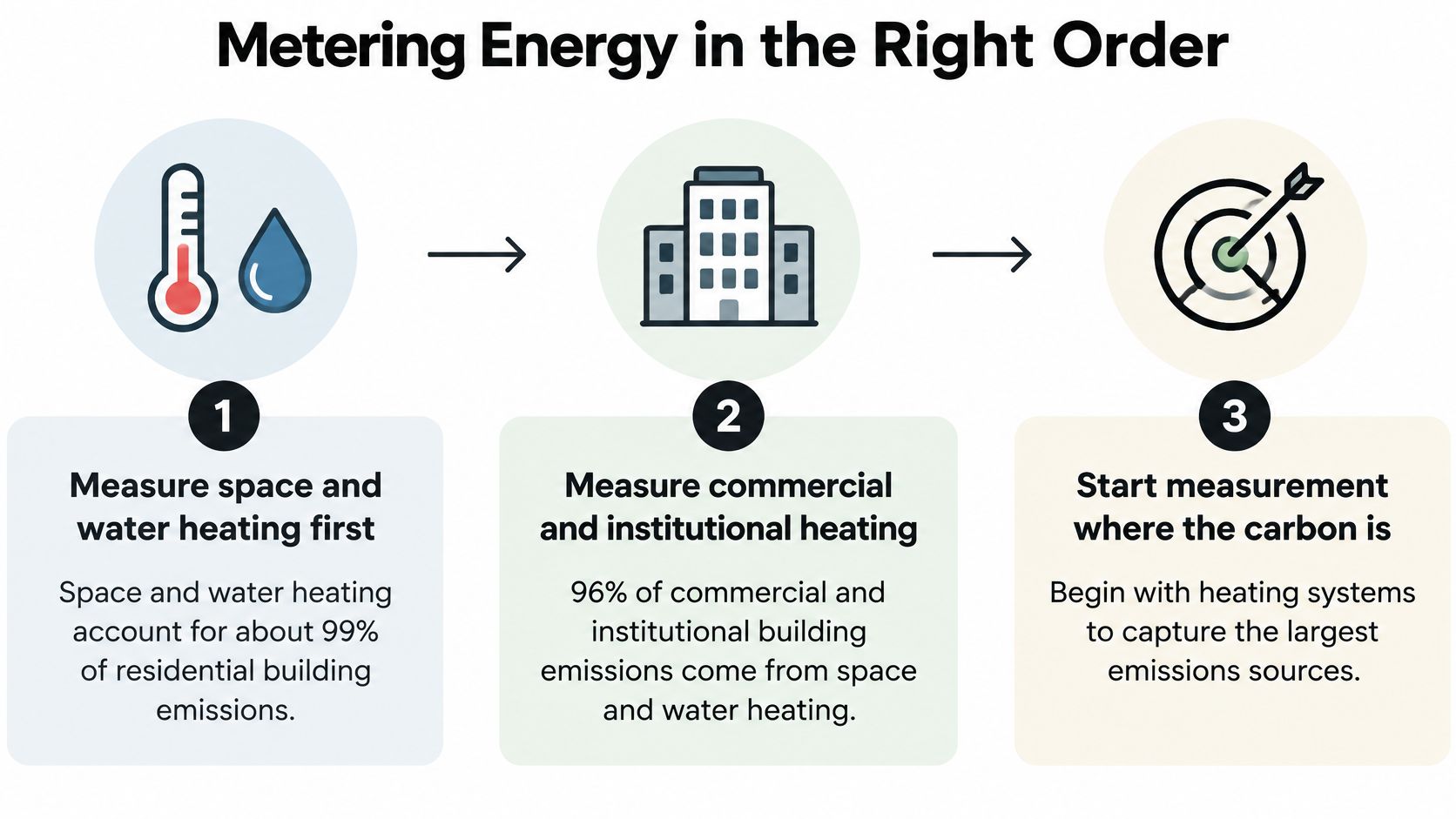
Space and water heating account for approximately 99% of residential building emissions and 96% of commercial and institutional building emissions, according to Natural Resources Canada. Start measurement where the emissions are concentrated, while distinguishing heating energy from the electricity used by lighting, appliances and other equipment.
The priority is to understand heating demand before selecting replacement equipment.
Sequence the investigation before the investment
- Gather a complete baseline year. Collect utility bills and available interval records separately for electricity, gas and purchased thermal energy. Preserve billing dates and actual-versus-estimated read flags so seasonal demand doesn't disappear inside an annual total.
- Separate shared and occupied-space loads. Map common areas, suites, commercial premises and central equipment to their meters. Where direct separation isn't possible, document the remaining uncertainty rather than presenting an allocation as a measurement.
- Audit the envelope and mechanical systems. Have the assessment address heat loss, ventilation, controls, heating distribution and domestic hot-water demand. This connects observed consumption to physical causes instead of assuming the boiler alone explains poor performance.
- Prioritise heating and domestic hot water. Compare demand-reduction measures with equipment changes, including envelope repairs, control adjustments and distribution improvements. Assess feasibility, disruption and occupant needs alongside the expected carbon benefit.
- Size replacements from audited demand. Use the engineering assessment and measured load profile, not the old equipment nameplate. Buying equipment before investigating demand risks retaining unnecessary capacity or missing distribution constraints.
- Verify results against the baseline. Use consistent meter boundaries and reporting periods, documenting meter changes and adjustments for weather or occupancy. Keep commissioning evidence separate from the later evidence that the retrofit delivered savings.
Keep permissions specific to the utility
Our Ontario Energy Board licence ES-2022-0268 applies to Ontario electricity submetering only. We review requirements for water, gas and projects outside Ontario separately for each jurisdiction.
That distinction belongs in project planning, before equipment selection or tenant-billing changes. We confirm availability, equipment approvals, installation requirements and tenant-billing rules before a project proceeds. Metering can support an engineering decision, but the metering arrangement and billing permissions still need their own review.
Closing Data Gaps and Stopping Water Loss
Say an owner can see common-area electricity invoices, but residents pay their suite electricity accounts directly. The owner also has a master water bill and no reliable allocation of gas use. Reporting only the visible accounts would describe the owner's purchasing activity, not necessarily the building's full resource consumption.
The Canada Green Building Council identifies consistent, standardised whole-building energy data as a foundational gap affecting benchmarking, emissions validation and credible sustainable-finance classification. Tenant-paid utilities create a data-access problem, not an exemption from defining the reporting boundary.
Common ESG data gaps and fixes
Data Gap
Effect on ESG Reporting
Fix
Tenant-paid electricity estimated
Scope 3 and intensity figures can be understated or overstated
Install suite-level meters where appropriate or document the estimation method
Common areas mixed with suites
Owner-controlled intensity is misstated
Install a common-area meter and reconcile it to the relevant bills
Missing or late meter reads
Year-on-year comparisons become unreliable
Set a fixed read schedule and validate each read
No written allocation method
Reviewers can't reproduce reported allocations
Write the method and give tenants appropriate notice
Leaks seen only on bills
Water loss and damage may grow before investigation
Install flow and leak sensors with alerts and log each incident
Gas and water on separate systems
Reporting totals are difficult to reconcile
Map each meter to a building, utility and reporting period
For each account, record the meter identifier, service location, units, read dates and responsible person. Reconcile suite and common-area submeters against the appropriate master meter, allowing for timing differences and identifying unexplained residual consumption.
Estimates need explicit labels. State the method, inputs, affected period and reason for use, then replace the estimate when a validated reading becomes available. Protect tenant privacy through appropriate permissions, restricted access and aggregated reporting where individual detail isn't necessary.
Turn water alerts into reportable evidence
A leak alert establishes that a sensor detected a condition, not automatically how much water was lost. Estimate loss from the available flow record and event duration, and label the result as estimated when it isn't directly measured.
A practical water system monitoring routine should connect detection to response:
- Review trends weekly. Examine overnight flow, unexplained baseline changes and sustained consumption during low-use periods.
- Assign every alert. Record who investigates, when they respond and what they find.
- Close the incident with evidence. Log the repair, measured or estimated loss volume and the post-repair flow check.
For properties with planted grounds, the Prestonwood smart water management insights provide a useful companion perspective when considering outdoor water use. Keep irrigation circuits identifiable so outdoor demand doesn't obscure an indoor leak investigation.
Audit safeguard: A tenant notice explains an allocation; it doesn't make an unsupported estimate accurate or authorise a charge.
Use written methods and clear communications, while checking applicable billing permissions. These controls make the report reproducible without overstating what the meters can establish.
Tenant Affordability as Part of ESG Performance
Efficiency doesn't automatically improve residents' finances. Ask who pays for the upgrade, who receives the operating savings and whether cost recovery could leave occupants with higher total housing costs.
The distinction matters whenever building improvements and household budgets move in different directions.

A Hamilton project covering 123 CityHousing townhouses is expected to reduce unit energy use by 61% and greenhouse-gas emissions by 90%, according to the federal Hamilton affordable-housing retrofit announcement. Those are projected project outcomes, not proof of realised household savings. The announcement also describes Canada's Greener Homes Affordability Program, designed to provide no-cost retrofits to low- and median-income households, including tenants, to reduce bills and emissions.
Test the resident outcome separately
The split-incentive problem arises when one party funds an improvement while another receives the utility savings. Resolve that question explicitly in the project's financial assessment rather than assuming the environmental return explains the household return.
Track resident outcomes alongside carbon:
- Consumption and cost. Compare energy intensity with utility cost per occupied unit, separating consumption changes from tariff changes.
- Affordability pressures. Review arrears and billing disputes without assuming every change was caused by the retrofit.
- Comfort and continuity. Record temperature complaints, service interruptions and the functioning of relevant resilience measures.
- Water incidents and communication. Track disruption, unresolved damage and whether residents understand new equipment or billing arrangements.
Billing design deserves particular scrutiny when costs move from an owner-paid arrangement to individual accounts. A review of how to bill tenants for utilities should address allocation, explanations and dispute handling, alongside jurisdiction-specific requirements.
Use the following video as a discussion prompt, not as a substitute for property-level evidence.
Assess the combined effect of rent-related cost recovery, utility charges and any new fees rather than selecting the bill that improved. Credible social ESG performance needs resident-benefit evidence, not just a lower building carbon footprint.
Confirm Your Metering Data Before the Next Report
Before approving the next disclosure, turn the unresolved questions into assigned work. Use this checklist this week, with a named person responsible for each answer.
- Confirm reporting and baseline periods. Record the dates and explain any mismatch between utility billing cycles and the reporting year.
- Inventory each property. List its location, fuel types, unit count, floor area and relevant meter identifiers.
- Mark metric readiness. Identify which measures are supported by readings, which rely on estimates and which can't yet be produced.
- Check separation and allocation. Confirm that shared and suite loads are identifiable and that the allocation method is written down.
- Select the biggest gaps. Assign a practical fix, responsible person and completion date to the most consequential omissions.
Choose the next action deliberately
If a property-specific assessment would help, we offer a free consultation with a submetering specialist, with no obligation. Share the property location, utility types, unit count, construction stage and needed services. We then confirm whether the project is a fit and outline the next step.
You don't need to conceal an incomplete dataset or postpone every disclosure until it's perfect. Decide whether to fix the material gaps before reporting or publish with clearly stated boundaries, estimates and exclusions. Never present an unresolved data gap as verified performance.
Axis Meter Solutions offers utility submetering, meter reading, tenant billing and ongoing monitoring to help property teams build a traceable reporting foundation. Visit Axis Meter Solutions to arrange a free, no-obligation consultation and discuss which metering improvements fit your property and jurisdiction.
Ready to Optimize Your Utility Management?
Tell us about the property, utility, number of units, and your billing or monitoring goals. We'll help you identify the right next step.
Book a Call