Flow Meter Liquid Guide for Property Owners

A tenant questions a shared water bill. At the same time, a maintenance technician finds staining near a riser, while the property administrator is still collecting readings from several mechanical meters by hand. None of these problems starts with a dramatic equipment failure. They usually begin with poor visibility, an unsuitable meter, or a reading nobody trusts.
For Canadian multi-family, condominium, mixed-use, and commercial properties, flow meter liquid systems now serve several jobs at once. They allocate consumption, support transparent billing, reveal abnormal use, and give operating teams evidence before a small leak becomes a building repair. The hardware still has to match the pipe, fluid, flow range, and installation conditions, but the business question is just as important: what will the meter help the property team prevent, recover, or manage?
Table of Contents
- Why Liquid Flow Measurement Matters for Your Property
- Comparing Major Flow Meter Technologies
- Regulatory Compliance and Canadian Standards
- How to Select the Right Meter for Your Building
- The Value of Smart Diagnostics and Leak Detection
- Putting It All Together for Smarter Property Management
Why Liquid Flow Measurement Matters for Your Property
A water meter only becomes valuable when its readings lead to better decisions. A suite-level reading can resolve a billing dispute, but the same data can also show that a common-area branch is consuming water overnight when the building should be quiet. A main meter can expose an unexplained difference between incoming supply and allocated use. Neither signal is useful if the meter is poorly selected, inaccessible, or read inconsistently.
Ontario's history illustrates how water measurement moved toward utility standardisation. Provincial survey data reported that 56% of Ontario's population had water meters in 1989, rising to 67% by 1994, while national coverage reached 54% of municipal populations in 1994. The same time-series study noted that one third of Ontario municipalities had no water metering at the time, with unmetered service concentrated in smaller urban areas and Toronto still largely unmetered. The Canadian Water Resources Journal study provides the historical context for that transition.
The operational cost of weak measurement
Poor metering creates more than an accounting nuisance.
- Billing friction: Tenants and owners are more likely to challenge charges when readings are estimated, delayed, or difficult to reconcile.
- Unclear responsibility: Without separate suite, common-area, and mechanical readings, a manager may not know whether unusual use belongs to a resident, a commercial tenant, or the building itself.
- Delayed maintenance: A slow leak can run for a long time before anyone sees physical damage. Trend data gives the team another way to identify abnormal consumption.
- Manual administration: Staff spend time accessing meters, transcribing readings, checking anomalies, and responding to disputes instead of managing exceptions.
Accurate submetering can support cost recovery and budget predictability, but it shouldn't be treated as a guaranteed profit lever. The result depends on the property's lease or condominium rules, local requirements, billing model, installation quality, and the team's ability to act on the data.
Practical rule: A meter should answer an operational question. If nobody knows what action follows an abnormal reading, the project is only collecting numbers.
The strongest installations separate consumption in a way that reflects how the building operates. Common areas should be visible independently from occupied suites. Commercial spaces with different operating hours may need their own measurement points. Mechanical rooms, irrigation branches, and domestic hot-water systems can each produce patterns that disappear inside one bulk reading.
That is why flow meter liquid selection belongs in the property plan, not only in the mechanical specification. The right device improves evidence, but the surrounding workflow determines whether that evidence protects the asset.
Comparing Major Flow Meter Technologies
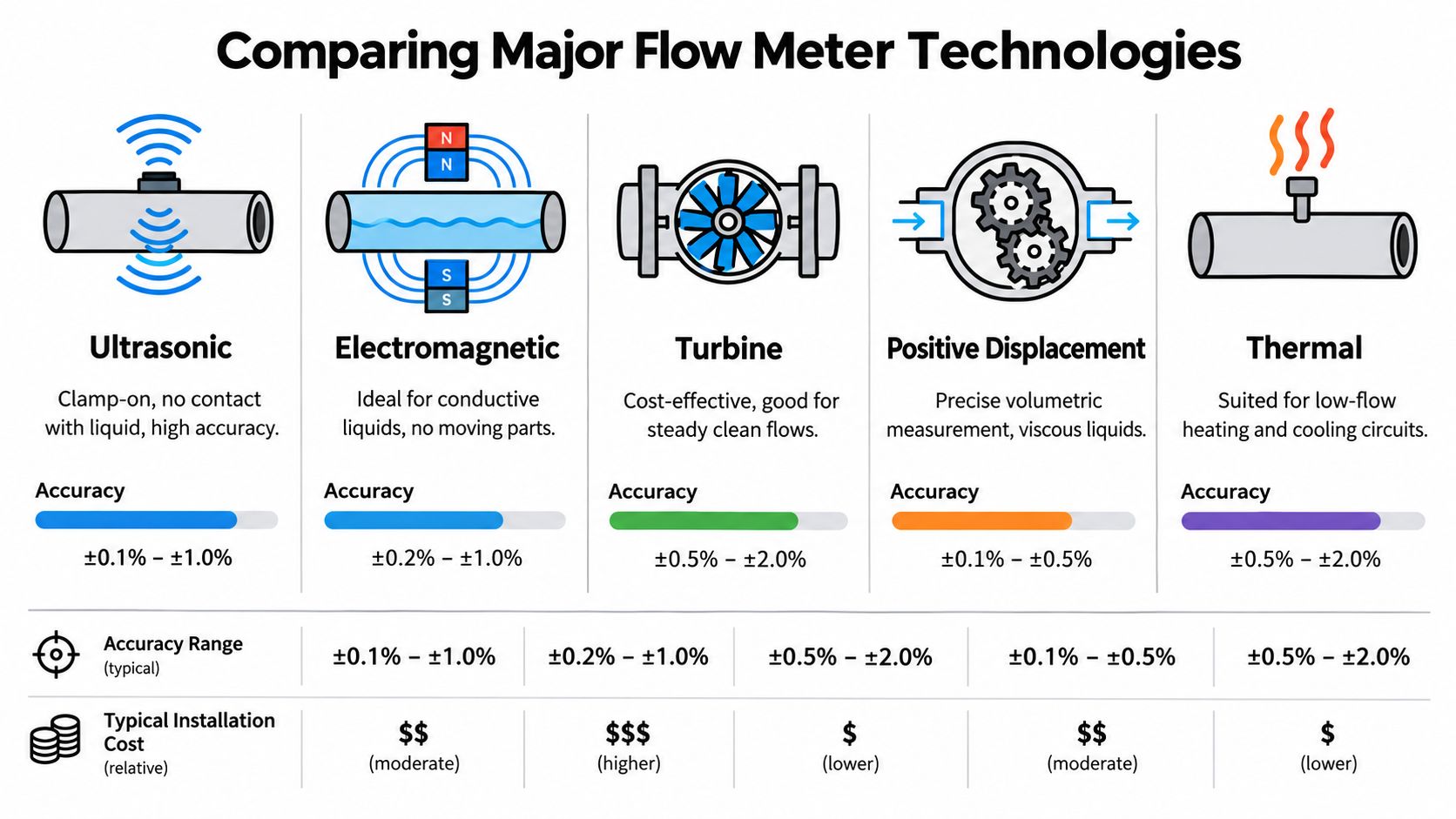
No single liquid meter technology wins every building application. A clean, conductive water line may favour an electromagnetic meter, while a retrofit where pipe cutting is impractical may favour ultrasonic measurement. A small branch with steady, clean flow can justify a turbine meter, whereas a viscous process liquid may require positive displacement measurement.
Five technologies in practical terms
Ultrasonic meters measure flow through sound signals and can be installed in clamp-on configurations without opening the pipe. That makes them useful for audits, temporary investigations, and some retrofit situations where shutdowns or cutting are difficult. Performance depends heavily on pipe condition, installation quality, acoustic coupling, and the liquid and flow profile. They can reduce disruption, but the lowest installation effort doesn't always produce the most dependable permanent billing point.
Electromagnetic meters have no moving parts and are well suited to conductive liquids, including many water applications. They generally avoid the mechanical wear associated with rotors and don't place an obstruction in the flow path, which helps limit pressure loss. They still need correct grounding, full-pipe conditions, appropriate lining and electrode materials, and suitable upstream and downstream installation. A magmeter isn't automatically the right answer for every liquid, particularly where conductivity is unsuitable or the pipe regularly runs partially full.
Turbine meters use a rotor that turns as liquid passes through the body. They can be economical for clean, steady flows, but the rotor introduces a wear and fouling consideration that owners shouldn't ignore. Particles, poor filtration, low-flow operation, and changing flow conditions can affect readings and maintenance intervals.
Positive displacement meters trap and count defined volumes of liquid. Their direct volumetric approach can work well where precise allocation matters or where the liquid is more viscous, but internal moving parts require attention. They are a poor choice for dirty water or liquids carrying particles that can jam or damage the measuring elements.
Thermal meters are more commonly associated with mass-flow measurement and low-flow heating or cooling circuits than with ordinary domestic water allocation. They measure heat transfer behaviour, so the application must justify the technology. For a standard potable-water branch, a thermal device may add complexity without solving the owner's main problem.
A field comparison
Technology
Accuracy
Best For
Ultrasonic
High when installed and configured correctly
Retrofit checks, non-invasive installation, selected permanent applications
Electromagnetic
High for suitable conductive liquids
Water and wastewater lines without moving parts
Turbine
Good in clean, stable flow
Cost-conscious measurement on steady branches
Positive displacement
Precise volumetric measurement
Clean, viscous liquids and defined allocation points
Thermal
Application-specific
Low-flow heating and cooling measurement
Meter selection guidance should also account for pipe geometry, fluid cleanliness, pressure drop, maintenance access, and communications. This overview of water-flow sensors is useful when comparing sensor types before requesting a quotation.
The installation matters as much as the sensing principle. A technically capable meter can underperform when the pipe is not full, the straight-run requirement is ignored, the sensor is mounted beside turbulence, or the selected range is too wide for the actual branch. A cheaper device that produces disputed readings is not cheaper after staff time, re-reads, corrections, and tenant complaints are included.
For a visual explanation of the measurement principles, this short video provides a useful introduction before a detailed site review.
Regulatory Compliance and Canadian Standards
A meter can produce stable readings and still create compliance problems if its approval status, application, and records do not align. Canadian property owners should separate device approval, billing rules, and good metrological practice because each addresses a different operational risk.
Measurement Canada exempts water meters from approval and initial inspection under the Weights and Measures Regulations. The exemption appears in federal water-meter consultation material, including documents from the consultation process launched in 2021 and later government materials. It does not remove the need for reliable performance. Property teams still need a meter suited to its intended use, a defensible installation, and records showing how readings are generated and applied.
The same consultation material cited a 2009 survey finding that households charged by water volume used 73% less water than households on flat-rate pricing. Measurement Canada's water-meter consultation introduction explains the policy rationale for measured consumption and the need for credible metering systems.
Approval classes are application-specific
Coriolis liquid meters show why a general accuracy statement is insufficient. For the category covering “all other liquid applications,” Measurement Canada lists acceptance limits of error of ±0.2% and in-service limits of ±0.3%. Retail motor-fuel dispensers under 90 lpm and heated products over 50 °C have different limits, with ±0.3% acceptance and ±0.5% in-service limits. These values belong to the relevant approval categories, not to every liquid meter in every Canadian building. Check The Coriolis approval terms against the actual application.
Canadian requirements also address the information shown on the assembly. Markings may need to identify minimum and maximum mass flow rates, maximum working pressure, the liquid operating temperature range when it falls outside −30 °C to +50 °C, minimum measured quantity, and applicable limitations. The detailed marking and operating requirements show why commissioning records must describe the process conditions the meter faces.
Compliance checkpoint: Keep the meter model, application class, operating range, installation details, commissioning results, and maintenance history together. A product brochure is not an audit file.
Confirm which rules apply in the province, municipality, utility arrangement, and billing model, and review Measurement Canada-approved meters for the applicable approval context. An exemption does not remove the need for documented accuracy, and approval for one liquid or temperature regime does not automatically cover another. That distinction protects billing credibility and prevents avoidable disputes during audits or tenant reviews.
How to Select the Right Meter for Your Building
Start with the building, not the catalogue. A property owner who asks only for the cheapest flow meter liquid option may receive a device that fits the pipe but performs poorly at the building's actual low-flow conditions.
Build the application record
Record the following before contacting suppliers:
- Measurement point: Identify suite feeds, risers, common areas, irrigation, domestic hot water, cooling loops, and process branches separately.
- Pipe information: Confirm nominal diameter, material, connection type, available straight run, access, and whether the pipe can be isolated.
- Operating range: Establish expected minimum, normal, and maximum flow. A meter selected around an occasional peak may lose useful resolution during ordinary consumption.
- Fluid condition: Note conductivity, temperature, suspended solids, scaling, air, viscosity, and whether the line can run partially full.
- Data requirement: Decide whether the team needs local display, pulse output, wired communications, wireless transmission, automated alerts, or integration with billing software.
- Service plan: Confirm how technicians will isolate, inspect, verify, replace, and access the meter without creating avoidable disruption.
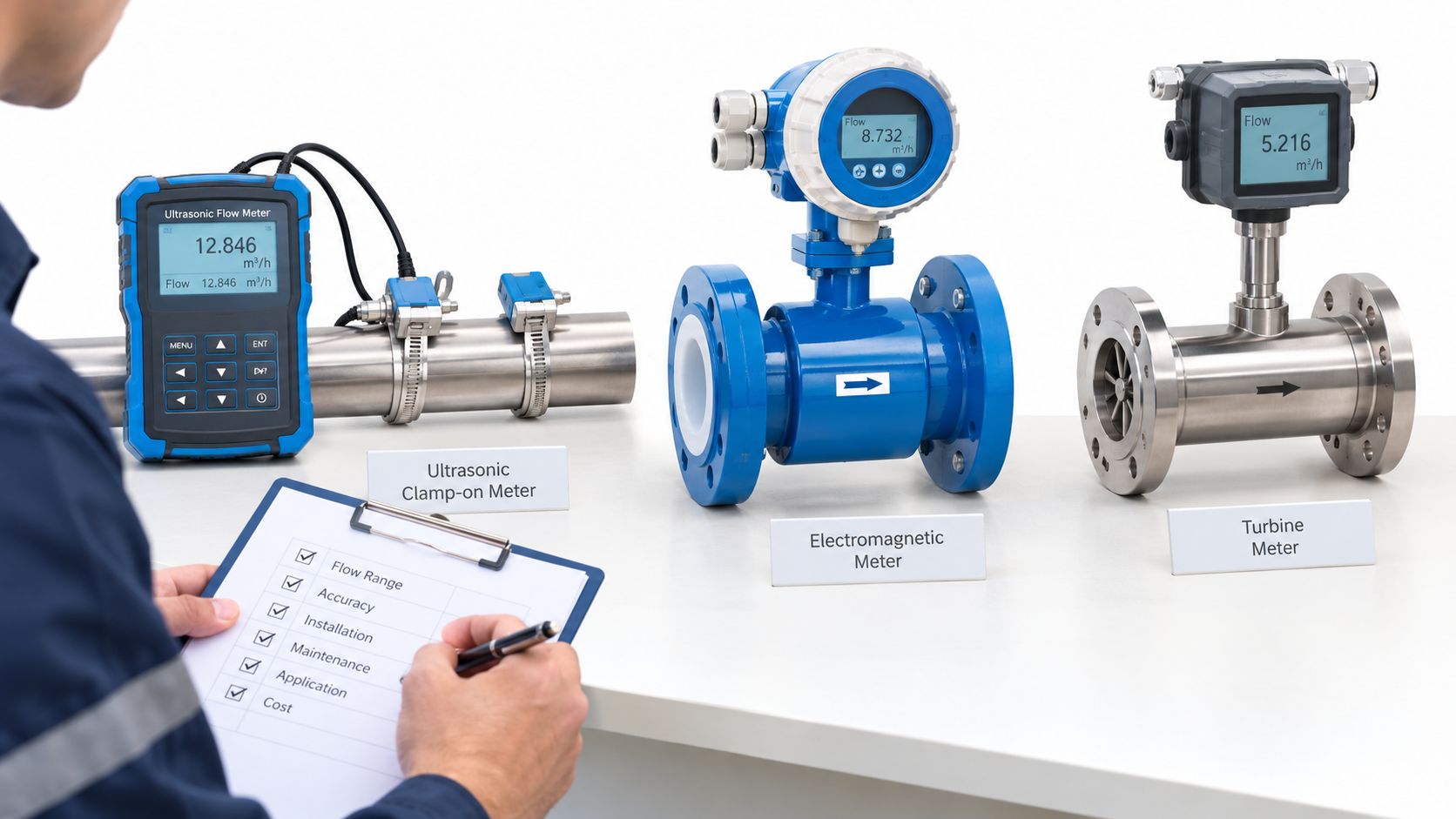
A mixed-use building often needs more than one technology. Suite water branches may use compact meters designed for allocation and communications, while a larger common-area supply may favour an electromagnetic meter with no moving parts. A restaurant or light industrial tenant could need a different arrangement because grease, suspended material, cleaning practices, or operating patterns make a standard clean-water assumption unreliable.
Test the decision against real operations
Ask three questions before approving the design.
Can the team reach it? A meter buried behind finished walls or installed above an inaccessible ceiling may be technically correct but operationally weak. Maintenance access should be part of the layout review, not an afterthought.
Will the meter see its normal flow? Undersizing can create pressure and capacity problems, while oversizing can make low-flow readings less useful. The manufacturer's range should be compared with actual branch behaviour, not just the pipe diameter.
What happens when the reading looks wrong? The project should define who receives an alert, who checks the fixture or valve, how the reading is verified, and how billing is handled during investigation.
A procurement package should include the proposed technology, meter model, flow range, installation drawings, communications design, commissioning method, data ownership, replacement process, and responsibility for tenant communications. If a supplier can't explain those items clearly, the risk will surface later as a service call or a billing dispute.
The Value of Smart Diagnostics and Leak Detection
A connected meter changes the question from “How much water did the property use?” to “What is happening on this line right now?” That difference matters in buildings where a manager may not be on site when consumption changes.
Kelowna's advanced-meter programme identifies sensitive leaks at 1 litre per hour, moderate leaks at 4 litres per hour, and high leaks at 10 litres per hour. EPCOR also explains that real-time water-meter data can indicate leaks and reduce the chance of an expensive bill. These thresholds and capabilities make leak detection relevant to suites, risers, mechanical rooms, and common areas, not just municipal supply management. EPCOR's explanation of advanced water meters provides a practical example of how utilities frame the benefit.
The operational value comes from the response process. An alert can prompt a manager to check a toilet, shutoff valve, mechanical seal, irrigation controller, or vacant suite before water reaches flooring and finishes. It can also provide a time-stamped record when a resident reports a leak or disputes responsibility.
Diagnostics need a workflow
Smart features don't replace maintenance judgement. They create a prioritised list of conditions that need attention.
- Continuous flow during vacancy: Check fixtures, valves, toilets, and appliances before assuming a meter fault.
- Unexpected overnight use: Compare the pattern with cleaning, irrigation, commercial operations, and domestic hot-water circulation.
- Abrupt change after work: Review recent plumbing repairs, valve positions, commissioning, and communications.
- Missing or inconsistent data: Investigate power, connectivity, gateway status, and the meter itself before using the record for billing.
One Canada-focused market report estimates that premium digital meters account for 35–45% of new installations and projects 4–6% value growth through 2035, as users prioritise connectivity and predictive maintenance. Those are projections from the Canada liquid-flow-meter market analysis, not a guarantee for every property or meter category.
Managers assessing a system should also review advanced water leak techniques for a broader maintenance approach. Connected metering works best when alerts feed a documented escalation path, rather than landing in an inbox nobody monitors. For equipment options and line-level detection considerations, this guide to leak detection equipment for water lines offers a useful reference.
Putting It All Together for Smarter Property Management
A successful liquid metering project combines measurement quality, regulatory awareness, installation discipline, and response capacity. Technology is only one part of that result. The owner also needs a clear allocation model, defined responsibilities, accessible equipment, reliable data transmission, and a process for correcting exceptions.
Before approving a project, review this short checklist:
- Map the building's water paths. Separate suites, common areas, risers, mechanical systems, and unusual tenant loads.
- Confirm operating conditions. Document flow range, pipe details, fluid quality, temperature, pressure, and full-pipe conditions.
- Choose by application. Compare ultrasonic, electromagnetic, turbine, positive displacement, and thermal options against the actual duty.
- Define the data outcome. Decide whether the system supports billing, leak alerts, maintenance diagnostics, owner reporting, or all of these.
- Document compliance. Retain model details, approvals where relevant, installation records, commissioning results, and service history.
- Plan the response. Assign people to review alerts, investigate abnormal use, communicate with occupants, and correct records when necessary.
A bulk utility bill tells you what the property consumed. A well-designed submetering system helps explain where consumption occurred, when it changed, and what action should follow. That supports fairer allocation, more controlled maintenance, and earlier intervention when water moves in a way the building team didn't expect.
Audit the existing meter map before replacing equipment. Identify disputed readings, inaccessible meters, unexplained common-area use, and lines with no leak visibility. Then request a design that treats the building as an operating system, not a collection of identical pipes.
Axis Meter Solutions provides turnkey water submetering for multi-family, condominium, mixed-use, and commercial properties, including meters, communications, leak and flood detection, billing workflows, commissioning, and ongoing service. Review your building's current measurement points and discuss a practical upgrade path with Axis Meter Solutions.
Ready to Optimize Your Utility Management?
Tell us about the property, utility, number of units, and your billing or monitoring goals. We'll help you identify the right next step.
Book a Call