Landlord and Tenant Board Guide to Utility Charges
The Tribunals Ontario 2017–18 annual report records that about 90% of applications came from landlords and 10% from tenants, a split broadly consistent since the 1998 transfer, and that the board received 81,432 applications and resolved 78,783 in fiscal year 2016–17. Cases carry over between fiscal years, so those two totals are not a yearly score.
A utility payment works like a parcel with one label. Classify it as rent, and that choice sets the application, the evidence, and the arrears method. Classify it as not rent, and those three shift. Many guides stop at the lease clause. The billing records still have to match the classification before the charge is pursued.
Table of Contents
- What the Landlord and Tenant Board Does
- Which Board Application Fits Your Dispute
- How Utility Charges Are Classified Under Ontario Rules
- Setting Up Tenant Utility Billing Legally
- Documenting Charges So They Hold Up at the Board
- Fixing Estimated Bills and Allocation Errors
- What Happens After You File
What the Landlord and Tenant Board Does
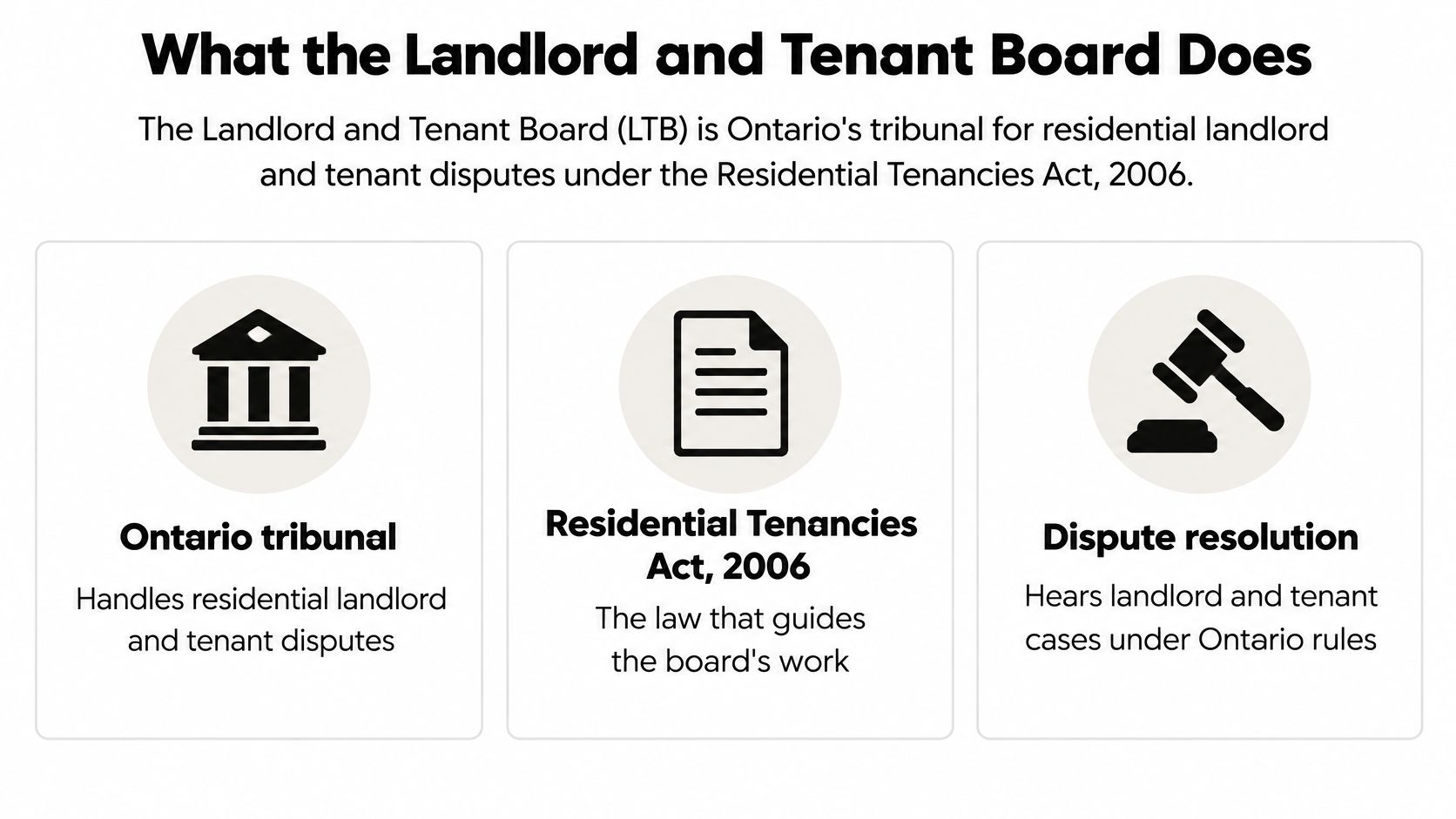
The Landlord and Tenant Board (LTB) is Ontario's tribunal for residential landlord and tenant disputes under the Residential Tenancies Act, 2006. Its modern role dates to 1998, when this work moved out of the provincial courts. Say a manager in a mid-rise has a tenant who has ignored a hydro share since March. The manager doesn't open a small-claims file. Rent, maintenance, termination, possession, and related tenancy obligations are heard here, and a utility disagreement usually rides inside one of those applications rather than as a standalone utility claim.
The hearing load
Tribunals Ontario recorded 89,494 in-person, electronic, and written hearing events during fiscal year 2024–2025 on its LTB key performance indicators. Landlord files, including non-profit housing co-operative applications, make up the bulk of that work. Tenant files are the smaller share, and that split has held since the court transfer.
Learn the forum before you pursue any charge. The form and the charge setup come after you know who actually decides the dispute.
Operators who treat the board as a last resort often arrive with the wrong application and a ledger that doesn't match the lease. The path below starts with the form, then the classification, then the paperwork that has to sit behind every dollar.
Which Board Application Fits Your Dispute
The right application depends on what the tenant owes and why. The L2 instructions identify heat, electricity, and water as utilities and let a landlord claim expenses when the tenancy agreement requires the tenant to pay utility costs. L1 applications concern eviction for non-payment of rent and collection of rent owed. L9 applications concern collection of rent owed.
Application
Used for
Who files
Utility link
L1
Eviction for non-payment of rent, with rent owed
Landlord
Covers rent-type amounts; classify the utility payment first
L2
Eviction on other grounds, with money owed
Landlord
Lists heat, electricity and water as utilities
L9
Collection of rent owed after the tenancy has ended
Landlord
Used for arrears once the tenant has moved out
T2
Tenant claim about maintenance and repair problems
Tenant
Used when a service or supply failure is the issue
T5
Tenant claim about an illegal charge
Tenant
Used to contest a utility or rent amount the tenant says is unlawful
How each row changes the utility file
L1 is the non-payment route, so it fits only when the unpaid amount is rent. A fixed monthly utility sum paid to the landlord may count as rent. A metered hydro bill owed to the utility or reimbursed to the landlord does not. Support the claim with the lease clause, rent ledger, and a calculation that excludes non-rent utility charges.
L2 covers eviction on other grounds, with money owed included in the application. Heat, electricity, and water costs may be part of the money claim when the tenancy agreement requires the tenant to pay them. Keep the agreement, invoices, and accounting records together so the same amount is not counted as both rent and a utility expense.
L9 seeks rent owed after the tenancy has ended. Moving out does not turn a non-rent utility reimbursement into rent. If the remaining debt is only a non-rent utility charge, L9 is not the route for claiming it as rent arrears.
T2 addresses a tenant's claim about maintenance or repair problems. It may fit when the dispute concerns a failed service, such as heat or water, rather than only the amount charged. Dates, photographs, and work orders can help document the service problem.
T5 lets a tenant claim that a charge is unlawful. For a disputed utility or rent amount, the lease, notice, and bill can show what was agreed and what was charged.
Choose the application based on the legal nature of the claim, not just the bill's label. Ontario's process differs from dispute resolution elsewhere, including how landlord and tenant in LA may handle disputes through mediation. Confirm the current form requirements, then make sure the billing records support the classification used in the application.
How Utility Charges Are Classified Under Ontario Rules
One classification changes four things: the application, the evidence, the arrears calculation, and the collection process. Ontario's L1 instructions distinguish a tenant's obligation to pay a share of a utility bill from a fixed monthly utility payment made to the landlord.
A tenant's obligation to pay all or part of a hydro bill, directly to the utility or indirectly through the landlord, is not rent. A fixed monthly utility amount paid to the landlord meets the definition of rent.
Consider two units with similar winter electricity use.
Fixed monthly charge: Unit 4's lease requires an $80 utility payment to the landlord each month. Because the amount is fixed, it meets the definition of rent. The rent ledger and lease clause should show the charge consistently.
Measured reimbursement: Unit 7 pays for measured electricity, either to the suite-meter provider or to the landlord. That payment is not rent, even if its yearly average is close to $80 per month. The bill should be supported by meter readings, the billing period, and the lease term that requires payment.
The amount alone does not decide its legal character. The agreement and billing records must match: a fixed amount treated as rent should appear consistently in the rent record, while a measured reimbursement should be documented as a utility charge. If those records mix the two categories, it becomes harder to show what the tenant owes and which process applies.
Rules can differ between provinces, so an arrangement used elsewhere does not establish how an Ontario charge should be classified. For Ontario electricity submetering, the Ontario Energy Board licence ES-2022-0268 applies; readers can find more about the Ontario Energy Board's role in electricity submetering.
Setting Up Tenant Utility Billing Legally
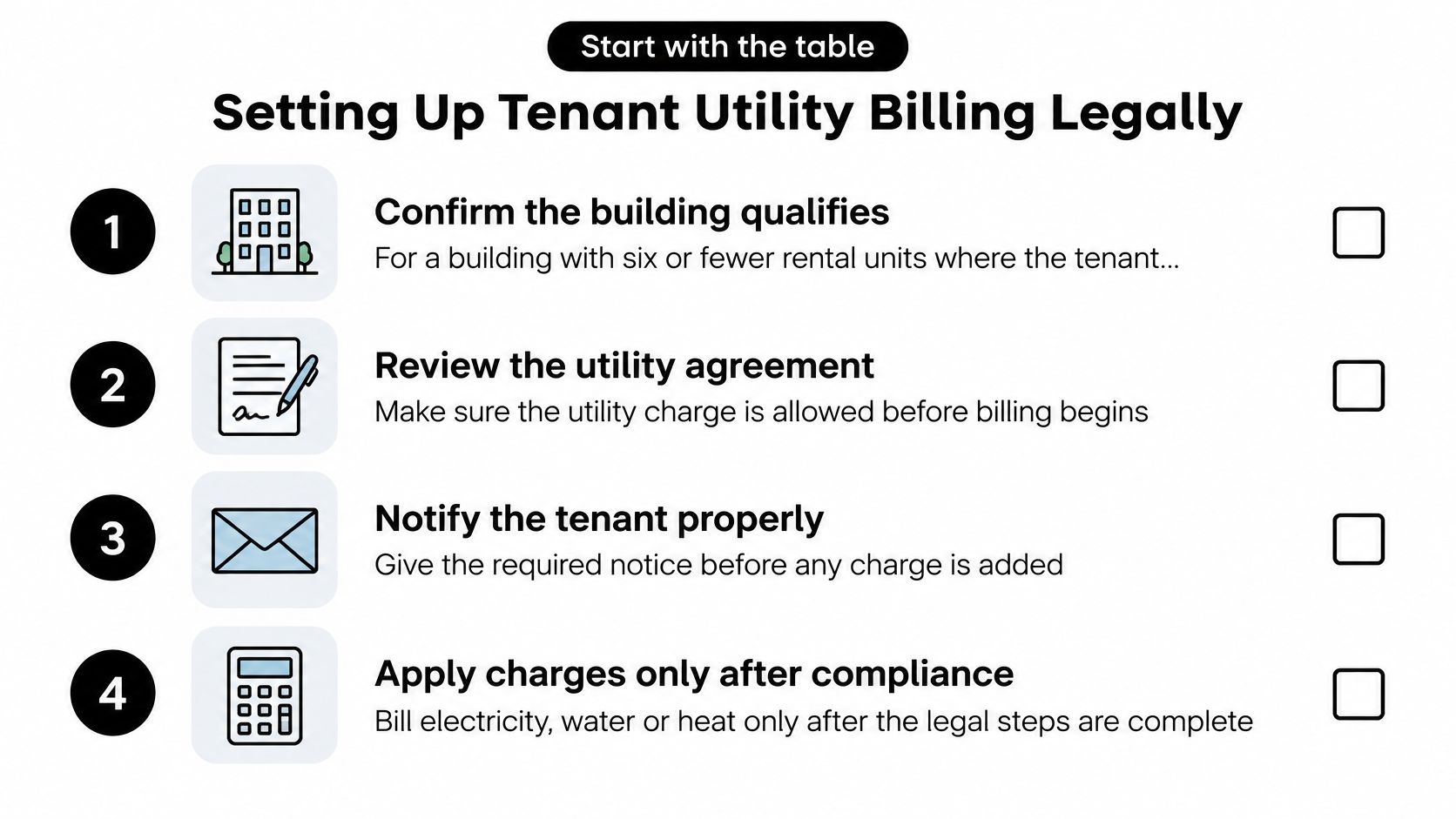
Charging a tenant for electricity, water, or heat is a sequence, not a line you add to the rent invoice. The Landlord and Tenant Board suite meter brochure sets the two arrangements operators meet most often. Ontario Regulation 394/10 governs suite-meter rules, including rent reductions and how utility costs are split.
Arrangement
Landlord duty
Tenant notice and consent
Six or fewer units, tenant pays a share of utilities
Give the 12 most recent months of total utility cost and the unit percentage
Written consent and at least 30 days' written notice
Separately metered suite, tenant pays provider directly
Agree the arrangement and set any rent reduction under Ontario Regulation 394/10
Notice must state the rent reduction, effective date and calculation method
For a building with six or fewer rental units, where the tenant pays a share rather than a separately metered amount, the prospective tenant must receive the building's total utility cost for the 12 most recent available months and the percentage attributable to that unit. For a suite meter, landlord and tenant may agree that the tenant pays the provider directly.
Notice sequence
- Lock the category first. Decide whether the lease makes the charge rent or a non-rent utility payment, and confirm the billing model matches. A shared-percentage bill on a lease that promises a fixed rent inclusion will not hold.
- Check the licence. Electricity submetering in Ontario is what the Ontario Energy Board licence covers. Water, gas, and projects outside Ontario are reviewed separately for each jurisdiction. Verify the electricity licence on the Ontario Energy Board register before you name a provider in the lease. Our licence can be checked there.
- Get written consent. Verbal agreement at a showing isn't the consent the rule describes. Keep the signed copy with the tenancy file.
- Send the notice. At least 30 days' written notice is required before you charge a portion of utility costs. The notice has to identify the rent reduction, the effective date, and the calculation method. Without the reduction, you risk charging utilities on top of rent that still includes them.
- Hold the first bill. Tenant billing begins once the meters go live, so the first invoice shouldn't go out before the notice period ends. We review the intended billing model and the applicable requirements before implementing tenant billing based on water submeter readings.
- Name who still owes the commodity. An owner can have the tenant set up an account with us, and the owner is responsible if the tenant fails to pay amounts owing. Where rent doesn't include commodity costs, that owner responsibility remains. A practical walk-through of invoice design sits in our note on how to bill tenants for utilities.
The billing system, the lease clause, and the actual meter allocation must match before any charge is pursued. An accurate read doesn't cure a missing consent or a short notice.
Documenting Charges So They Hold Up at the Board
A clean meter read still fails if nobody can match it to the lease and the rule that allows the charge. Unresolved disputes at the Landlord and Tenant Board sit for months. The file has to be auditable on the day you bill, not the week before a hearing.
Classification comes first. A utility payment is either rent or it is not rent. That split decides which application fits, what evidence the member will expect, and how arrears are calculated. Billing records have to match the classification before anyone pursues the charge. An electricity line the lease calls a separate commodity is not the same thing as a fixed amount the lease calls rent, even when the dollar figure looks identical. Ontario's residential tenancy rules draw that line. Other provinces use their own boards and tests, so do not carry an Ontario file structure into a hearing somewhere else without checking the local rule.
The invoice works like a grocery receipt. One blended total hides which item the lease allows. Split consumption, pass-through charges, taxes, and late-payment penalties on the tenant invoice and on the owner's ledger. Delivery, regulatory, debt-retirement, billing, administrative, tax, setup, and late-payment charges can all appear on an electricity bill. If they sit inside one number, nobody can test which part the clause permits.
Fields every charge should carry
- Tenancy clause: the sentence that creates the duty, quoted, not paraphrased.
- Classification: rent, or a charge outside rent, in the same words as the lease.
- Utility rule: suite meter, shared allocation, or a fixed amount that is rent.
- Meter identifier: the unit meter, not the building bulk meter.
- Billing period: start and end dates that do not overlap the previous invoice.
- Opening and closing reads: actual figures, with any estimated read labelled as estimated.
- Adjustments: credits, rebills, and the reason for each.
The property audit file
Keep, in one folder per building, the signed agreement, baseline utility data, the allocation formula, the effective-date notice, the rent-reduction calculation, and proof of what you sent the tenant. We may disclose customer, unit, and account information, including consumption, allocation, and payment information, to the landlord, property manager, developer, condominium corporation, or owner, and the customer consents to that. Confirm what arrives and on which day of the month, so the ledger is not waiting on a portal export during a dispute.
Owners often ask whether they can see the underlying invoices. The short answer, and the limits, are set out in can a landlord request utility bills.
Each month, before invoices go out, reconcile three things: the provider invoice, the opening and closing reads, and the allocation formula. A formula that still uses last year's percentage will not survive a tenant who asks for the math. Match that math to the classification on the lease. A separate utility charge needs the reads and the method. An amount that is rent needs the clause that makes it rent. Bring the wrong stack, and months of waiting will not fix the mismatch.
Fixing Estimated Bills and Allocation Errors
Ontario reported that the LTB resolved 106,000 cases in 2024, while L1 eviction and L9 rent-recovery applications had average hearing times of 8–9 weeks, an improvement from 34–43 weeks in early 2023, in an Ontario government summary. A written correction, backed by reads and a recalculation, often resolves a billing dispute before a hearing. It also leaves the same kind of record a tribunal expects if the dispute continues.
An estimated bill works like a grocery scale that never weighed this week's cart. It guesses from an older pattern. When the figure sits far above a tenant's normal winter use, the usual cause is an assumed read, not a sudden jump in the suite.
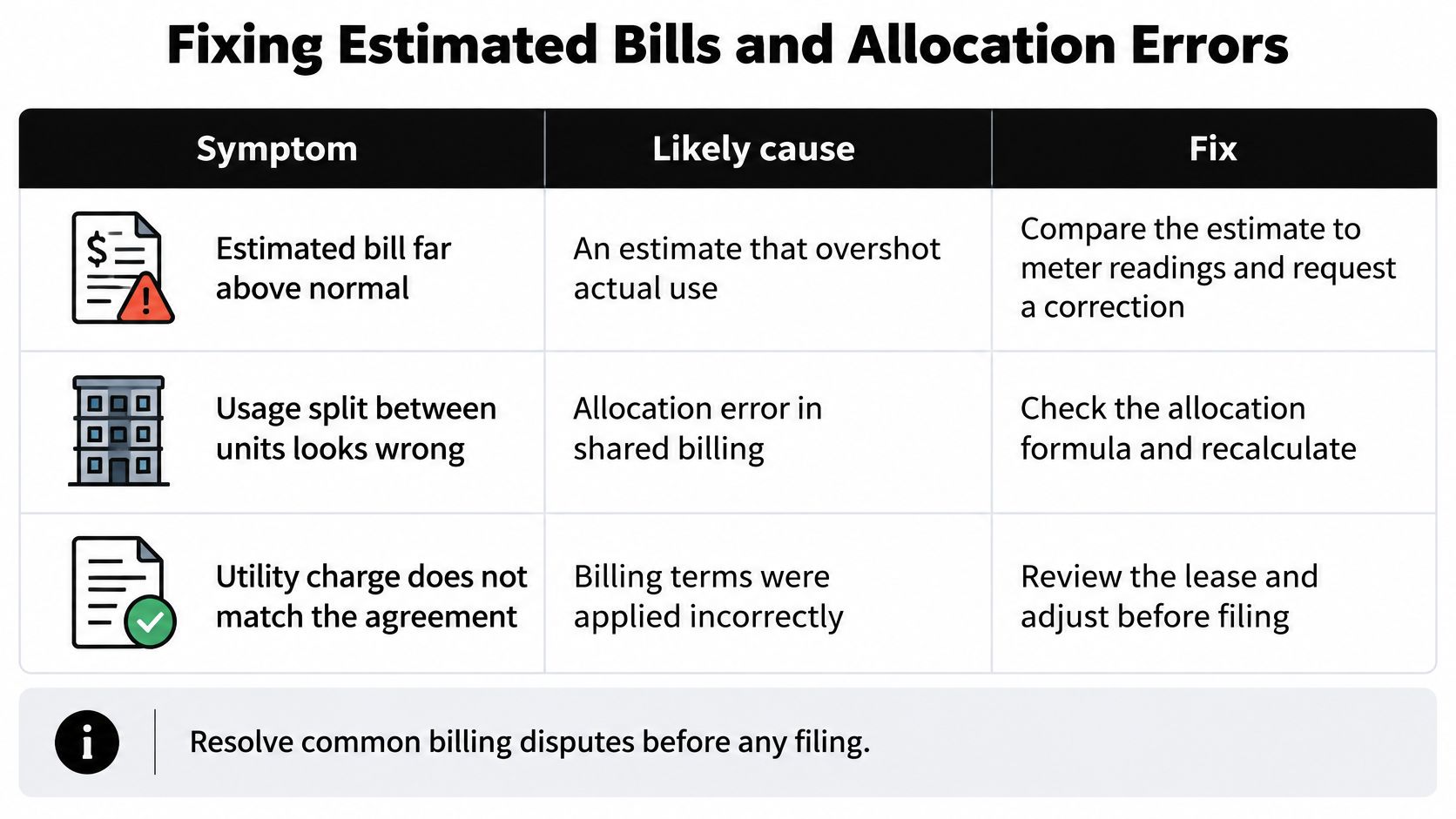
Symptom
Likely cause
Fix
Estimated bill far above normal
Assumed read used instead of actual
Replace with actual reads and issue a corrected bill
Tenant share looks wrong
Allocation percentage not recalculated
Rebuild the share from the 12-month baseline
Common-area costs on tenant bill
Shared load not separated
Add common-area metering or a documented allocation
Charge continues after move-out
Account not closed on move-out date
Close the account and credit any overcharge
Pull the actual opening and closing figures, reissue the invoice, and show the tenant both versions. A share that looks wrong usually means nobody rebuilt the percentage after a vacancy or a meter swap. Go back to the 12-month baseline and the unit's percentage, then send the new math. Common-area lights and the boiler room stay off a suite bill unless a documented allocation puts them there. After move-out, close the account on the written vacate date and credit anything billed past that day.
Sort the corrected dollars before anyone pursues them. If the lease folds the utility into rent, the application, the evidence, and the arrears method follow the rent rules. If the lease keeps the charge as a separate reimbursement, those same dollars are not rent, and each of those three things changes. A clean meter read does not rescue a charge pursued under the wrong label. The written correction has to name the classification and show arithmetic that matches it.
Correction before escalation
- Set the invoice beside the meter reads, line by line.
- Recalculate the allocation from the baseline, not from last month's percentage.
- Send a written correction that shows the old figure, the new figure, whether the amount is rent or a separate utility charge, and the arithmetic.
- Keep heat and water running while the amount is in dispute. Cutting either service to force payment creates a second claim.
- Go to the board only if the written correction fails.
Tenants should dispute an inaccurate charge in writing. Withholding rent, or withholding a utility amount that is not in dispute, is not a safe default. Unpaid utilities can be claimed as their own amount when the lease does not treat them as rent. Other provinces use different boards and different tests, so an Ontario correction file is not a template you can carry across a provincial border.
What Happens After You File
Once the application is in, the board doesn't issue an order the same week. Cash flow and habitability both sit in that gap, so plan for them before you file.
Filing. The package is the application, the lease, the notices, and a calculation of the amount claimed. Amounts that are rent stay in one column. Amounts that are utility reimbursements stay in another. Mixing them invites an adjournment while someone rebuilds your math.
Scheduling. Hearing dates move faster than they did at the worst of the backlog, but they aren't instant. Build a cash-flow plan that assumes the first date isn't the last date.
Adjournments. A hearing can be postponed because a party, a document, or the board's own list isn't ready. Complex files wait longer than straightforward rent claims. Operators who spent the float in the first month feel that wait in the operating account.
Hearing. The board hears the matter in person, electronically, or in writing. It applies the rent or non-rent classification to decide the amount. A precise read doesn't rescue a charge pursued on the wrong basis.
Order. The result is a board order. Recovery tracks the amounts established at the hearing, not the total you typed on the form.
While the claim waits, landlords should keep essential services running. Tenants should keep paying every amount that isn't in dispute. Bring the lease, the notices, the audit file, and the written correction. If the correction already did the work, you may not need the hearing at all.
Axis Meter Solutions provides turnkey utility submetering for multi-family, condominium, mixed-use, and commercial buildings, including tenant billing that follows the lease category and the provincial rules that apply to the property. If you want electricity, water, or thermal charges set up so the reads, the allocation, and the notices can stand up at the Landlord and Tenant Board, visit Axis Meter Solutions and tell us about the building.
Ready to Optimize Your Utility Management?
Tell us about the property, utility, number of units, and your billing or monitoring goals. We'll help you identify the right next step.
Book a Call