Affordable Housing Management That Protects Budgets
Government and nonprofit operators managed 78% of reported social and affordable housing units in CMHC's fourth-cycle survey of Canadian rental structures, CMHC reported in 2024. That makes affordable housing management a stewardship problem, not a rent-collection exercise. Managers must keep buildings solvent while answering to public funders, community boards and residents who may have little room for another charge.
The difficult decisions sit where budgets and fairness meet. Recovering utilities can strengthen an owner's accounts, but it doesn't prove that housing remains affordable. A sound operating approach separates waste the building can fix from shared services and household consumption, then tests any resident charge against the rules and the household's circumstances.
Table of Contents
- The Financial Pressure Managers Inherit
- Treat Utilities as a Lifecycle Cost
- Split Charges Without Raising Energy Burden
- Metrics That Show a Building Is Improving
- When Heat Leaks and Weather Change the Plan
- A Monthly Routine for Cost and Maintenance
- Book a Building Assessment Before the Next Budget
The Financial Pressure Managers Inherit
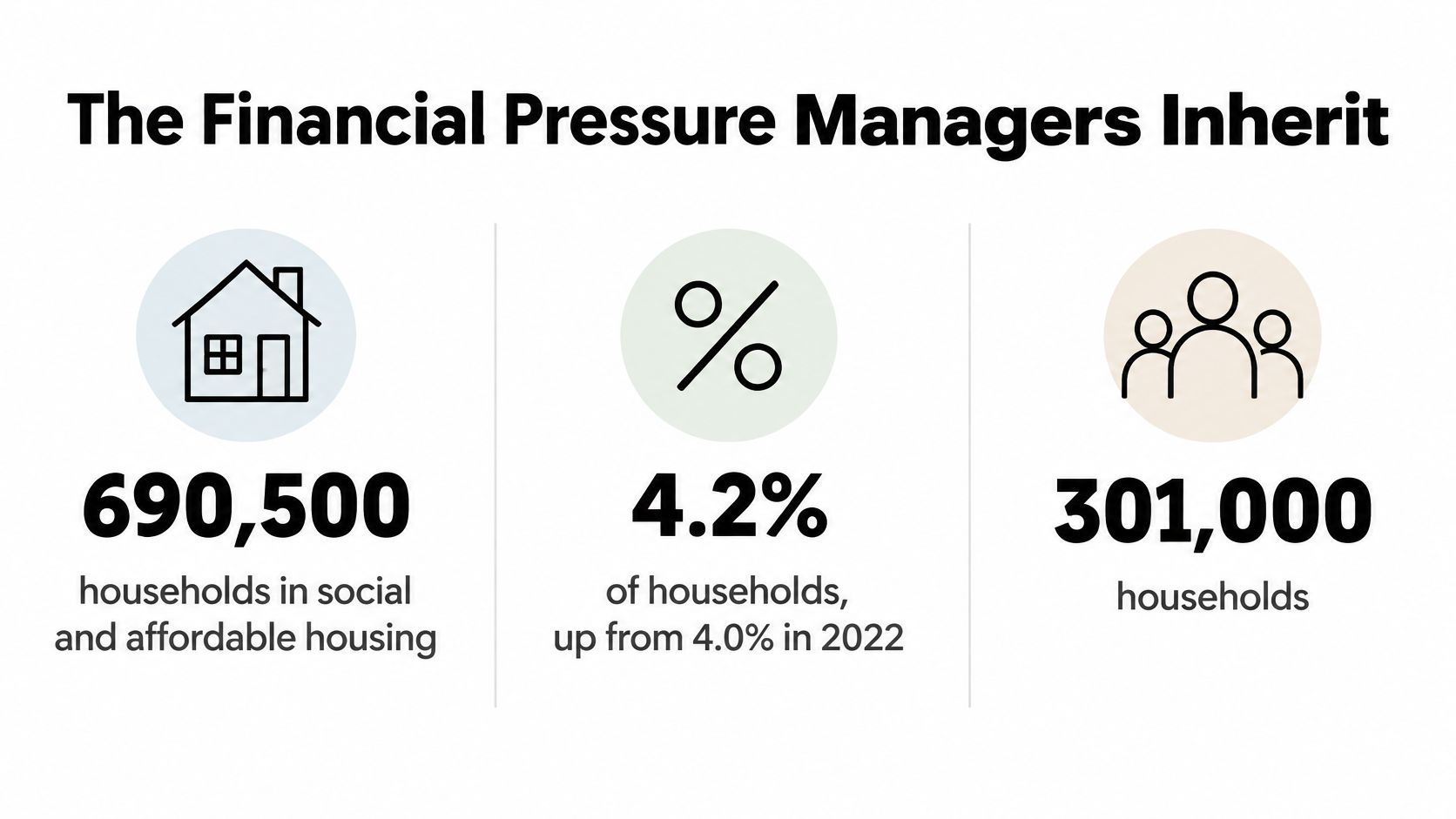
The operating challenge starts with occupied homes, waiting households and limited resident income. Statistics Canada's 2024 social and affordable housing snapshot records 690,500 households in this housing, 301,000 households with someone on a waitlist and a $30,270 median household income among social-and-affordable-housing households. The full snapshot below belongs beside the rent roll, not just in a funding presentation.
Canadian social and affordable housing pressure in 2024
Indicator
2024 figure
What it changes for managers
Households in social and affordable housing
690,500, or 4.2% of households
Plan staffing for a larger occupied stock that is still scarce
Change since 2022
Up from 621,400 households, or 4.0%
Growth in files does not mean more slack in operating budgets
Households with someone on a waitlist
301,000
Turnover and eligibility administration are core operations
Share of waitlisted households waiting at least two years
59.2%
An avoidable vacancy is a service failure as well as lost revenue
Median household income
$30,270
Test every new charge against very low income
Difficulty meeting financial needs
51.5% difficult or very difficult
Pair recoverable charges with hardship and arrears rules
Housing cost at 30% or more of income
31.7%, up from 25.4% in 2022
Utility recovery is not cost-free for residents
A larger occupied stock means more eligibility files, repair requests and account changes. It doesn't, by itself, give staff more time or buildings a healthier reserve. Long waiting lists also make prompt repairs between tenancies part of service delivery, rather than merely a revenue target.
Make the affordability test explicit
In market rental housing, utility recovery may be considered primarily through its effect on margin, although resident protections still apply. In affordable housing, managers must also ask whether the household can carry the charge without falling behind elsewhere.
Budget test: An expense hasn't disappeared when it moves from the building's ledger to a resident's bill.
The practical controls are building consumption, who gets billed, when maintenance happens and whether performance improves. Treat those as connected decisions, with finance, maintenance and resident-services staff working from the same information.
Treat Utilities as a Lifecycle Cost
A new boiler that runs on day one can still be the expensive choice five years later. A retrofit proposal should address what the building costs to operate after the contractor leaves: energy and water use, repairs, parts, and the staff time those repairs consume.
Purchase price works like a down payment on a car. The cheaper vehicle can cost more once fuel, breakdowns and hard-to-find parts are counted. The same logic applies to mechanical, electrical, water and appliance systems. Replacing worn equipment can cut consumption and repair calls together, because the maintenance budget and the utility budget draw on the same limited operating capacity, even when different staff manage them.
Build a comparison that includes doing nothing
Start with a unit and common-area baseline. Gather invoices, meter readings, equipment schedules and maintenance records, then reconcile billing periods before comparing consumption. Where the building allows it, separate heating, cooling, domestic hot water, lighting and other loads.
Model a do-nothing case beside a modest efficiency option and a more extensive one. Doing nothing still costs money: ongoing utility consumption, expected repairs and eventual replacement. Leaving those expenses off the spreadsheet makes inaction look free.
For each option, record:
- Annual avoided costs: Estimate utility savings and maintenance savings separately so a weak assumption stays visible.
- Simple payback: Divide the installed project cost by expected annual net savings.
- Lifecycle value: Compare future operating and replacement costs over one study period and one discount-rate assumption.
- Reserve impact: Show when cash leaves the reserve and whether other replacements, such as a roof or an accessibility repair, stay funded.
An attractive payback can still be the wrong job this year if it empties the reserve before a failing roof. Replacing failed equipment with the cheapest equivalent can also lock the property into avoidable consumption for the life of that unit.
Cost recovery belongs in this comparison, and it is not the same thing as affordability. Billing suites for measured use can tidy the owner's books by moving a utility line off the operating statement. It can worsen housing affordability at the same time if that bill still includes building losses, common-area use, or a charge a household cannot carry. Measure those three together before treating recovered utility cost as money the building has saved. A dollar shifted onto a resident is not a dollar the property has stopped spending on waste.
Commission the result, not just the equipment
Say a building replaces a central hot-water system. The installer confirms that it runs. Staff should also check temperature settings, circulation schedules, controls, and whether measured demand matches expected demand. A system that functions is not automatically a system that runs efficiently.
Assign someone to review performance after commissioning. Resident use, seasonal conditions, equipment settings and unnoticed leaks can move the result. Investigate the gap before anyone records projected savings as achieved savings.
Keep raw monthly bills for accounting and payment approval. For comparisons between buildings, use consumption intensity and cost per floor area, with weather and occupancy considered, rather than ranking properties by the unadjusted invoice.
Split Charges Without Raising Energy Burden
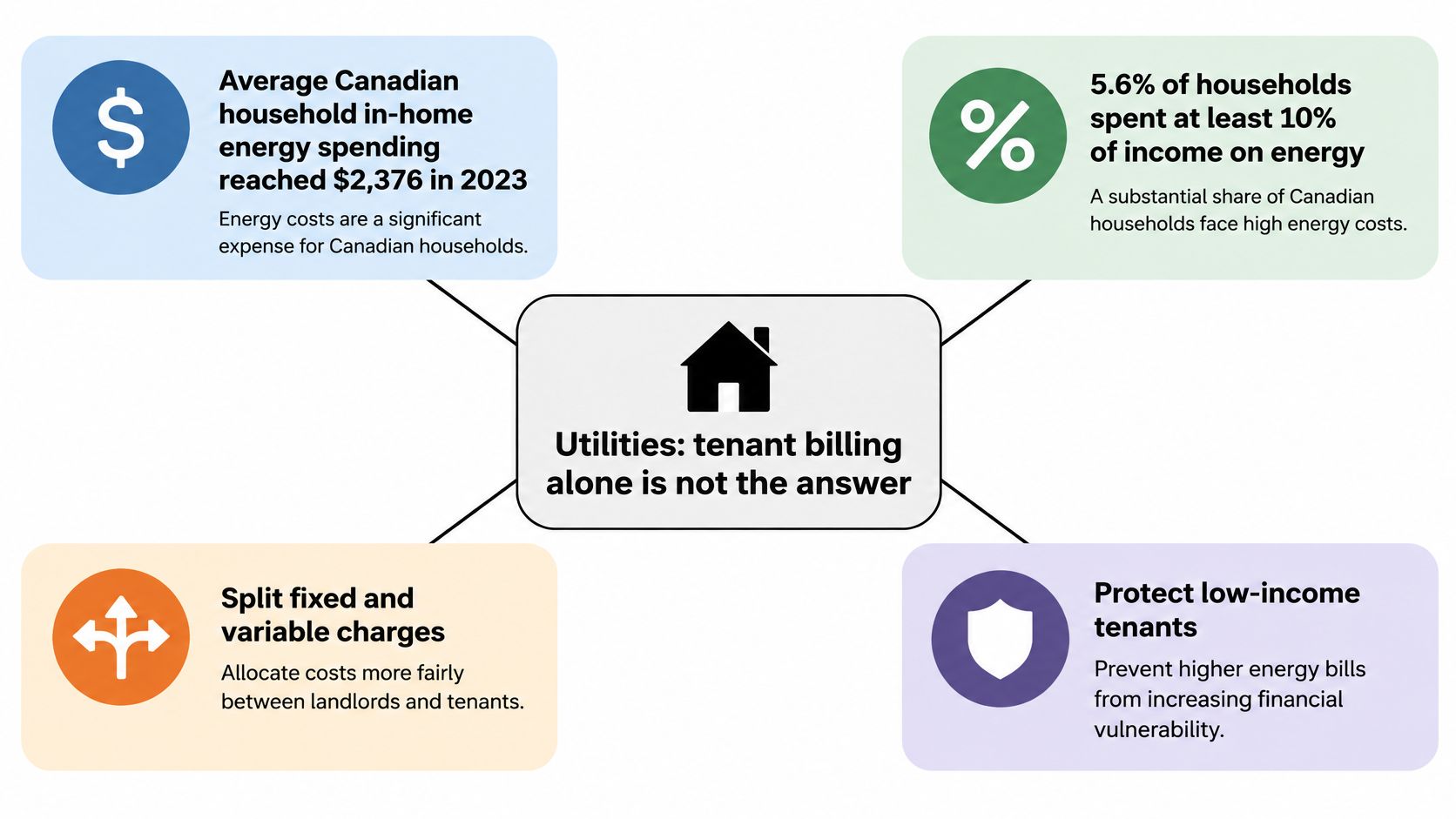
Average Canadian household in-home energy spending reached $2,376 in 2023, and 5.6% of households spent at least 10% of disposable income on energy, according to the Canadian Energy Fact Book. Those national figures are not specific to affordable housing. They still show why a new resident bill needs a fairness test, not only an accounting justification.
Suite billing can tidy the owner's books while making housing less affordable. Recovered utility cost helps the operating statement only if building losses, common-area use and resident hardship are measured in the same decision. Passing the whole bulk invoice through skips that test.
Consumption works like separate buckets. A leaking riser is a building loss. Lobby lighting is shared use. Electricity used by a suite stove belongs to that household. Splitting one bulk invoice by unit count hides which bucket grew.
Who carries each utility cost bucket
Cost bucket
Who carries it
How to measure it
Protection required
Structural building loss, such as a leaking riser or failing equipment
Operating budget or reserve fund, according to the work and funding rules
Reconcile bulk-meter consumption against suite and common-area reads, then investigate the residual
Fix the loss before assigning it to residents
Common-area use, including lobby, halls, laundry, parking and amenities
Operating budget or a disclosed, permitted allocation
Common-area readings with a stated allocation method
Identify it as excluded from suite consumption charges
In-suite use, including stove, heater and suite equipment
Household, only where rules allow recovery
Measured suite consumption for the billing period
Rent-geared-to-income rules, written hardship policy and dispute path
A gap between bulk and suite readings is not automatically a leak. Staff check reading dates, missing accounts and common-area consumption before naming a cause. A reserve fund is also a poor place to park recurring operating waste.
Make protections part of billing approval
Before changing charges, check the tenancy agreement, the funding agreement, applicable billing requirements and rent-geared-to-income treatment. A measured quantity does not create permission to bill it.
Use VerticalRent's guide to landlord utilities beside those checks, then apply the property's affordable-housing obligations. The guide to billing tenants for utilities can frame the workflow. It does not replace a jurisdiction-specific review.
A written hardship policy should say how residents request help, who reviews the request and how staff handle a disputed amount. After a billing change, watch arrears and check assistance eligibility before treating non-payment as a refusal to pay.
Cost recovery has not been shown to be affordable unless building losses, common-area use, billing accuracy and assistance eligibility are assessed together.
Residents should be able to see their consumption, the billing period, excluded building or common-area use and a named contact for questions. When a bill jumps, staff need a review path, not only a payment reminder.
Metrics That Show a Building Is Improving
A lower invoice can mean less consumption, a lower tariff, warmer weather or a partially empty building. Managers need a scoreboard that distinguishes those explanations before declaring an upgrade successful.
CMHC's environmental-sustainability evaluation uses utility cost per gigajoule, energy-use intensity and floor area to estimate annual utility expense, and identifies projects targeting approximately 16%–30% energy savings as reaching estimated cost-savings balance fastest. That's a screening insight, not a universal target: the deepest reduction isn't automatically the best first investment.
Building performance metrics for affordable housing
Metric
Unit
Use it to
Energy-use intensity
kWh per m²
Compare buildings of different sizes
Utility cost
Dollars per m²
See budget pressure after area is removed
Water use
Per resident or per unit
Separate potential leaks from higher occupancy
Equipment failure frequency
Failures per year
Spot deferred maintenance before it becomes a capital crisis
Post-retrofit variance
Difference from a weather-normalized baseline
Check that predicted savings actually lasted
Give every change a decision
Energy-use intensity divides energy consumption by floor area. If it rises, check operating schedules, controls and equipment performance, but don't assume area-normalisation also corrects for weather. Staff still need weather adjustment for seasonal comparisons and a consistent definition of included floor area.
Utility cost per square metre connects consumption to budget pressure. When cost rises without a similar increase in energy use, finance staff should inspect rates, demand charges and invoice adjustments before maintenance staff change equipment settings.
For water use per resident or unit, choose a denominator the property can maintain reliably. If occupancy is stable and use climbs, investigate fixtures and distribution systems. If occupancy changed, check whether consumption increased proportionately before opening a leak investigation.
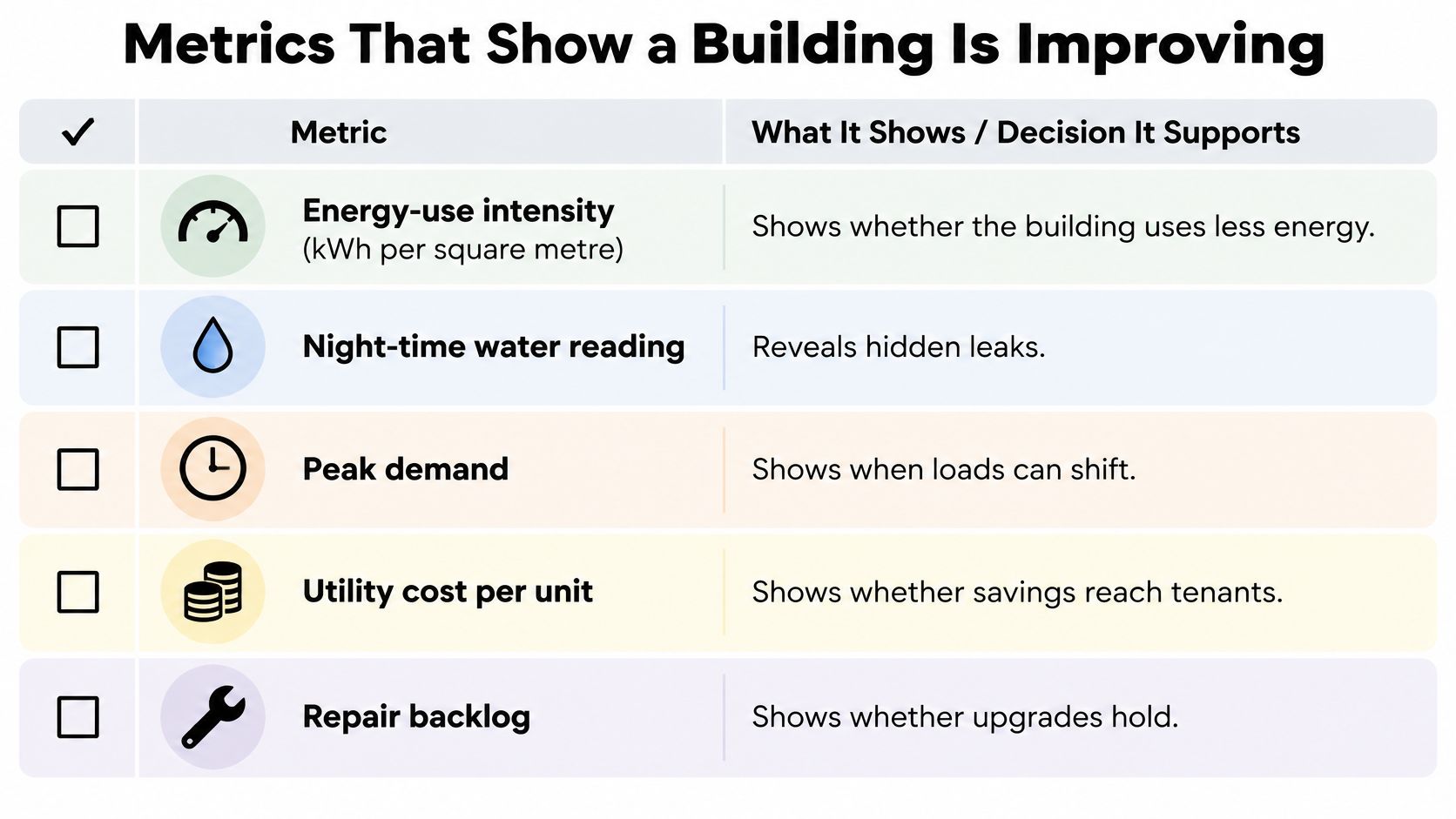
The visual scoreboard adds operational prompts alongside the core measures.
Investigate drift before accepting it
Rising equipment-failure frequency calls for a review of repeated work orders, component condition and preventive maintenance. Distinguish actual failures from routine service visits, or the property with better recordkeeping may appear to perform worse.
For post-retrofit variance, compare actual use with the weather-normalized baseline and the project's expected result. A persistent gap should trigger commissioning checks, not an immediate assumption that residents caused the shortfall.
Review the scoreboard at least quarterly and assign an owner to each flagged property. An energy management system should support that assignment by connecting readings to investigation and follow-up, rather than producing a dashboard nobody acts on.
Record what staff found and when they'll verify the correction. This prevents utility overruns from becoming an accepted expense that reduces money available for accessibility work or resident services.
When Heat Leaks and Weather Change the Plan
A cold wall can raise a suite bill the way a dripping tap raises a water bill. The resident pays for a loss the building never fixed. Recovering heat, water or cooling through suite charges can tidy the owner's books while making housing less affordable, unless staff measure building losses, common-area use and resident hardship together.
Future weather can also move those loads. ClimateData.ca's buildings module describes climate data and climate design values for buildings, including heat, cold, wind, snow and rainfall. Those values help operators judge how a hotter summer or a colder winter could change demand. They are not an operating plan for an existing property.
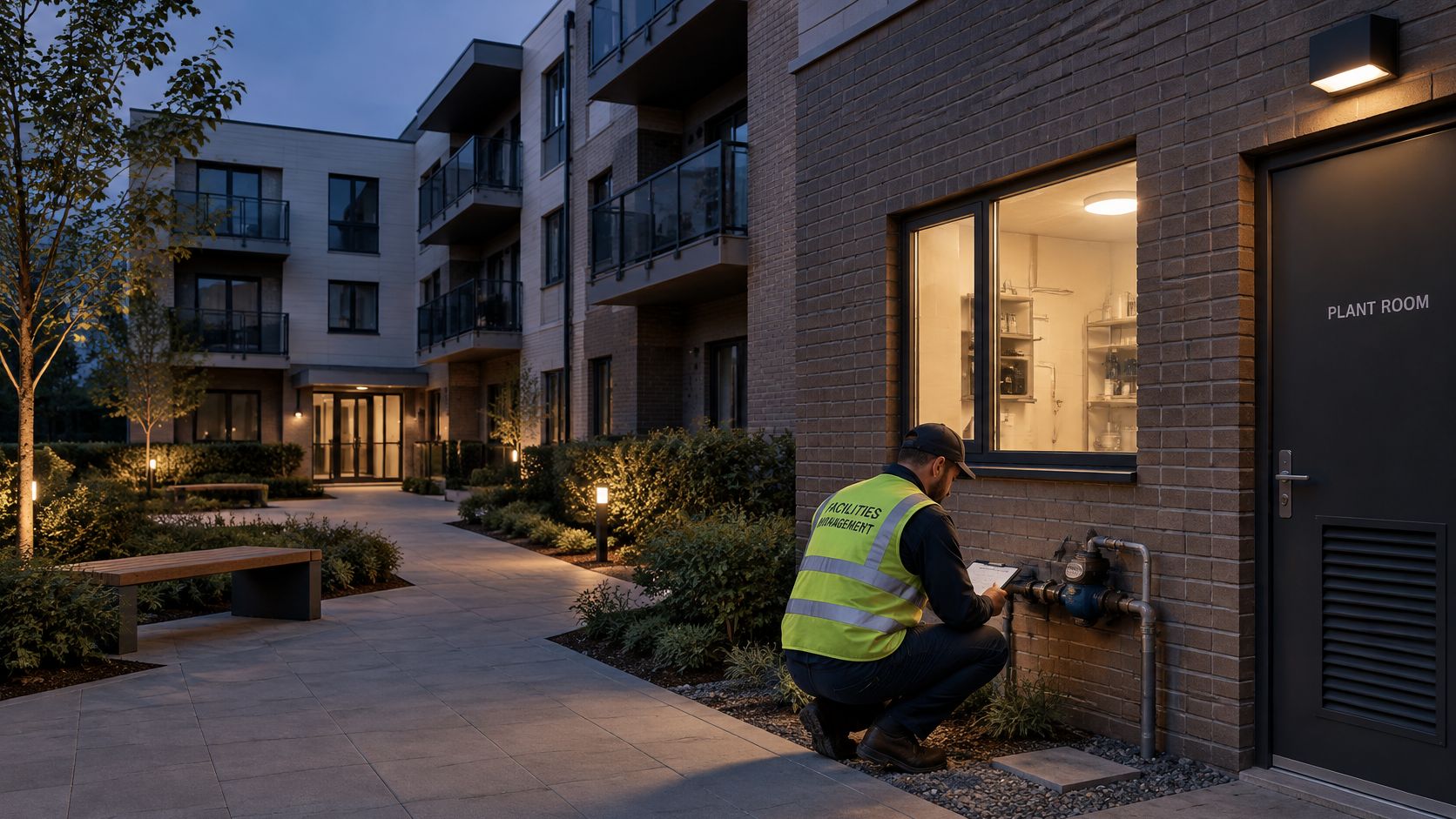
A site inspection gives staff the context that a consumption chart can't provide.
Choose the repair that prevents harm
Consider a mid-rise where night-time water use keeps climbing and occupancy stays steady. Check running fixtures, leaks and equipment before treating the rise as resident behaviour. Review detection coverage, send a plumber, and hold the cosmetic lobby refresh until the loss is clear.
Residents wait longer for fresh paint. Staff cut the chance of water damage and ongoing waste. Name that trade-off before recommending the delay. Spend against the risk, not against the project that is easiest to show the board.
Now take an older walk-up in extreme heat. Shorter cooling hours can lower consumption and still leave older residents, or people with health conditions, in unsafe rooms. Set resident-protection limits first. Find the spaces that overheat. Keep the cooling those rooms need running while staff look for safer efficiency measures.
Safety boundary: A consumption target never justifies an indoor condition that puts residents at risk.
Billing that extra cooling to suites, without separating common-area load from building losses, shifts a weather cost onto people who may already be struggling. Hardship belongs in the same review as the energy use.
Allocate scarce capital by consequence
One deep-retrofit grant may have to serve several ageing buildings. Compare abnormal water and cooling use, deferred repairs, outage exposure and resident vulnerability before choosing a site. A larger projected percentage saving should not outrank a clearer risk of building failure or harm to residents.
Give decision-makers a short property file containing:
- Failure exposure: Equipment condition, recurring incidents and work that can't safely wait.
- Resident consequences: Overheating, disrupted essential services and barriers to accessing help.
- Practical readiness: Investigations, design work and interim repairs needed before the larger project.
Use the accompanying video alongside the property's inspection records, not as a substitute for them.
Older buildings may need monitoring and maintenance before a deep retrofit makes operational sense. In a tight budget year, put active leaks and immediate safety threats first, extreme-weather health risks next, then projects ranked by avoided utility and repair cost. Respond at once to any emergency, whatever its category. A repair that stops heat or water from leaking into a suite charge protects both the building and the housing cost residents can still carry.
A Monthly Routine for Cost and Maintenance
A shared spreadsheet, invoice folder and work-order register can support a disciplined monthly cycle. The important part is assigning responsibility for exceptions, rather than buying software before staff agree on the process.
Run the cycle in order
- Reconcile the source records. Pull bulk invoices, suite readings and common-area readings for matching periods. Record move-ins, move-outs and whether supplier bills are actual or estimated. Common slip: treating an estimated invoice as measured consumption and overlooking the later adjustment.
- Sort consumption into the approved cost buckets before calculating resident charges. Keep unexplained differences in an investigation queue, with an owner and next action. Common slip: calling the residual suite use when it includes shared loads or missing reads.
- Check the seasonal comparison. Compare water, heating and cooling with the corresponding season, accounting for weather and occupancy. Investigate a jump that those changes don't explain. Common slip: comparing unmatched billing periods and opening unnecessary work orders.
- Convert significant anomalies into work orders and record the cause, such as a leaking fixture, incorrect control setting or failed component. Verify the repair with a follow-up reading. Common slip: closing a leak ticket when the plumber leaves, without confirming that consumption returned to an expected pattern.
- Approve charges through the resident-protection workflow. Apply applicable rent-geared-to-income treatment, hardship provisions and arrears procedures before issuing recoverable charges. Record disputes and their resolution. Common slip: assuming billing software has already checked programme eligibility or tenancy permissions.
- Update the agreed building metrics for the quarterly portfolio review and identify properties that drifted. Keep the definitions consistent with the previous review. Common slip: changing floor area or occupancy assumptions without documenting the change, making performance look better or worse artificially.
- Re-rank capital work quarterly. Use avoided utility and repair cost alongside safety, resident consequences and reserve capacity. Pause any efficiency setting that creates unsafe indoor conditions. Common slip: keeping an outdated project ranking after new failures change the building's priorities.
Keep resident reports connected to work orders
Residents may report running water, failed heating or unusual bills outside office hours. If you're considering 24/7 call handling for rental properties from Mercateer, define how urgent reports reach the responsible person and how routine inquiries enter the work-order system.
The broader multifamily property management workflow should connect those reports to account changes and maintenance records. The signs of a working routine are practical: fewer surprise invoices, fewer unresolved billing disputes and repair priorities informed by abnormal consumption, not complaints alone.
Book a Building Assessment Before the Next Budget
Before approving the next budget, resolve the costs you still can't confidently classify. Estimated bulk bills, leaks discovered only after damage and staff repeatedly rebuilding charges in spreadsheets point to a measurement and workflow gap, not the need for another general energy goal.
Define the assessment deliverables
At Axis Meter Solutions, we assess the property and existing systems, then coordinate meter selection and layout with the engineering team and property managers. Our turnkey utility submetering work supports affordable housing and other multi-family and mixed-use properties in Canada and the United States, with availability confirmed for the project.
The scope can cover installation, commissioning, data validation, ongoing reads, resident billing, move-in and move-out support, inquiries, reporting and maintenance. We own and maintain the equipment during the agreement term, with responsibilities and service levels defined in the agreement.
For boards reviewing the accounting treatment, Blue Sage Tax & Accounting Inc.’s HOA accounting fundamentals offer related governance context, although affordable-housing funding and accounting requirements need their own review.
Send the information needed to scope the work
Provide the property location, unit count, piping configuration, current billing method and whether you need remote readings, leak alerts or resident billing. We offer a free, no-obligation consultation and a free HVAC assessment to determine thermal submetering options; availability, approvals and tenant billing must still be confirmed for the province or state and project.
Axis Meter Solutions offers property assessment, coordinated submetering implementation and ongoing billing and maintenance support to help operators distinguish building waste from fairly recoverable consumption. Visit Axis Meter Solutions to request an assessment before capital and operating budgets are frozen, and bring your property details so the discussion starts with your building's actual constraints.
Ready to Optimize Your Utility Management?
Tell us about the property, utility, number of units, and your billing or monitoring goals. We'll help you identify the right next step.
Book a Call