Garden Hose Flow Meter: Buyer and Installation Guide
A garden hose flow meter measures cumulative water volume in litres, helping you track usage, identify leaks, and save on water bills. In 2021, 51% of Canadian households that watered their lawns did so by hand with a hose or watering can, so hose-end measurement applies to a common household task, not a niche setup.
You may already know the scene. The sprinkler is running, the lawn looks dry, and nobody can say how much water has left the tap. Or you return from a weekend away and notice that the meter has advanced even though nobody remembers watering. A garden hose flow meter makes that invisible usage visible.
The practical question isn't whether a consumer meter can display litres. Most can. The better question is whether the reading is reliable enough for the decision you need to make. For personal conservation feedback and early leak awareness, a hose-end meter can be useful. For tenant billing, formal cost allocation, or dispute resolution, it shouldn't automatically be treated as a certified submeter.
Table of Contents
- Understanding What a Garden Hose Flow Meter Does
- Choosing the Right Type for Your Needs
- Installing Your Flow Meter Correctly
- Calibrating and Interpreting Your Readings
- Real-World Uses for Water Conservation
- Maintenance Tips and Common Troubleshooting
Understanding What a Garden Hose Flow Meter Does
A garden hose flow meter sits inline between an outdoor faucet and the hose. Water passes through an internal sensor, and the device reports either the current flow rate, the cumulative volume, or both. The totalizer is usually the more useful reading because it tells you how much water moved during a watering session or over a chosen period.
Outdoor watering deserves measurement because household water bills combine many activities into one total. Statistics Canada's household outdoor-water data found that just over two-thirds of Canadian households had a lawn in 2021, and 51% of those lawn-owning households watered it during the previous summer, compared with 43% in 2015. The same survey found that 61% of Canadian households had a garden or outdoor area containing planted features, and 82% of those households watered it during the previous summer.
What the reading can tell you
A meter can answer practical questions that a general utility bill can't isolate:
- Session volume: How much water did the vegetable garden, lawn, or flower bed receive?
- Usage comparison: Does hand watering use less than running a sprinkler for the same task?
- Leak awareness: Is volume accumulating when the hose should be idle?
- Operational control: Are common-area maintenance routines using more water than expected?
Historical Canadian data reinforce the value of looking at seasonal use directly. Canadians used an average of 223 litres per person per day at home in 2013, covering indoor and outdoor use, while earlier analysis found that domestic consumption could rise by as much as 50% during summer months when lawns and gardens were watered. Those figures come from Statistics Canada's analysis of household water consumption.
A hose meter doesn't measure the whole property. It only sees water passing through the connection where it's installed. That limitation is useful to understand before purchase. If you need suite-level water allocation, common-area monitoring, or billing-quality records, use a properly designed submetering system rather than several consumer devices and a spreadsheet.
Practical rule: Use a consumer hose meter to improve decisions, not to create a level of precision the device was never designed to provide.
For installation principles and the difference between measuring liquid flow and only detecting it, this overview of liquid flow meters provides useful technical context. The important distinction remains straightforward: a meter gives you volume and rate, while a basic flow switch only indicates whether flow is present.
Choosing the Right Type for Your Needs
The best garden hose flow meter is the one that matches your routine. A gardener who checks a display at the tap has different needs from a property operator who wants a usage history and an alert when a hose connection continues flowing after maintenance is complete.
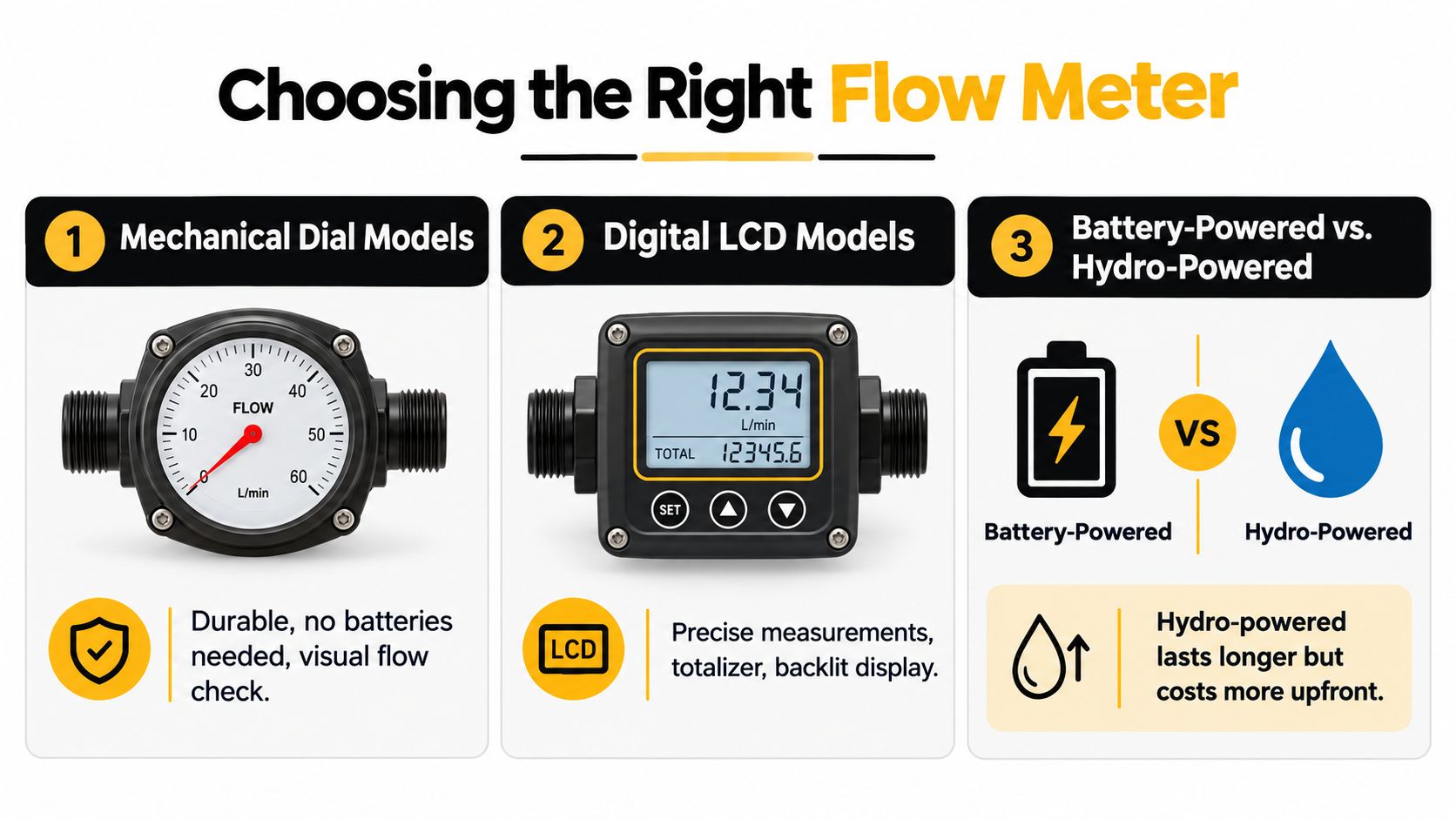
Compare the main formats
Meter type
What works well
Main compromise
Mechanical dial
Simple visual feedback, no battery to replace, and a familiar total reading
Usually offers less information and can be harder to read in poor light
Digital LCD
Clear cumulative volume, flow-rate information, and often easier reading
Needs power and may lose stored information if the battery fails
Smart meter
Remote monitoring, alerts, and usage records through an app or connected system
Higher complexity, more setup, and more points of failure
Battery-powered
Flexible installation where water-powered operation isn't available
Battery condition affects display and data retention
Hydro-powered
Can reduce routine battery changes by using the water stream for power
Often costs more upfront and may need sufficient flow to operate properly
Check the fittings before comparing features. The hose, faucet, quick-connect, and meter must use compatible threads, and an adapter may be needed when the connection sizes differ. Don't assume that a meter designed for one hose arrangement will seal properly on another just because the threads appear similar.
The display also affects everyday use. A large mechanical dial suits someone who wants a quick visual check at the tap. A backlit LCD is more practical when you inspect readings early in the morning or later in the day. A smart device only earns its added complexity if you will actually review alerts and records.
Match the device to the decision
Choose a simple meter for occasional garden watering and personal feedback. Choose a digital totalizer when you want to compare sessions, establish a baseline, or investigate unexplained use. Consider connected monitoring only where remote visibility has a clear operational purpose.
Don't buy an app-enabled meter expecting it to become a billing instrument. Connectivity can improve access to data, but it doesn't by itself validate the measurement. For terminology and selection considerations around sensing equipment, the guide to water-flow sensors is a useful companion resource.
Installing Your Flow Meter Correctly
Installation is usually a short plumbing job, but small mistakes can produce leaks or misleading readings. Start with the water turned off at the outdoor faucet. Disconnect the hose, inspect the faucet threads, and make sure the rubber washers supplied with the meter are seated inside the fittings.
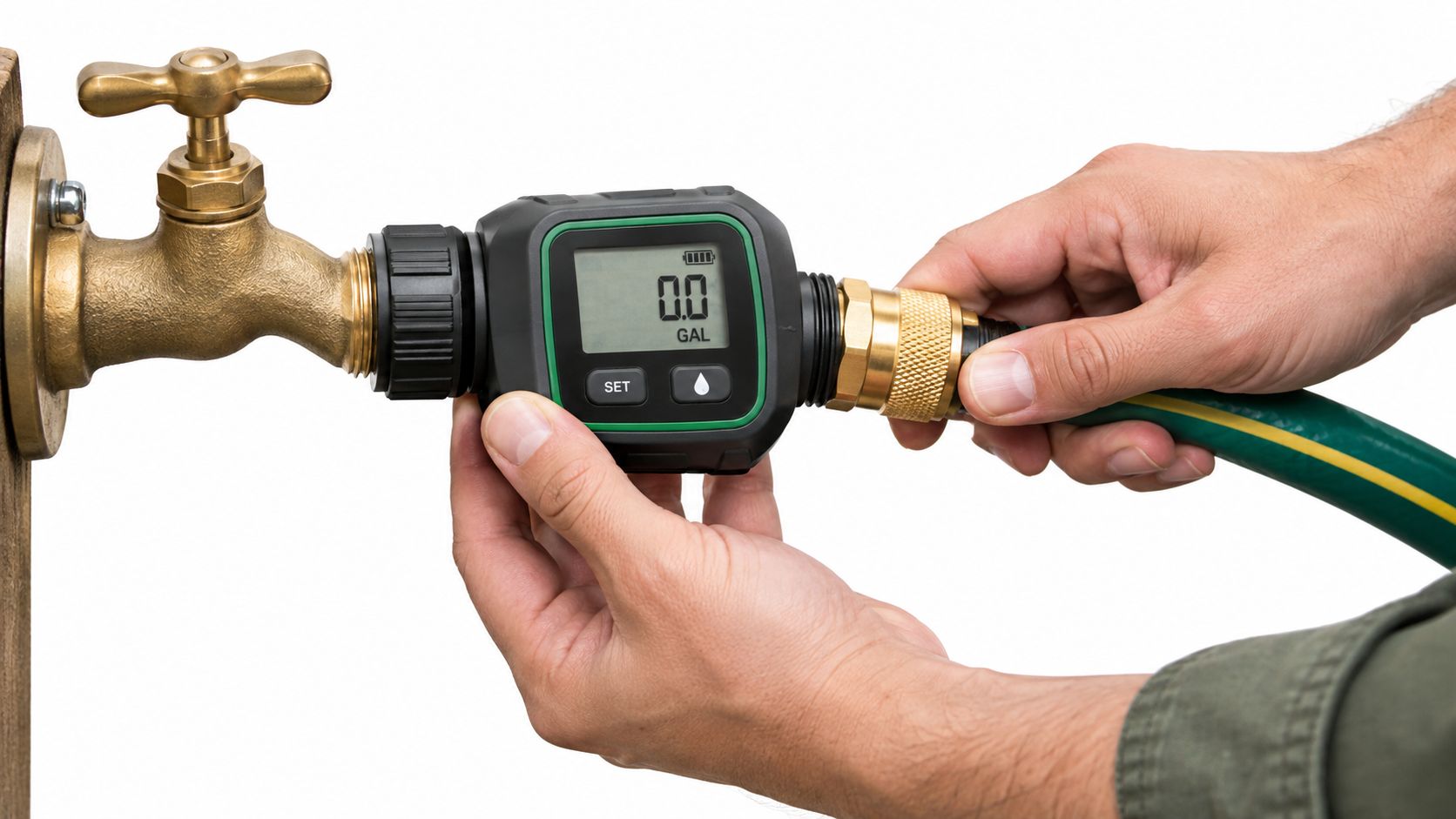
Follow the flow path
Look for an arrow on the meter housing. It should point from the faucet toward the hose, matching the direction water will travel. Attach the meter to the faucet first, then connect the hose to the outlet side.
Use this sequence:
- Seat the washers: Confirm that each threaded connection has its rubber washer. A missing washer is a common cause of dripping.
- Start by hand: Turn the fitting slowly so the threads engage cleanly. Stop and realign if it feels cross-threaded.
- Tighten gently: Hand-tighten the connection, then use channel-lock pliers only for a small final adjustment if needed. Excessive force can damage plastic threads or crack the housing.
- Open the faucet slowly: Bring the system up to pressure gradually instead of opening the tap abruptly.
- Inspect every joint: Watch the faucet connection, meter outlet, and hose coupling while water flows.
- Flush the line: Run water briefly to move out debris that may have entered during installation.
A meter should remain accessible enough to read and inspect. Avoid suspending a heavy hose from the device, and support the hose if its weight pulls sideways on the fittings. If the unit has a quick-connect or bypass arrangement, confirm that you can remove it without twisting the faucet or straining the housing.
Installation check: A dry connection after the system reaches normal pressure is more useful than a connection that looks tight while the tap is closed.
Before winter, disconnect the meter, drain it fully, and follow the manufacturer's storage instructions. Some models are designed for outdoor exposure, but freeze protection still depends on the product's specifications and the conditions at the installation point.
A visual demonstration can help if you're unfamiliar with hose-end fittings. Keep the water off while copying the connection order, and use the arrow on your own device as the final reference.
Calibrating and Interpreting Your Readings
A new meter should be tested before you rely on it for comparisons. The simplest field check uses a container with a known capacity. Place the hose where you can fill the container safely, reset the meter if the device allows it, and run water until the container reaches its marked volume.
Repeat the test under more than one operating condition. A device may behave differently when water is barely flowing compared with when a sprinkler is drawing heavily. Record the meter reading before and after each test, then compare the difference with the container's known volume. If the readings don't align, document the variance rather than treating the display as exact.
A practical verification routine
- Check the totalizer: Confirm which display shows cumulative volume and which shows instantaneous flow.
- Use a known volume: Fill the container to its marked level without splashing or spilling.
- Repeat at low flow: Open the tap modestly and observe whether the meter registers consistently.
- Repeat at higher flow: Test again with the sprinkler or nozzle you use.
- Inspect for air: Air pockets, surging, and partially open valves can make readings harder to interpret.
- Record reset behaviour: Find out whether the device retains its total after a reset, battery change, or power interruption.
The meter's suitability depends on the decision. Personal watering feedback can tolerate a practical field estimate. Tenant billing, cost allocation, or a formal dispute requires validated performance across the actual operating range and independent checks. A consumer device isn't automatically a reliable water-allocation meter just because it displays litres.
For help understanding registers, units, and cumulative readings, refer to this guide to reading a water meter. Read the labels carefully, because a current rate and a running total answer different questions.
Turn litres into a garden decision
Raw volume becomes more useful when you relate it to the area being watered. Measure the irrigated area, divide the delivered volume by that area, and express the result as an approximate depth of water. This lets you compare a targeted bed with a broad lawn instead of judging both by hose-running time.
Rainfall belongs in the same record. Check a reliable local weather or municipal source before watering, note recent precipitation, and consider soil condition, plant type, shade, and temperature. A high meter reading isn't automatically wasteful if it served a large planted area during a dry spell. Conversely, a modest-looking session may be unnecessary after meaningful rainfall.
Real-World Uses for Water Conservation
The strongest benefit of a garden hose flow meter is behavioural feedback. A running hose feels abstract. A totalizer that advances as water moves gives the person at the tap an immediate reason to stop, reposition the hose, or shorten the session.
Canadian evidence points to different watering behaviours rather than one uniform user. Among households with lawns that watered them in 2021, 51% used a hose or watering can by hand, 41% used a lawn sprinkler, and 19% used a lawn sprinkler system, with households able to report more than one method. A useful meter program should therefore distinguish manual watering from longer sprinkler or irrigation-system use instead of treating every litre as the same kind of activity.
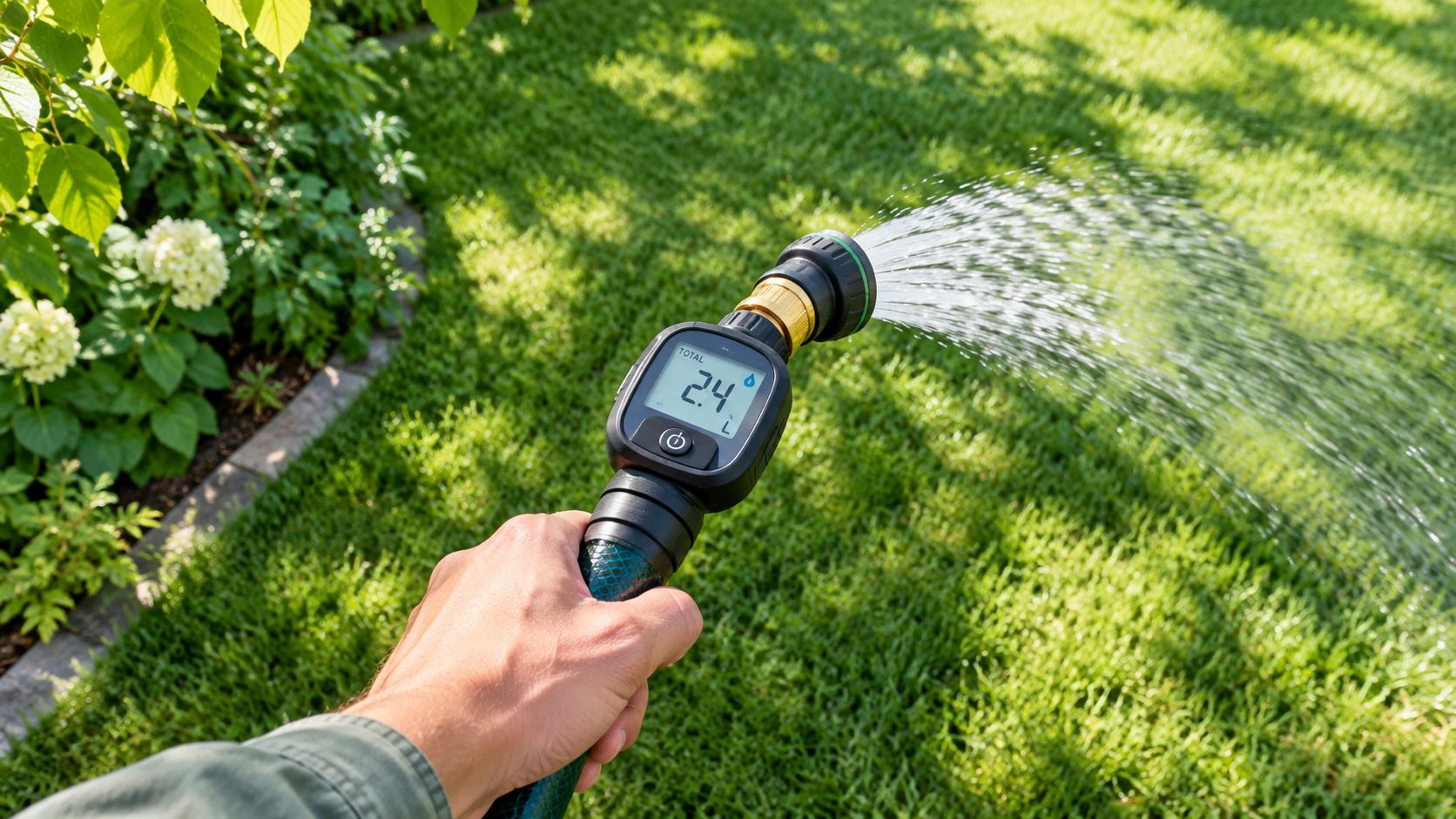
Use the data to find abnormal flow
A cumulative reading can expose a problem that isn't visible at the faucet. Establish a normal pattern for watering days, then check whether the total rises when the hose should be idle. Possible causes include a loose connection, a worn tap washer, a hose left open, or a downstream irrigation fault.
Don't treat one unexpected reading as proof of an underground leak. First verify that nobody used the tap, inspect the fittings, check the meter's reset and rollover behaviour, and repeat the observation. If the unexplained flow continues, investigate the plumbing or irrigation line.
Ontario guidance shows why the scale of a watering habit matters. The Ontario Water Works Association notes that a typical hose can deliver more than 4,500 litres in three hours at 25 litres per minute, while an Ontario demand study found that homes using automatic irrigation averaged about 2,450 litres per day, compared with roughly 180 litres per day for homes using manual irrigation. These figures are presented in the Ontario outdoor water-use reduction manual.
The useful question isn't only “How much did we use?” It's “Which watering behaviour created that volume, and what can we change?”
For a property manager, a shared garden, or a community growing space, record the date, task, area, weather, and cumulative reading. That creates a fair operating baseline without pretending that an inexpensive hose-end meter is suitable for formal tenant charges. People respond better to a clear measured routine than to a general instruction to “use less water.”
Where greenery planning is part of the solution, a practical xeriscape guide for Peoria homes can provide ideas for reducing reliance on thirsty planting and routine irrigation. A meter and a lower-water garden work best together. One measures the behaviour, while the other reduces the demand that behaviour has to satisfy.
Maintenance Tips and Common Troubleshooting
A hose-end meter lives in a wet, exposed environment, so maintenance should be seasonal rather than reactive. Before freezing weather arrives, close the faucet, disconnect the hose, remove the meter, and drain trapped water from the housing. Store it indoors in a dry place unless the manufacturer specifically approves outdoor winter use.
Check the simple causes first
- Dripping connection: Reseat or replace a flattened, brittle, or cracked rubber washer. Inspect both sides of the meter, not just the faucet.
- Unexpectedly low reading: Look for a partly closed tap, kinked hose, clogged nozzle, or debris in the sensor path.
- Slow or irregular registration: Flush the device and inspect for mineral buildup. A manufacturer-approved cleaning method is preferable to forcing tools into the sensor.
- Display failure: Replace the battery and check the battery contacts. Confirm whether the model preserves its total during a battery change.
- Reading that seems implausible: Repeat the known-volume test, check the flow direction, and look for air or surging in the line.
Don't use strong chemicals or disassemble the sensor unless the instructions permit it. A mild cleaning approach may clear minor deposits, but an internal mechanism can be damaged by probing or aggressive treatment.
At the start of the watering season, inspect the housing for cracks, verify that the arrow still points downstream, and repeat a quick container test. Keep a note of the baseline reading and any reset date. That record will help separate a genuine usage change from a device or installation problem.
For property operators, replace a consumer meter when its readings can no longer support the decision at hand. If the requirement has shifted from personal feedback to formal allocation, install an appropriately specified and validated submetering solution instead of relying on a progressively less trustworthy hose-end total.
Axis Meter Solutions provides turnkey electricity, water, gas, and thermal submetering for multi-family, condominium, mixed-use, and commercial properties, including installation, commissioning, billing support, and ongoing service. If you need dependable unit-level usage data or leak and flood detection beyond a garden hose flow meter, visit Axis Meter Solutions to discuss a practical metering programme for your property.
Ready to Optimize Your Utility Management?
Tell us about the property, utility, number of units, and your billing or monitoring goals. We'll help you identify the right next step.
Book a Call