Automatic Water Shut Off Valve: How It Protects Buildings
An average household leak can waste more than 10,000 gallons of water a year, a volume roughly equal to 270 loads of laundry, according to The Source's report on the rising cost of water damage in American homes. That figure is the one worth carrying into any decision about an automatic water shut off valve.
The device is usually sold on convenience, but what it buys is time. Water escapes a broken line in gallons per minute, so every minute the supply stays open adds a measurable amount to the loss. A valve that closes quickly after a burst fitting turns a flood into a wet cabinet. A valve that closes late, or never, leaves you with the same damage you would have had without it.
So the useful questions are flow questions. How many gallons per minute leave the pipe? How long does the water run before something closes it? And what does the equipment miss entirely? The answers start with what the hardware is and end with what it cannot do.
Table of Contents
- What an Automatic Water Shut Off Valve Does
- Why Hidden Leaks Cost More Than They Look
- How Sensors, Controllers and Valves Work Together
- Choosing Valve Size, Flow and Response Time
- Where It Fits in Multifamily, Condominium and Commercial Buildings
- What the Valve Cannot Do and What Claims to Test
- Confirm Local Rules and Insurance Terms Before You Buy
What an Automatic Water Shut Off Valve Does
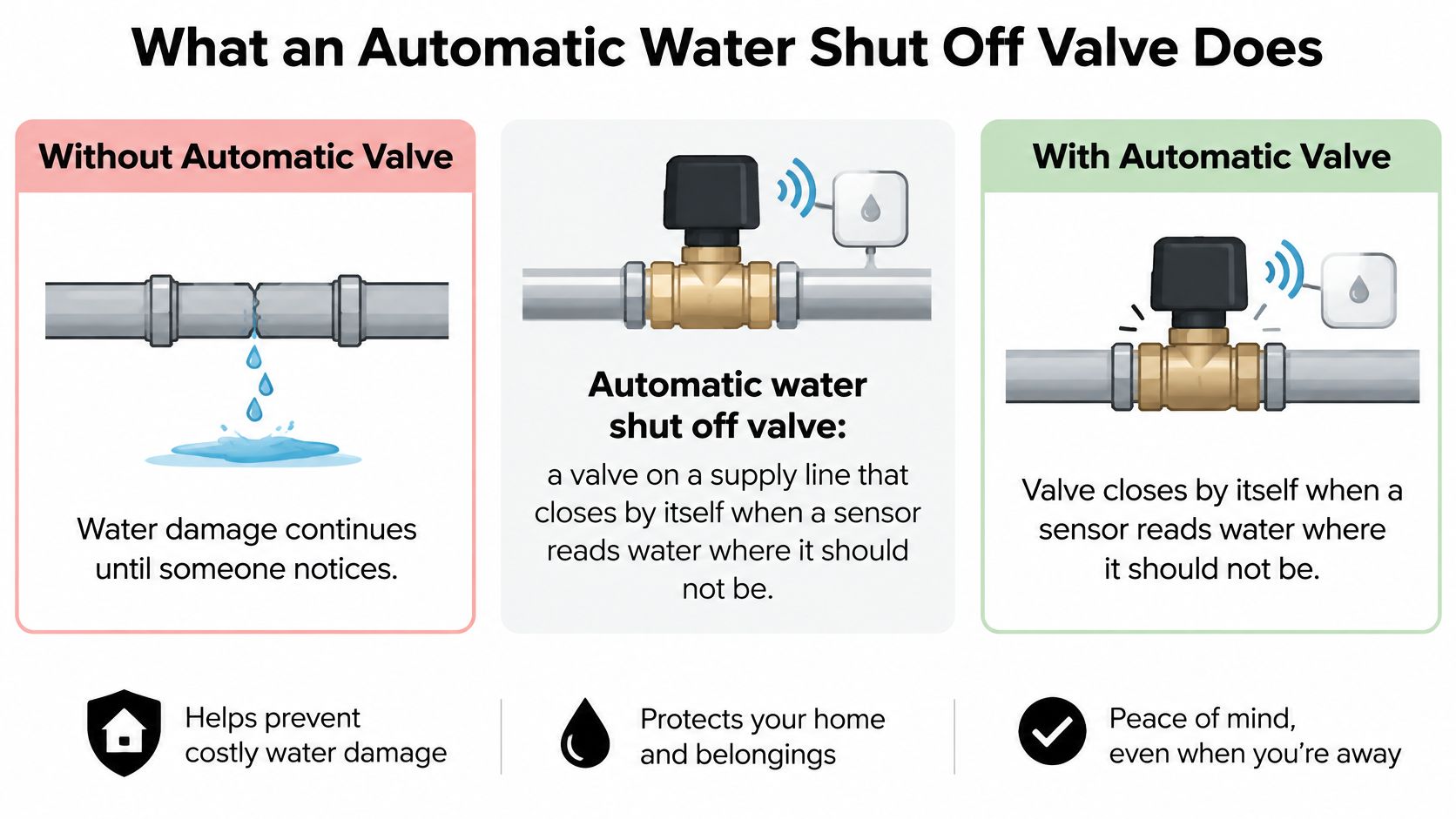
An automatic water shut off valve is a valve on a supply line that closes by itself when a sensor reads water where it should not be, or when flow through the line stops matching normal use. It sits on the domestic-water main downstream of the meter, or on a branch serving one zone, and it acts without anyone walking to a handle.
The closest analogy is a circuit breaker. A breaker doesn't wait for someone to smell burning insulation, it trips when current exceeds what the circuit should draw. A shutoff valve runs on the same logic, with gallons per minute in place of amps. When flow keeps going past the pattern the building normally produces, the valve closes and the supply stops.
The name covers a family of equipment, and the differences matter far more than the brand on the box. Four approaches turn up in real buildings, and only two of them close a supply without a person in the loop.
Four levels of water control
Approach
Detects a leak?
Closes supply without a person?
Typical use
Manual isolation valve
No
No
Stops flow only after someone finds the leak and turns the handle
Leak sensor with alert only
Yes
No
Notifies staff or owner; water keeps flowing until someone responds
Automatic shutoff valve with flow sensor
Yes
Yes
Closes the supply when abnormal flow persists
Master valve on irrigation supply
Yes, via flow sensor
Yes
Stops irrigation water entering the system
Reading down that table is the quickest way to see where the money goes. A leak sensor is inexpensive and useful, but it only shortens the gap between a leak starting and a person learning about it. The gap itself is still filled with water.
The manual valve stays, and it should never be removed to make space for a motorised one. Motorised valves need power and a signal, a hand valve needs neither. Anyone responsible for a building with shared risers should know how to shut off water quickly, because the day the network drops is the day somebody needs to close a supply in a hurry.
Here is a test you can run on your own property this week. Time what happens after an alert. If the water keeps running until a person reaches a valve, that building has a monitoring system.
Practical test: if water still flows after the notification, you own monitoring, not shutoff.
Why Hidden Leaks Cost More Than They Look
Liberty Utilities California's leak figures describe losses that hide in plain sight. The utility reports that 10% of homes have leaks wasting at least 90 gallons per day, and that a continuously running toilet can waste up to 26 gallons per day, or 9,490 gallons a year. Those aren't dramatic failures. They're ordinary ones.
Small fixtures add up in the same direction. A shower leaking at 10 drips per minute wastes more than 500 gallons a year, and a faucet dripping once per second wastes more than 3,000 gallons a year, by the utility's numbers. None of these announce themselves. A drip inside a wall cavity or under a cabinet is silent, and the first visible sign is usually a stain on the ceiling below.
Three things keep these leaks running, and all three are about timing rather than plumbing skill.
- They run between inspections. Nobody walks a 60-unit building weekly. A weeping fitting behind a laundry box can run for months between service visits.
- The bill arrives after the damage. Consumption shows up on a statement weeks later, by which time the drywall, flooring and cabinets have already absorbed the cost.
- The damage bill isn't the water bill. Water is the cheap part. Remediation, displaced tenants and replacement finishes are where the money goes.
For multifamily, condominium and commercial owners, that last point compounds. One undetected supply-line failure can affect several suites, a common corridor and the unit below, and the repair crosses insurance deductibles, strata responsibilities and tenant claims at once. Water that travels inside walls and ceilings is the hardest kind to trace, which is why finding leaks inside walls early is worth more than any single fixture repair.
A leak that runs for eight days isn't a plumbing problem anymore. It's a restoration project.
Ask yourself a plain question about your own building. If a supply line failed tonight, how long would it run before a person saw water, and what would that delay cost?
How Sensors, Controllers and Valves Work Together
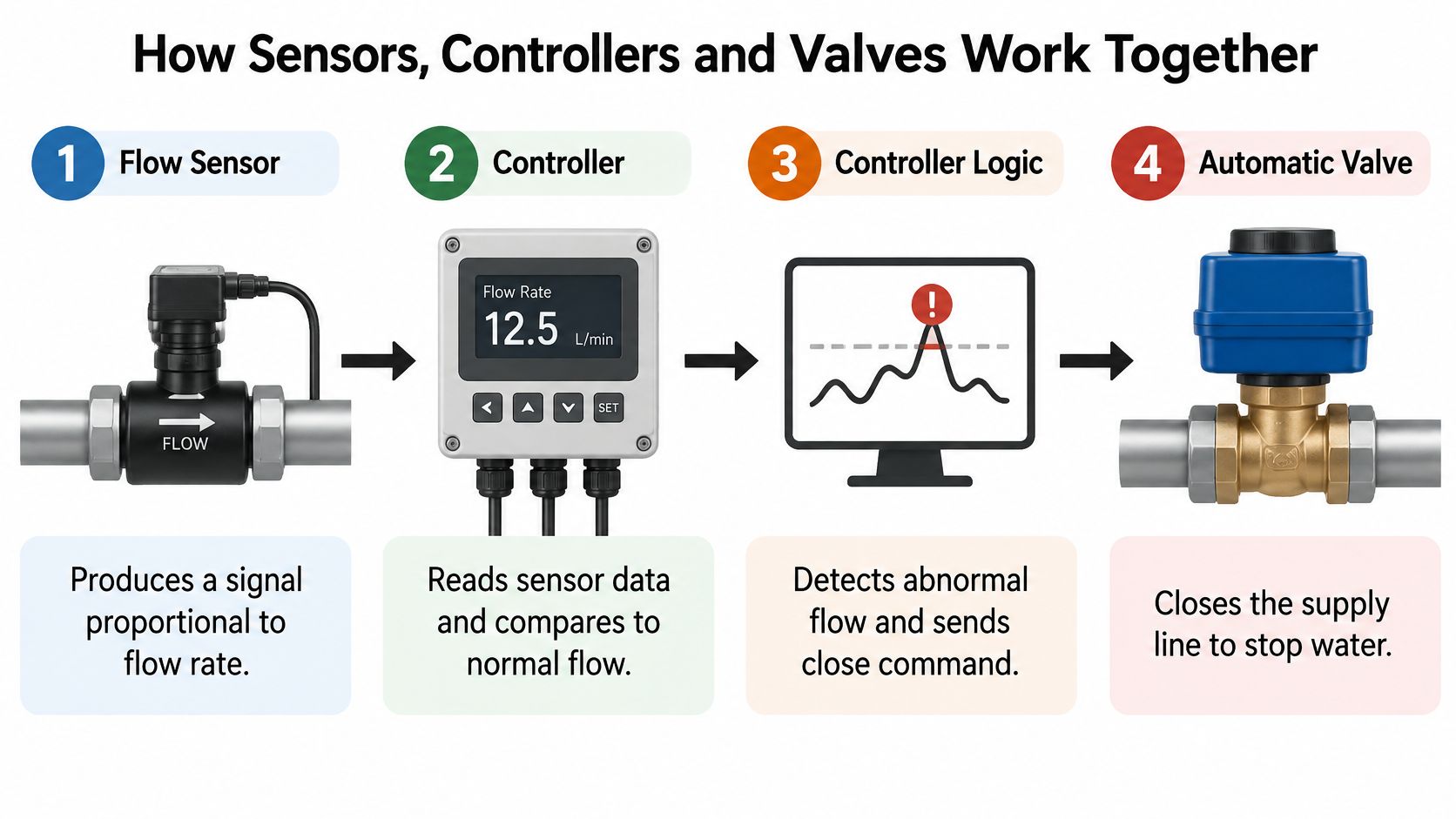
The system has three parts, and each one has a separate job. Confusing them is where most expectations go wrong, because a sensor that detects water and a valve that closes a pipe are not the same purchase.
- The flow sensor reads the pipe. It sits inline, upstream of the lines it protects, and produces a signal proportional to flow rate. Upstream placement matters, because anything that tees off before the sensor is invisible to it.
- The controller compares that signal with a profile. You establish what normal looks like for that building, which may mean a few hundred gallons overnight and much more during a morning peak.
- Persistence separates a normal draw from a leak. A brief draw should never close a supply. Steady flow at 3 a.m., when the building is asleep, should.
- The controller sends a command, not just an alarm. This is the step that turns detection into action, and it's the one alert-only devices don't have.
- The valve closes and the event is recorded. Closure interrupts the source, and the log gives you the duration and volume to work with afterwards.
California's Model Water Efficient Planting Ordinance uses the same architecture in its definitions. It describes a master shut-off valve as an automatic valve installed at an irrigation supply point that stops water entering the system when closed, and a flow sensor as an inline device producing a repeatable signal proportional to flow rate, which must connect to a compatible controller or flow monitor able to receive that data and operate master valves.
Design rule: sensor upstream, controller capable of operating the valve, detection delay chosen on purpose rather than left at the factory default.
What that produces is cause and effect rather than a notification. Abnormal continuous flow generates a control signal, the valve interrupts the supply, and the volume that escapes is limited by the delay you set. In a larger property, the same signals should land in the building management system so that a closure is visible to whoever is on call, not buried in a separate app.
Two checks belong in every design. Confirm what the actuator does when power fails, and confirm that a person can always open and close the valve by hand. After any event, the same crew checking the valve should also spot hidden moisture behind drywall near the affected pipe, because a closure limits the water and doesn't dry the assembly.
Choosing Valve Size, Flow and Response Time
Two numbers decide what a leak costs: how fast the water escapes and how long the system waits before closing. Water-loss analysts commonly model a reported customer-connection leak at about 7 gallons per minute, running for roughly 8 days before repair. Even a modest flow turns expensive once it is multiplied by time.
Leak flow
Per day
Over 8 days
Per year (continuous)
2 gallons per minute
2,880 gallons
23,040 gallons
1,051,200 gallons
7 gallons per minute
10,080 gallons
80,640 gallons
3,679,200 gallons
Toilet running continuously (26 gallons per day)
26 gallons
208 gallons
9,490 gallons
At 7 gallons per minute, an uncontrolled leak discharges roughly 10,080 gallons in 24 hours and 80,640 gallons over eight days. The same arithmetic explains the scale of the problem upstream: California's Department of Water Resources has estimated that distribution-system leaks remove more than 700,000 acre-feet of water each year, and urban water audits have put average losses near 10% of total supply.
Response time runs the same multiplication in the other direction. With a detection delay set to one hour, a 7-gallon-per-minute leak releases 420 gallons before the valve finishes closing. A ten-minute delay cuts that to about 70 gallons. The delay works like a running meter on the leak itself, which is why it decides more about real-world savings than any hardware spec on the datasheet.
Why pipe size is the wrong starting point
A valve that matches the pipe can still be the wrong valve. The diameter tells you the size of the opening; the numbers that matter describe behaviour under load. Verify a short list instead.
- Maximum flow capacity. Peak morning demand across a riser must pass freely. A valve sized to average demand throttles every fixture at the busiest hour.
- Pressure-drop characteristics. A restrictive valve costs pressure at every fixture downstream, and tenants notice.
- Actuator fail-safe behaviour. Decide in advance whether a power loss leaves the valve open or closed, and tell the people who respond.
- Sensor resolution. The running toilet in the table moves about a gallon an hour. A sensor tuned only for large flows will never close on it.
- Communications reliability. Remote closure is only as good as the link that carries the command.
- Programmed detection delay. The single setting that decides how much water escapes before closure.
What to test before you trust it
Commissioning is where claims become facts. Run a sustained low-flow event and see whether the valve treats it as a leak or ignores it. Open a high-flow rupture and measure time to closure. Cut the power, record what the actuator does, operate the manual override with the controller live, and walk through restoration: who reopens the valve, and what gets logged.
Each test answers one question. Did the valve close when it had to, and did it stay closed until a person reopened it?
Where It Fits in Multifamily, Condominium and Commercial Buildings
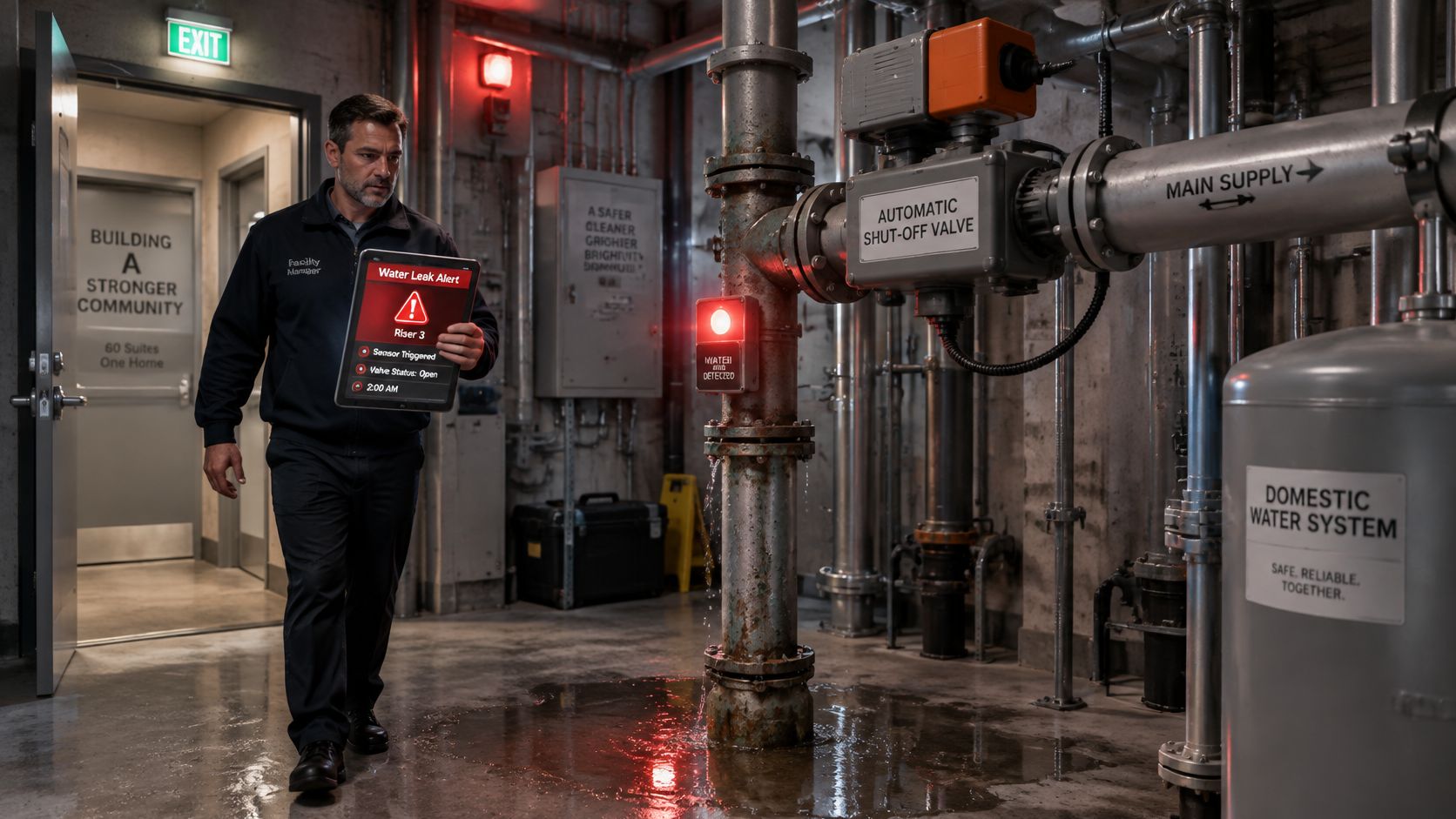
At 2 a.m. in a 60-suite building, a fitting on a riser in the ground-floor mechanical room starts to weep. Nobody is awake. Water is already tracking along the slab toward the elevator lobby, and the first person to notice will be a resident on the floor below, barefoot, at breakfast.
Now run the same night with a sensor on the mechanical-room floor and a valve on the building supply. The alert reaches the on-call number within minutes, the valve closes, and the water stops at the source before it reaches the corridor. The cleanup is a wet mechanical room rather than three suites and a lobby.
Placement decides what gets protected
Building-level closure protects every riser downstream, which is what you want for a main break and what you don't want for a false alarm at 9 a.m. on a Tuesday. A branch valve isolates one zone or one suite riser, so a closure affects a defined group of occupants rather than everyone.
Sensors belong where water collects. Mechanical rooms, laundry rooms, water-heater closets, under sink cabinets in suites and common-area restrooms carry most of the risk, which is why the sensor map should be drawn before any valve is specified.
Suite meters add a second, independent view. Unusually high consumption on one meter can flag a slow leak that never trips a floor sensor, while the shutoff log helps validate what the meter recorded during the event. Neither instrument covers the other's blind spot on its own.
For buildings where closures must be coordinated with staff, this short walkthrough of how a leak triggers a closure is worth watching before you write a procedure.
Mixed-use properties raise the stakes, because one domestic supply often feeds retail units, common washrooms and residential risers from the same main. Closing that main to protect a mechanical room can shut a café during trading hours. The design answer is usually zone valves with independent sensors, not a single whole-building trip.
The occupant side needs a written answer before installation, not after. Who holds authority to reopen the supply, how tenants are notified when water is off, what happens when a false alarm closes a line during a working day, and how long a suite can be without water before it becomes a habitability issue. Put those four answers in the operations manual and give the on-call contact a paper copy.
What the Valve Cannot Do and What Claims to Test
Start with the gap. A valve responds only to water at the points it can see, so anything downstream of an unmonitored branch runs unseen. Drain-side failures are outside its scope entirely, and slow seepage that never crosses a threshold can continue for weeks.
Three corrections are worth making before you sign anything.
- It doesn't replace inspection. Fittings, risers, appliance hoses and water-heater pans still need eyes on them. The valve limits the consequence of a failure, it doesn't prevent the failure.
- The headline percentage is a manufacturer claim. In 2024, Moen announced an agreement with Frontdoor to install its Flo Smart Water Monitor and Shutoff for California customers who obtain the device through certain home-insurance marketing programs. The announcement cited a potential reduction in water-damage claim frequency of as much as 96%, which is a manufacturer-reported performance claim, not an independent statewide result.
- There is no broad statewide code mandate. California adoption is insurer- and program-driven rather than a universal legal requirement, so treat any claim that the state building code requires smart shutoff valves cautiously unless an official code provision says so.
That second point matters commercially as well as technically. A number produced by a manufacturer tells you what the product can do under favourable conditions. It doesn't tell you what your building will achieve, because outcomes depend on where sensors sit, how the threshold is set, whether the valve closes reliably under load, how fast the response is, and whether the leak happens upstream or downstream of the monitored point. Some qualifying devices only flag abnormal use while others provide remote closure, and it's worth knowing which one sits in your budget.
If the priority is preventing water from reaching finished space at all, flood prevention measures that combine detection with building-level isolation outperform any single device.
Treat every vendor figure as a hypothesis you test against your own baseline, alert log and closure record.
Confirm Local Rules and Insurance Terms Before You Buy
The purchase order is the wrong place to discover a constraint. A valve that fails a rebate's approved-product list, a pipe run with no room for the tap point, or a program that excludes your building type can each stop a project after the money is committed. Work through the following checks before any equipment is specified, and get the answers in writing.
- Installation point. Confirm whether a qualifying device must sit inline on the cold-water main after the meter and the primary shutoff, and who signs off on the tap point.
- Who fits it. Professional installation may be a condition of the rebate, the warranty and the insurance credit.
- Network and power. Many devices depend on reliable Wi-Fi for remote closure and alerts. Ask what still works when the connection drops.
- Property eligibility. Some programs are limited to single-family customers rather than multifamily buildings, which rules out most strata and apartment owners.
- Budget. Rebate values differ by agency. SoCal Water$mart starts at $100 and depends on the participating agency and its approved-product list, and agency device listings run from roughly $393 to $613 before tax and shipping. For CalWEP's 2025 rebate programme through participating agencies, gather receipts, model information and proof of service address before applying.
- Insurance credit. Ask your insurer whether the device qualifies for underwriting credit rather than assuming a discount. LexisNexis estimates cited by Parks Associates put water-leak damage at twice the rate of fire or theft events and suggest prevention may reduce average claim payouts by 72%, though those are portfolio-level estimates rather than a promise about your building.
After installation, record the evidence that supports your renewal conversation: baseline consumption, alert frequency, closure events, false positives, restoration time and incidents avoided. A month of normal readings gives you the denominator every leak claim needs. Without it, you cannot show how much water an undetected leak would have lost before closure, or whether the valve's response time limited the volume that escaped. One building's records are more persuasive than any brochure.
For owners who want detection built into the metering scope, Axis Meter Solutions installs leak detection sensors in high-risk areas during metering installation. The sensors monitor the building 24/7 and alert the customer immediately when water is detected where it should not be, with placement near water heaters, under sinks, in laundry rooms, in mechanical rooms and in common areas. A water submeter alone does not detect every possible leak. Consumption data reveals unusual usage patterns, dedicated sensors detect water at selected locations, and a combined design gives broader protection than either one alone. Coverage questions of this kind are operational rather than legal advice, so local requirements still need confirmation before meters are purchased, installed or used for occupant billing.
Write the checklist this week, collect four weeks of baseline consumption, and ask one provider to state their detection coverage in writing, room by room.
Every Axis Meter Solutions installation includes leak and flood detection at no extra cost, covering mechanical rooms, laundry rooms, under-sink cabinets and common areas with sensors monitored 24/7 and an immediate alert the moment water appears where it should not. Axis owns and maintains the equipment, keeps the sensors and batteries serviced through the term, and pairs suite-level consumption data with dedicated leak detection so a slow leak surfaces as a pattern change before it becomes a repair bill. Visit Axis Meter Solutions to arrange a walkthrough of your risers and mechanical spaces and get the sensor map in writing.
Ready to Optimize Your Utility Management?
Tell us about the property, utility, number of units, and your billing or monitoring goals. We'll help you identify the right next step.
Book a Call